Reindeer
Rangifer tarandus
Quick answer
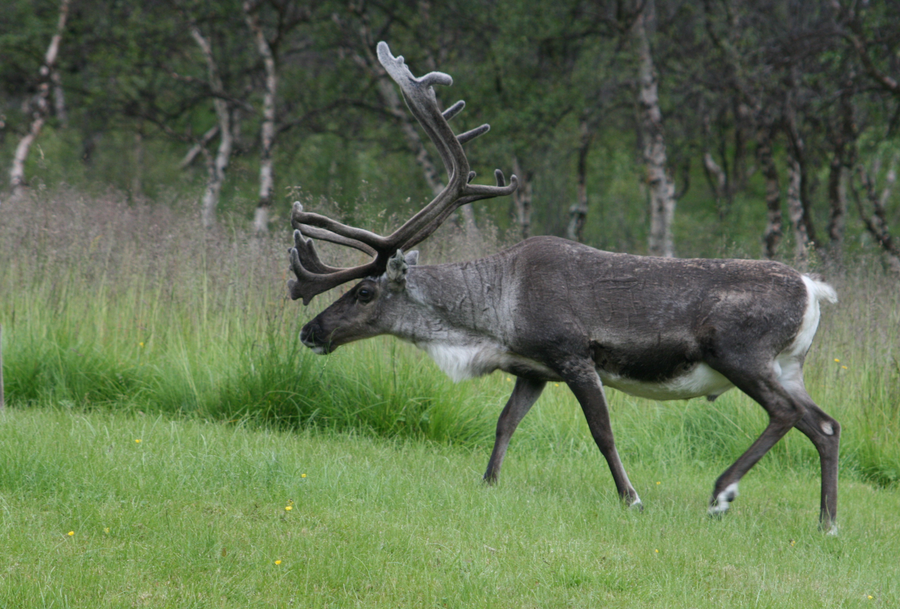
Reindeer — called caribou in North America — are Arctic deer where both sexes grow antlers, undertaking the longest land migrations of any terrestrial mammal. Herds cross tundra from Alaska to Scandinavia, support Indigenous herding cultures, and are listed Vulnerable from climate change and disturbance.
Also available in Español (Reindeer)
Reindeer facts at a glance
| Scientific name | Rangifer tarandus |
|---|---|
| Diet | Herbivore — lichens, grasses, leaves, and mushrooms |
| Habitat | Arctic tundra, boreal forest, and mountain plateaus |
| Lifespan | 12–15 years in the wild |
| Weight | 60–180 kg (130–400 lb); bulls larger |
| Top speed | Up to 80 km/h (50 mph) in flight |
| Conservation status | Vulnerable (IUCN) |
| Kingdom | Animalia |
|---|---|
| Phylum | Chordata |
| Class | Mammalia |
| Order | Artiodactyla |
| Family | Cervidae |
| Genus | Rangifer |
Where it lives
Arctic tundra and boreal forest from Scandinavia and Russia through Alaska and Canada to Greenland; wild caribou in North America, herded reindeer in Eurasia.
What is a group of reindeer called?
Group name (collective noun)
A group of Reindeer is called a herd.
Baby name
A baby Reindeer is called a calf.
Explore more animal collective nouns and baby animal names .
Epic migration
Some barren-ground caribou herds travel over 5,000 km annually between calving grounds and winter range — the longest terrestrial migration on Earth. Calving synchrony on Arctic tundra overwhelms predators, but warming disrupts timing and insect harassment increases.
Antlers on females
Reindeer are the only deer where females commonly grow antlers. Cows retain theirs through winter, while bulls shed after the rut. Antlers are used for digging through snow for lichens — critical winter food called reindeer moss.
Indigenous herding
Sámi, Nenets, and other Arctic peoples have herded domestic reindeer for centuries, following migrations and relying on meat, hides, and transport. Wild caribou remain vital subsistence resources for Alaska Native communities.
Climate vulnerability
Listed Vulnerable, reindeer and caribou face rain-on-snow events that ice over food, increased parasitic flies in warmer summers, and industrial disturbance of migration routes from mining and roads in the Arctic.
Dig deeper into the Reindeer
- Are Reindeer Endangered
Dig deeper into reindeer — are reindeer endangered.
- How Long do Reindeer Live?
Dig deeper into reindeer — how long do reindeer live.
- Reindeer Facts 5
Dig deeper into reindeer — reindeer facts 5.
- What do Reindeer Eat
Dig deeper into reindeer — what do reindeer eat.
- Where do Reindeer Live?
Dig deeper into reindeer — where do reindeer live.
Explore the Reindeer
Compare
Collections
Did you know? Reindeer facts
- Reindeer — called caribou in North America — are Arctic deer where both sexes grow antlers, undertaking the longest land migrations of any terrestrial mammal.
- Same species — Rangifer tarandus. 'Reindeer' usually means domesticated or Eurasian populations; 'caribou' refers to wild North American forms.
- Rich blood flow in nasal passages warms frigid air before it reaches the lungs — physiology that inspired festive folklore, though real noses are not bright red.
- Yes — females grow antlers, unlike most other deer, and keep them longer through winter.
- Lichens (reindeer moss), grasses, sedges, leaves, and mushrooms — diet shifts between summer greenery and winter lichens dug from snow.
- Conservation: Vulnerable (IUCN).
Diet & feeding
Reindeer feeds primarily as a herbivore — lichens, grasses, leaves, and mushrooms. Sámi, Nenets, and other Arctic peoples have herded domestic reindeer for centuries, following migrations and relying on meat, hides, and transport. Wild caribou remain vital subsistence resources for Alaska Native communities.
Adaptations
- Some barren-ground caribou herds travel over 5,000 km annually between calving grounds and winter range — the longest terrestrial migration on Earth. Calving synchrony on Arctic tundra overwhelms predators, but warming disrupts timing and insect harassment increases.
- Reindeer are the only deer where females commonly grow antlers. Cows retain theirs through winter, while bulls shed after the rut. Antlers are used for digging through snow for lichens — critical winter food called reindeer moss.
Behaviour & ecology
- Some barren-ground caribou herds travel over 5,000 km annually between calving grounds and winter range — the longest terrestrial migration on Earth. Calving synchrony on Arctic tundra overwhelms predators, but warming disrupts timing and insect harassment increases.
- Reindeer are the only deer where females commonly grow antlers. Cows retain theirs through winter, while bulls shed after the rut. Antlers are used for digging through snow for lichens — critical winter food called reindeer moss.
- Sámi, Nenets, and other Arctic peoples have herded domestic reindeer for centuries, following migrations and relying on meat, hides, and transport. Wild caribou remain vital subsistence resources for Alaska Native communities.
Communication
- Reindeer uses scent, posture, and vocal signals to mark territory and coordinate social behaviour.
- Communication intensity often peaks during breeding seasons and territorial disputes.
Habitat & range
Arctic tundra, boreal forest, and mountain plateaus
Ecological role
Reindeer shapes vegetation through grazing or browsing and serves as prey for larger predators where ranges overlap.
Frequently asked questions about the Reindeer
Reindeer vs caribou?
Same species — Rangifer tarandus. 'Reindeer' usually means domesticated or Eurasian populations; 'caribou' refers to wild North American forms.
Why do reindeer noses turn red?
Rich blood flow in nasal passages warms frigid air before it reaches the lungs — physiology that inspired festive folklore, though real noses are not bright red.
Do female reindeer have antlers?
Yes — females grow antlers, unlike most other deer, and keep them longer through winter.
What do reindeer eat?
Lichens (reindeer moss), grasses, sedges, leaves, and mushrooms — diet shifts between summer greenery and winter lichens dug from snow.
Are reindeer endangered?
Listed Vulnerable globally. Some herds are declining sharply from climate change and habitat disturbance, though total numbers remain in the millions.
What is a group of reindeer called?
A group of Reindeer is called a herd.
What is a baby reindeer called?
A baby Reindeer is called a calf.
Sources & references
This guide is compiled and reviewed against established zoological and conservation references. Key sources for the Reindeer:
-
IUCN Red List of Threatened Species
Conservation status (Vulnerable) reflects the IUCN Red List category for Rangifer tarandus.
- IUCN Red List — Rangifer tarandus.
Conservation status (Vulnerable) and population trends.
- Animal Diversity Web — Rangifer tarandus. University of Michigan Museum of Zoology.
Life history, morphology, and range.
-
Global Animal Guide editorial standards
How we research, source, review, and update every guide for accuracy.