Image sourcing: see credits & licences
Quick answer
The leopard gecko (Eublepharis macularius) is a spotted, ground-dwelling lizard from the arid grasslands and rocky deserts of South Asia and the Middle East, and one of the most popular beginner pet reptiles. It grows to about 18 to 25 cm (7 to 10 in) including the tail, is active at dusk, and eats insects. Hardy and long-lived, it can reach 15 to 20 years in captivity and is listed as Least Concern.
Top questions about the Leopard Gecko
Leopard Gecko facts at a glance
- Weight 60 g
- Length 22 cm
- Top speed 12 km/h
- Lifespan 18 years
| Scientific name | Eublepharis macularius |
|---|---|
| Diet | Insectivore |
| Habitat | Arid grassland and rocky desert |
| Lifespan | 15–20 years in captivity |
| Length | 18–25 cm (7–10 in) including tail |
| Top speed | Up to 12 km/h (7 mph) in short dashes |
| Conservation status | Least Concern (IUCN) |
| Kingdom | Animalia |
|---|---|
| Phylum | Chordata |
| Class | Reptilia |
| Order | Squamata |
| Family | Eublepharidae |
| Genus | Eublepharis |
Where it lives
The leopard gecko (Eublepharis macularius) is native to The dry grasslands and rocky deserts of Afghanistan, Pakistan, northwestern India, and Iran. — recorded across Asia in this guide’s range summary.
For occurrence records, see GBIF species search and sources below.
How big is a leopard gecko?
An adult leopard gecko measures 22 cm long — about 13% of the height of an average adult person (1.73 m) — and weighs around 60 g, a small fraction of an average adult’s body weight (70 kg).
Length vs an average adult’s height (to scale)
What is a group of leopard geckos called?
Group name (collective noun)
A group of Leopard Geckos is called a lounge.
Baby name
A baby Leopard Gecko is called a hatchling.
Explore more animal collective nouns and baby animal names .
Appearance and features
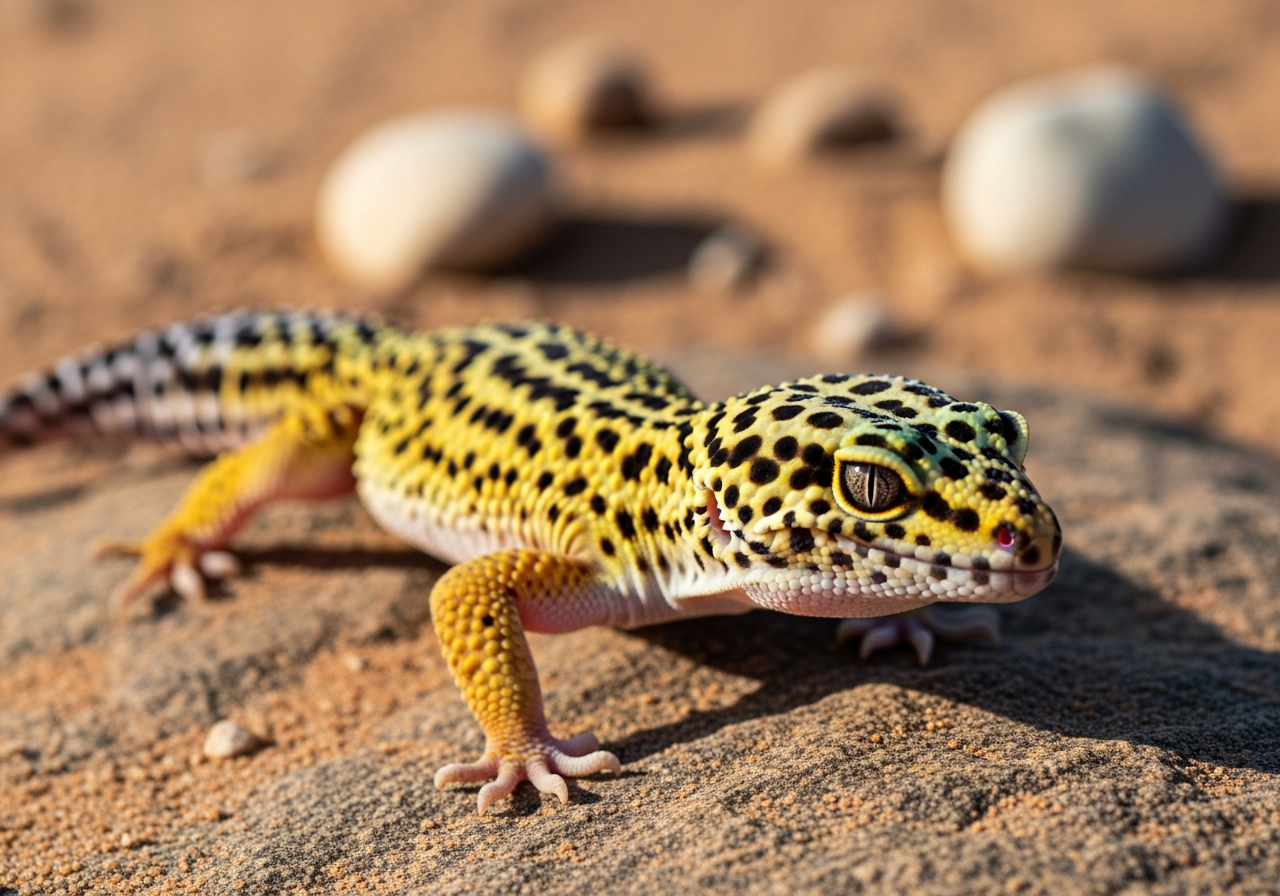
The leopard gecko takes its name from the dark spots that speckle its yellow, cream, and white body, though decades of captive breeding have produced a huge range of colours and patterns known as morphs. Adults reach about 18 to 25 cm (7 to 10 in) in length including the tail and weigh around 60 grams. Unlike many geckos it has movable eyelids and lacks the sticky toe pads that let others climb glass, so it is a ground-dweller. Its plump tail stores fat as an energy reserve for lean times.
Natural habitat and behaviour
In the wild the leopard gecko lives across the arid grasslands and rocky deserts of Pakistan, Afghanistan, north-west India, and Iran. It is crepuscular, most active at dusk and dawn, and shelters by day in burrows and under rocks to escape the fierce heat. During the coolest part of the year it may enter a period of reduced activity called brumation. Short dashes of up to about 12 km/h (7 mph) let it snap up prey and dart back to cover.
Diet
Leopard geckos are insectivores, hunting live prey such as crickets, mealworms, dubia roaches, and the occasional waxworm as a treat. In captivity their food is usually dusted with calcium and vitamin supplements to keep their bones healthy, since a varied insect diet alone can fall short. They do not eat plants or fruit at all. A healthy adult is fed every few days, while growing juveniles need feeding more often.
Keeping one as a pet
The leopard gecko is one of the most popular pet reptiles and a common first lizard because it is small, docile, and undemanding. A single adult needs a floor-space enclosure of at least around 60 by 30 cm, with a warm basking zone and a cooler end so it can regulate its temperature, plus a humid hide to help it shed its skin. Keepers use an under-tank heat source or overhead heating to create the gradient, along with clean water and secure hides. Handled gently and regularly, most become tame and tolerant of being picked up.
The tail and defence
Like many lizards, the leopard gecko can shed its tail when grabbed by a predator, a process called autotomy, and the detached tail wriggles to distract the attacker while the gecko escapes. A new tail grows back over time, but it is usually shorter, smoother, and blunter than the original. Because the tail is a vital fat store, losing it is costly, so a dropped tail is often a sign of stress or rough handling. Gentle, low-stress care helps keep the original tail intact.
Lifespan and health
Leopard geckos are notably long-lived, commonly reaching 15 to 20 years in captivity with good care, and males in particular can live even longer. Their long lives make them a real commitment for any keeper. Common health problems include metabolic bone disease from too little calcium and vitamin D, and impaction from swallowing loose substrate, both largely preventable with correct feeding and setup. As a widespread species, the leopard gecko is assessed as Least Concern in the wild.
Dig deeper into the Leopard Gecko
- How Long Do Leopard Geckos Live?
Leopard Gecko lifespan is typically 15–20 years in captivity. What shortens or extends life, life stages, and status (Least Concern).
- Leopard Gecko: Key Facts
Leopard Geckos (Eublepharis macularius) are reptiles found across Asia. The spotted desert gecko and beginner-friendly pet.
- What Do Leopard Geckos Eat?
What leopard geckos eat: Insectivore, foraging style, and seasonal shifts in Arid grassland and rocky desert.
- Where Do Leopard Geckos Live?
Where leopard geckos live: Arid grassland and rocky desert, native range cues, and human overlap. Status Least Concern.
Explore the Leopard Gecko
Related Reptiles
Range & geography
Did you know? Leopard Gecko facts
- The leopard gecko is a small, ground-dwelling lizard from the dry grasslands and deserts of South Asia, named for the dark spots that cover its yellowish skin.
- Leopard geckos are insectivores. They eat live insects such as crickets, mealworms, and roaches, which in captivity are usually dusted with calcium and vitamin supplements.
- With good care, leopard geckos commonly live 15 to 20 years in captivity, and some individuals live even longer, making them a long-term pet commitment.
- Yes. They are popular starter reptiles because they stay small, are generally docile, tolerate gentle handling, and have relatively simple heating and habitat needs.
- No. Unlike many geckos, leopard geckos lack sticky toe pads, so they cannot climb smooth vertical surfaces. They have clawed feet suited to walking and digging instead.
- Conservation: Least Concern (IUCN).
Diet & feeding
Leopard Gecko feeds primarily as a insectivore. Leopard geckos are nocturnal and crepuscular, sheltering under rocks during the heat of the day and emerging at dusk to hunt. Their plump tails store fat and water, helping them survive lean periods, and they can drop the tail to escape a predator before slowly regrowing
Adaptations
- Leopard geckos are nocturnal and crepuscular, sheltering under rocks during the heat of the day and emerging at dusk to hunt. Their plump tails store fat and water, helping them survive lean periods, and they can drop the tail to escape a predator before slowly regrowing it. Unlike wall-climbing geckos, they have clawed feet and eyelids rather than sticky toe pads.
- These geckos are insectivores that hunt live prey such as crickets, mealworms, and roaches. They detect movement and seize insects with a quick lunge, often pausing to wiggle the tail before striking. In captivity their feeder insects are usually dusted with calcium and vitamins to keep their bones strong.
Behaviour & ecology
- Leopard geckos are nocturnal and crepuscular, sheltering under rocks during the heat of the day and emerging at dusk to hunt. Their plump tails store fat and water, helping them survive lean periods, and they can drop the tail to escape a predator before slowly regrowing it. Unlike wall-climbing geckos, they have clawed feet and eyelids rather than sticky toe pads.
- These geckos are insectivores that hunt live prey such as crickets, mealworms, and roaches. They detect movement and seize insects with a quick lunge, often pausing to wiggle the tail before striking. In captivity their feeder insects are usually dusted with calcium and vitamins to keep their bones strong.
- Leopard geckos are native to the dry uplands of Afghanistan, Pakistan, northwestern India, and Iran. They live in rocky, sparsely vegetated grasslands and deserts, where daytime heat gives way to cooler nights. They shelter in burrows and crevices to avoid temperature extremes.
Communication
- Scent marking, body posture, and head-bobbing or tail signals communicate threat and dominance.
- Vocalisations are limited in many reptiles but hissing or bellowing occurs in some groups.
Habitat & range
Arid grassland and rocky desert
Ecological role
Leopard Gecko plays a recognised ecological role in arid grassland and rocky desert.
Conservation status of the Leopard Gecko
The leopard gecko (Eublepharis macularius) is listed as Least Concern on the IUCN Red List. Least Concern (LC) is the IUCN's lowest-risk category, assigned to widespread, abundant species that have been evaluated and found not to be threatened. It does not mean a species faces no pressures — only that it is not currently at risk of extinction.
The leopard gecko (Eublepharis macularius) is assessed on the IUCN Red List. Look up on the IUCN Red List .
Frequently asked questions about the Leopard Gecko
How long do leopard geckos live?
Leopard geckos are long-lived reptiles, commonly reaching 15 to 20 years in captivity with good care. Males in particular can live even longer, so keeping one is a long-term commitment.
What do leopard geckos eat?
Leopard geckos are insectivores that eat live prey such as crickets, mealworms, and dubia roaches. In captivity their food is usually dusted with calcium and vitamin supplements, and they do not eat any plants or fruit.
Are leopard geckos good pets for beginners?
Yes. Leopard geckos are among the most popular beginner reptiles because they are small, docile, hardy, and undemanding. They need a warm-to-cool temperature gradient, a humid hide, live insect food, and gentle regular handling to stay tame and healthy.
How big do leopard geckos get?
Adult leopard geckos reach about 18 to 25 cm (7 to 10 in) in length including the tail, and weigh around 60 grams. Males are generally a little larger and bulkier than females.
Can a leopard gecko lose its tail?
Yes. Like many lizards, a leopard gecko can drop its tail when grabbed or badly stressed, and the wriggling tail distracts a predator while it escapes. A new tail regrows but is usually shorter and blunter, and since the tail stores fat, losing it is costly.
Do leopard geckos climb like other geckos?
No. Unlike many geckos, leopard geckos lack sticky toe pads, so they cannot climb smooth glass or walls and live on the ground instead. They also have movable eyelids, which most other geckos do not.
What is a group of leopard geckos called?
A group of Leopard Geckos is called a lounge.
What is a baby leopard gecko called?
A baby Leopard Gecko is called a hatchling.
Sources & references
This guide is compiled and reviewed against established zoological and conservation references. Key sources for the Leopard Gecko:
-
IUCN Red List of Threatened Species
Conservation status (Least Concern) reflects the IUCN Red List category for Eublepharis macularius.
-
iNaturalist — observations & photos
Search citizen-science observations and community IDs for Eublepharis macularius. Useful for range checks and recent sightings — not a substitute for formal Red List status.
-
GBIF — occurrence data
Global Biodiversity Information Facility species search for Eublepharis macularius. Explore published occurrence records used in range research.
- IUCN Red List — Eublepharis macularius.
Conservation status (Least Concern) and population trends.
- Animal Diversity Web — Eublepharis macularius. University of Michigan Museum of Zoology.
Life history, morphology, and range.
- Wikipedia — Leopard Gecko.
General taxonomy and overview (cross-check primary sources).
-
Global Animal Guide editorial standards
How we research, source, review, and update every guide for accuracy.