Quick answer
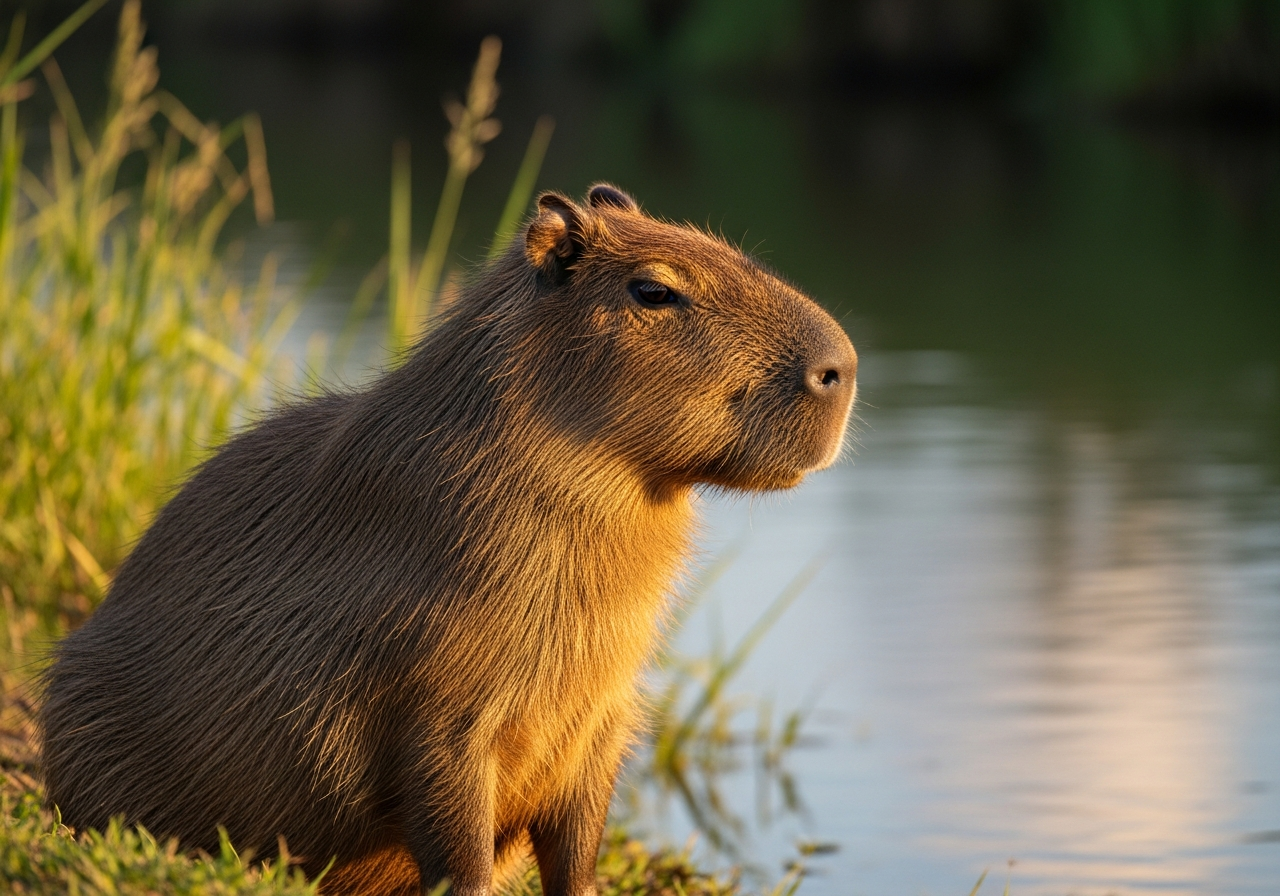
The capybara is the largest living rodent, a barrel-shaped, semi-aquatic herbivore from the wetlands and grasslands of South America. Adults can weigh up to 65 kg (143 lb) and stand about 0.6 m (2 ft) tall, with partially webbed feet for swimming. Highly social, capybaras live in groups near water, grazing on grasses and aquatic plants, and are known for their remarkably calm, friendly demeanor. In the wild they typically live 8 to 10 years.
Top questions about the Capybara
Capybara facts at a glance
- Weight 55 kg
- Length 1.2 m
- Top speed 35 km/h
- Lifespan 9 years
| Scientific name | Hydrochoerus hydrochaeris |
|---|---|
| Diet | Herbivore (grazer) |
| Habitat | Wetlands, riverbanks, and grasslands |
| Lifespan | 8–10 years in the wild |
| Weight | 35–65 kg (77–143 lb) |
| Top speed | Up to 35 km/h (22 mph) |
| Conservation status | Least Concern (IUCN) |
| Kingdom | Animalia |
|---|---|
| Phylum | Chordata |
| Class | Mammalia |
| Order | Rodentia |
| Family | Caviidae |
| Genus | Hydrochoerus |
Where it lives
The capybara (Hydrochoerus hydrochaeris) is native to Wetlands, riverbanks, and grasslands across much of South America east of the Andes. — recorded across South America in this guide’s range summary.
For occurrence records, see GBIF species search and sources below.
How big is a capybara?
An adult capybara measures 1.2 m long — about 69% of the height of an average adult person (1.73 m) — and weighs around 55 kg, about 79% of an average adult’s body weight (70 kg).
Length vs an average adult’s height (to scale)
What is a group of capybaras called?
Group name (collective noun)
A group of Capybaras is called a herd.
Baby name
A baby Capybara is called a pup.
Explore more animal collective nouns and baby animal names .
Diet and digestion
Capybaras are grazing herbivores that feed mainly on grasses and aquatic plants, supplementing their diet with fruit and bark in the dry season. Like rabbits, they practice coprophagy, eating some of their own droppings to extract more nutrients from tough, fibrous plants. Their teeth grow continuously to cope with the wear of grinding vegetation. An adult can eat several kilograms of grass each day.
Habitat and range
Capybaras live across much of South America east of the Andes, in countries including Brazil, Venezuela, Colombia, and Argentina. They are always found near water, inhabiting marshes, riverbanks, flooded grasslands, and the edges of lakes and ponds. Water is central to their lives, providing food, escape from predators, and relief from the heat. They are well adapted to seasonally flooded landscapes such as the Pantanal and Llanos.
Predators and conservation
As large, abundant herbivores, capybaras are important prey for jaguars, pumas, caimans, and anacondas, and the young are vulnerable to many predators. They are listed as Least Concern, with healthy populations across their range, and are even farmed in some areas for meat and leather. Their habit of staying near water makes wetland conservation important for them. In some regions they have adapted well to human-altered landscapes and even urban parks.
Dig deeper into the Capybara
- Capybara: Key Facts
The capybara is the largest living rodent, a barrel-shaped, semi-aquatic herbivore from the wetlands and grasslands of South America.
- How Fast Is A Capybara?
Capybara top speed is up to about 35 km/h (22 mph). Sprint vs endurance and what limits pace.
- How Long Do Capybaras Live?
Capybara lifespan is typically 8–10 years in the wild. What shortens or extends life, life stages, and status (Least Concern).
- What Do Capybaras Eat?
What capybaras eat: Herbivore (grazer), foraging style, and seasonal shifts in Wetlands, riverbanks, and grasslands.
- Where Do Capybaras Live?
Where capybaras live: Wetlands, riverbanks, and grasslands, native range cues, and human overlap. Status Least Concern.
Explore the Capybara
Compare
Range & geography
Did you know? Capybara facts
- The capybara is the largest living rodent, a barrel-shaped, semi-aquatic herbivore from the wetlands and grasslands of South America.
- The capybara is the largest living rodent. Adults can weigh up to 65 kg (143 lb), far larger than any other rodent, and stand about 0.6 m (2 ft) at the shoulder.
- Capybaras are grazing herbivores that eat mainly grasses and aquatic plants, plus some fruit and bark. They also eat their own droppings to absorb more nutrients from fibrous plants.
- Capybaras have a calm, tolerant temperament and are social grazers that pose no threat to other species, so many animals, including birds and monkeys, are comfortable around them.
- Yes. Capybaras are excellent swimmers with partially webbed feet. They use water to feed, cool off, and escape predators, and can stay submerged for several minutes.
- Conservation: Least Concern (IUCN).
Diet & feeding
Capybara feeds primarily as a herbivore (grazer). Capybaras are highly social and usually live in groups of around 10 to 20, sometimes far larger near abundant water in the dry season. Groups are led by a dominant male and communicate through barks, whistles, purrs, and scent marking. They are semi-aquatic and take to
Adaptations
- Capybaras are highly social and usually live in groups of around 10 to 20, sometimes far larger near abundant water in the dry season. Groups are led by a dominant male and communicate through barks, whistles, purrs, and scent marking. They are semi-aquatic and take to water to feed, cool off, and escape predators, and they can stay submerged for several minutes. Their calm temperament has made them famous for tolerating the company of many other animals.
- Capybaras are grazing herbivores that feed mainly on grasses and aquatic plants, supplementing their diet with fruit and bark in the dry season. Like rabbits, they practice coprophagy, eating some of their own droppings to extract more nutrients from tough, fibrous plants. Their teeth grow continuously to cope with the wear of grinding vegetation. An adult can eat several kilograms of grass each day.
Behaviour & ecology
- Capybaras are highly social and usually live in groups of around 10 to 20, sometimes far larger near abundant water in the dry season. Groups are led by a dominant male and communicate through barks, whistles, purrs, and scent marking. They are semi-aquatic and take to water to feed, cool off, and escape predators, and they can stay submerged for several minutes. Their calm temperament has made them famous for tolerating the company of many other animals.
- Capybaras are grazing herbivores that feed mainly on grasses and aquatic plants, supplementing their diet with fruit and bark in the dry season. Like rabbits, they practice coprophagy, eating some of their own droppings to extract more nutrients from tough, fibrous plants. Their teeth grow continuously to cope with the wear of grinding vegetation. An adult can eat several kilograms of grass each day.
- Capybaras live across much of South America east of the Andes, in countries including Brazil, Venezuela, Colombia, and Argentina. They are always found near water, inhabiting marshes, riverbanks, flooded grasslands, and the edges of lakes and ponds. Water is central to their lives, providing food, escape from predators, and relief from the heat. They are well adapted to seasonally flooded landscapes such as the Pantanal and Llanos.
Communication
- Capybara uses scent, posture, and vocal signals to mark territory and coordinate social behaviour.
- Communication intensity often peaks during breeding seasons and territorial disputes.
Habitat & range
Wetlands, riverbanks, and grasslands
Ecological role
Capybara shapes vegetation through grazing or browsing and serves as prey for larger predators where ranges overlap.
Conservation status of the Capybara
The capybara (Hydrochoerus hydrochaeris) is listed as Least Concern on the IUCN Red List. Least Concern (LC) is the IUCN's lowest-risk category, assigned to widespread, abundant species that have been evaluated and found not to be threatened. It does not mean a species faces no pressures — only that it is not currently at risk of extinction.
The capybara (Hydrochoerus hydrochaeris) is assessed on the IUCN Red List. Look up on the IUCN Red List .
Frequently asked questions about the Capybara
What is the largest rodent in the world?
The capybara is the largest living rodent. Adults can weigh up to 65 kg (143 lb), far larger than any other rodent, and stand about 0.6 m (2 ft) at the shoulder.
What do capybaras eat?
Capybaras are grazing herbivores that eat mainly grasses and aquatic plants, plus some fruit and bark. They also eat their own droppings to absorb more nutrients from fibrous plants.
Why are capybaras so friendly with other animals?
Capybaras have a calm, tolerant temperament and are social grazers that pose no threat to other species, so many animals, including birds and monkeys, are comfortable around them.
Can capybaras swim?
Yes. Capybaras are excellent swimmers with partially webbed feet. They use water to feed, cool off, and escape predators, and can stay submerged for several minutes.
Where do capybaras live?
Capybaras live in wetlands, grasslands, and riverbanks across much of South America east of the Andes, always staying close to water.
How long do capybaras live?
Wild capybaras typically live 8 to 10 years, though predation often shortens their lives. In captivity, protected from predators, they can live around 12 years.
What is a group of capybaras called?
A group of Capybaras is called a herd.
What is a baby capybara called?
A baby Capybara is called a pup.
Sources & references
This guide is compiled and reviewed against established zoological and conservation references. Key sources for the Capybara:
-
IUCN Red List of Threatened Species
Conservation status (Least Concern) reflects the IUCN Red List category for Hydrochoerus hydrochaeris.
-
iNaturalist — observations & photos
Search citizen-science observations and community IDs for Hydrochoerus hydrochaeris. Useful for range checks and recent sightings — not a substitute for formal Red List status.
-
GBIF — occurrence data
Global Biodiversity Information Facility species search for Hydrochoerus hydrochaeris. Explore published occurrence records used in range research.
- IUCN Red List — Hydrochoerus hydrochaeris.
Conservation status (Least Concern) and population trends.
- Animal Diversity Web — Hydrochoerus hydrochaeris. University of Michigan Museum of Zoology.
Life history, morphology, and range.
- Wikipedia — Capybara.
General taxonomy and overview (cross-check primary sources).
-
Global Animal Guide editorial standards
How we research, source, review, and update every guide for accuracy.