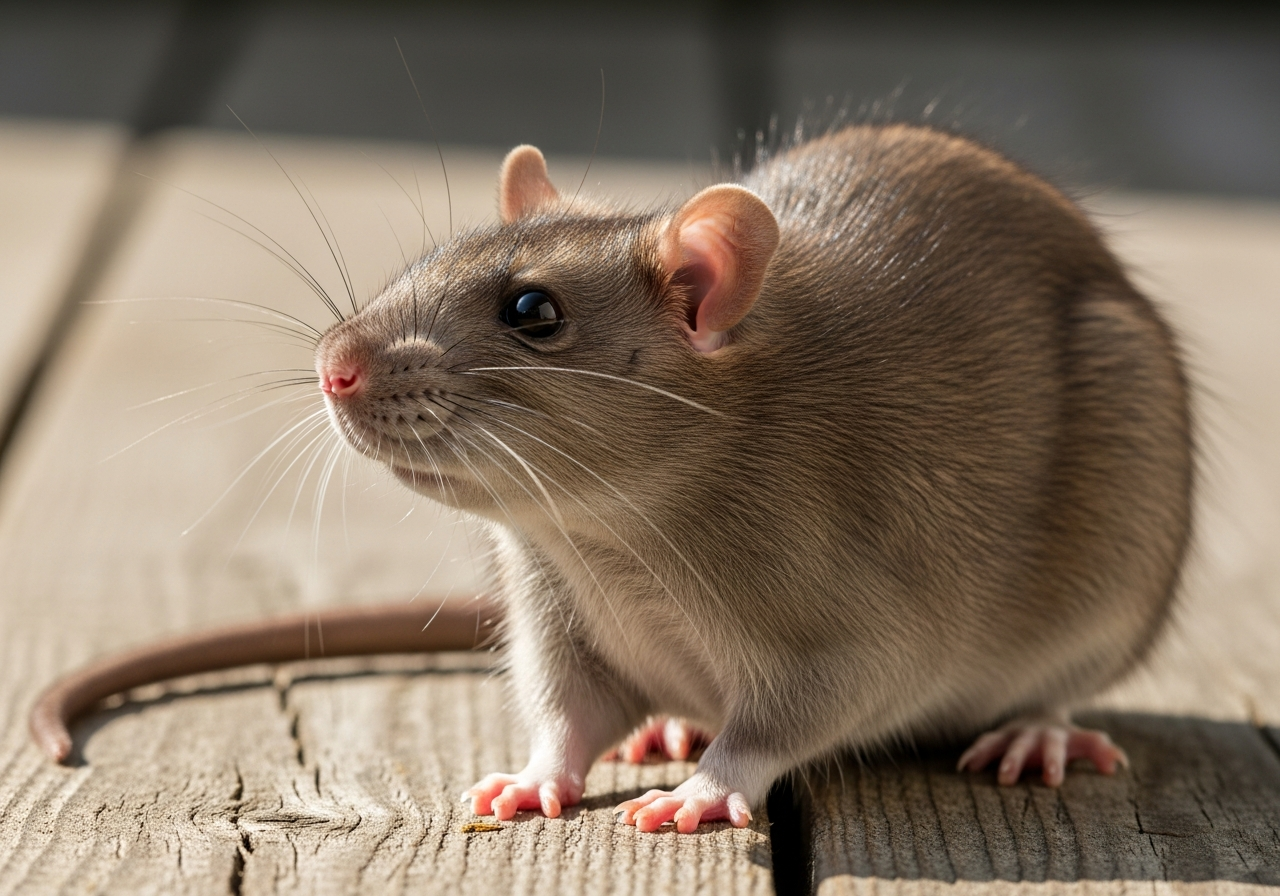
Rat
Rattus norvegicus
Quick answer
The brown rat, also called the Norway rat, is a large, highly intelligent rodent that lives alongside people across most of the world. It has coarse brown-grey fur, a blunt snout, and a long scaly tail, and it thrives in sewers, cities, farms, and waterways. Brown rats weigh up to about 500 g, are strong swimmers and climbers, and usually live one to two years in the wild.
Rat facts at a glance
| Scientific name | Rattus norvegicus |
|---|---|
| Diet | Omnivore (highly opportunistic) |
| Habitat | Cities, sewers, farms, riverbanks worldwide |
| Lifespan | 1–2 years in the wild |
| Weight | 200–500 g (7–18 oz) |
| Top speed | 13 km/h (8 mph) |
| Conservation status | Least Concern (IUCN) |
| Kingdom | Animalia |
|---|---|
| Phylum | Chordata |
| Class | Mammalia |
| Order | Rodentia |
| Family | Muridae |
| Genus | Rattus |
Where it lives
Probably originated in northern China and Mongolia; the brown rat is now found worldwide near people on every continent except Antarctica.
What is a group of rats called?
Group name (collective noun)
A group of Rats is called a mischief. It is also known as a colony or a swarm.
Baby name
A baby Rat is called a pup. It may also be called a kitten or a pinkie.
Explore more animal collective nouns and baby animal names .
Intelligence and behaviour
Brown rats are among the most intelligent rodents, capable of learning routes, solving simple puzzles, and even showing signs of empathy in laboratory studies. They are highly social, living in colonies with a clear hierarchy, and they are famously neophobic — wary of new objects and foods in their environment, which makes them difficult to trap or poison. They are also excellent swimmers and can climb, gnaw through tough materials, and squeeze through surprisingly small gaps.
Diet and adaptability
As opportunistic omnivores, brown rats eat almost anything, from grain, fruit, and seeds to meat, refuse, and insects. This flexible diet, combined with rapid breeding and a tolerance for human environments, has made the brown rat one of the most successful mammals on the planet. A colony can grow quickly wherever food and shelter are available.
Range and history
The brown rat probably originated in northern China and Mongolia and spread worldwide by stowing away on ships and in cargo, reaching Europe in the 1700s. Today it is found on every continent except Antarctica, usually close to people. Its smaller relative, the black rat, was historically linked to the spread of plague, while the brown rat is the species most often seen in modern cities.
Rats and people
Brown rats have a complex relationship with humans. In the wild they are treated as pests because they damage stored food, gnaw structures, and can carry disease. Yet the same species, bred as the fancy rat, is a popular and affectionate pet, and laboratory strains have been central to advances in medicine, psychology, and genetics.
Dig deeper into the Rat
- How Long do Rat Live?
Dig deeper into rat — how long do rat live.
- Rat Facts 4
Dig deeper into rat — rat facts 4.
- Rat Facts 5
Dig deeper into rat — rat facts 5.
- What do Rat Eat
Dig deeper into rat — what do rat eat.
- Where do Rat Live?
Dig deeper into rat — where do rat live.
Explore the Rat
Range & geography
Did you know? Rat facts
- The brown rat, also called the Norway rat, is a large, highly intelligent rodent that lives alongside people across most of the world.
- A group of rats is called a mischief. A baby rat is called a pup or kitten, and a newborn without fur is sometimes called a pinkie.
- Yes. Brown rats are very intelligent — they can learn routes and tasks, solve simple problems, and remember solutions. This intelligence and their wariness of new things make wild rats hard to trap.
- Rats can carry organisms that cause illnesses such as leptospirosis and, historically, plague (mainly linked to the black rat). Good hygiene and pest control reduce the risk; pet rats from reputable sources are generally safe.
- Wild brown rats usually live only one to two years because of predation, disease, and harsh conditions. Well-cared-for pet rats often live around two to three years.
- Conservation: Least Concern (IUCN).
Diet & feeding
Rat feeds primarily as a omnivore (highly opportunistic). As opportunistic omnivores, brown rats eat almost anything, from grain, fruit, and seeds to meat, refuse, and insects. This flexible diet, combined with rapid breeding and a tolerance for human environments, has made the brown rat one of the most successful mamm
Adaptations
- Brown rats are among the most intelligent rodents, capable of learning routes, solving simple puzzles, and even showing signs of empathy in laboratory studies. They are highly social, living in colonies with a clear hierarchy, and they are famously neophobic — wary of new objects and foods in their environment, which makes them difficult to trap or poison. They are also excellent swimmers and can climb, gnaw through tough materials, and squeeze through surprisingly small gaps.
- As opportunistic omnivores, brown rats eat almost anything, from grain, fruit, and seeds to meat, refuse, and insects. This flexible diet, combined with rapid breeding and a tolerance for human environments, has made the brown rat one of the most successful mammals on the planet. A colony can grow quickly wherever food and shelter are available.
Behaviour & ecology
- Brown rats are among the most intelligent rodents, capable of learning routes, solving simple puzzles, and even showing signs of empathy in laboratory studies. They are highly social, living in colonies with a clear hierarchy, and they are famously neophobic — wary of new objects and foods in their environment, which makes them difficult to trap or poison. They are also excellent swimmers and can climb, gnaw through tough materials, and squeeze through surprisingly small gaps.
- As opportunistic omnivores, brown rats eat almost anything, from grain, fruit, and seeds to meat, refuse, and insects. This flexible diet, combined with rapid breeding and a tolerance for human environments, has made the brown rat one of the most successful mammals on the planet. A colony can grow quickly wherever food and shelter are available.
- The brown rat probably originated in northern China and Mongolia and spread worldwide by stowing away on ships and in cargo, reaching Europe in the 1700s. Today it is found on every continent except Antarctica, usually close to people. Its smaller relative, the black rat, was historically linked to the spread of plague, while the brown rat is the species most often seen in modern cities.
Communication
- Rat uses scent, posture, and vocal signals to mark territory and coordinate social behaviour.
- Communication intensity often peaks during breeding seasons and territorial disputes.
Habitat & range
Cities, sewers, farms, riverbanks worldwide
Ecological role
Rat plays a recognised ecological role in cities, sewers, farms, riverbanks worldwide.
Frequently asked questions about the Rat
What is a group of rats called?
A group of rats is called a mischief. A baby rat is called a pup or kitten, and a newborn without fur is sometimes called a pinkie.
Are rats intelligent?
Yes. Brown rats are very intelligent — they can learn routes and tasks, solve simple problems, and remember solutions. This intelligence and their wariness of new things make wild rats hard to trap.
Do rats spread disease?
Rats can carry organisms that cause illnesses such as leptospirosis and, historically, plague (mainly linked to the black rat). Good hygiene and pest control reduce the risk; pet rats from reputable sources are generally safe.
How long do rats live?
Wild brown rats usually live only one to two years because of predation, disease, and harsh conditions. Well-cared-for pet rats often live around two to three years.
Can rats swim?
Yes. Brown rats are strong swimmers that can paddle for long distances and even tread water for days. They often live along waterways and in sewers, and can enter buildings through drains.
What is a baby rat called?
A baby Rat is called a pup. It may also be called a kitten or a pinkie.
Sources & references
This guide is compiled and reviewed against established zoological and conservation references. Key sources for the Rat:
-
IUCN Red List of Threatened Species
Conservation status (Least Concern) reflects the IUCN Red List category for Rattus norvegicus.
- IUCN Red List — Rattus norvegicus.
Conservation status (Least Concern) and population trends.
- Animal Diversity Web — Rattus norvegicus. University of Michigan Museum of Zoology.
Life history, morphology, and range.
- Wikipedia — Rat.
General taxonomy and overview (cross-check primary sources).
-
Global Animal Guide editorial standards
How we research, source, review, and update every guide for accuracy.