Coconut Crab
Birgus latro
Quick answer
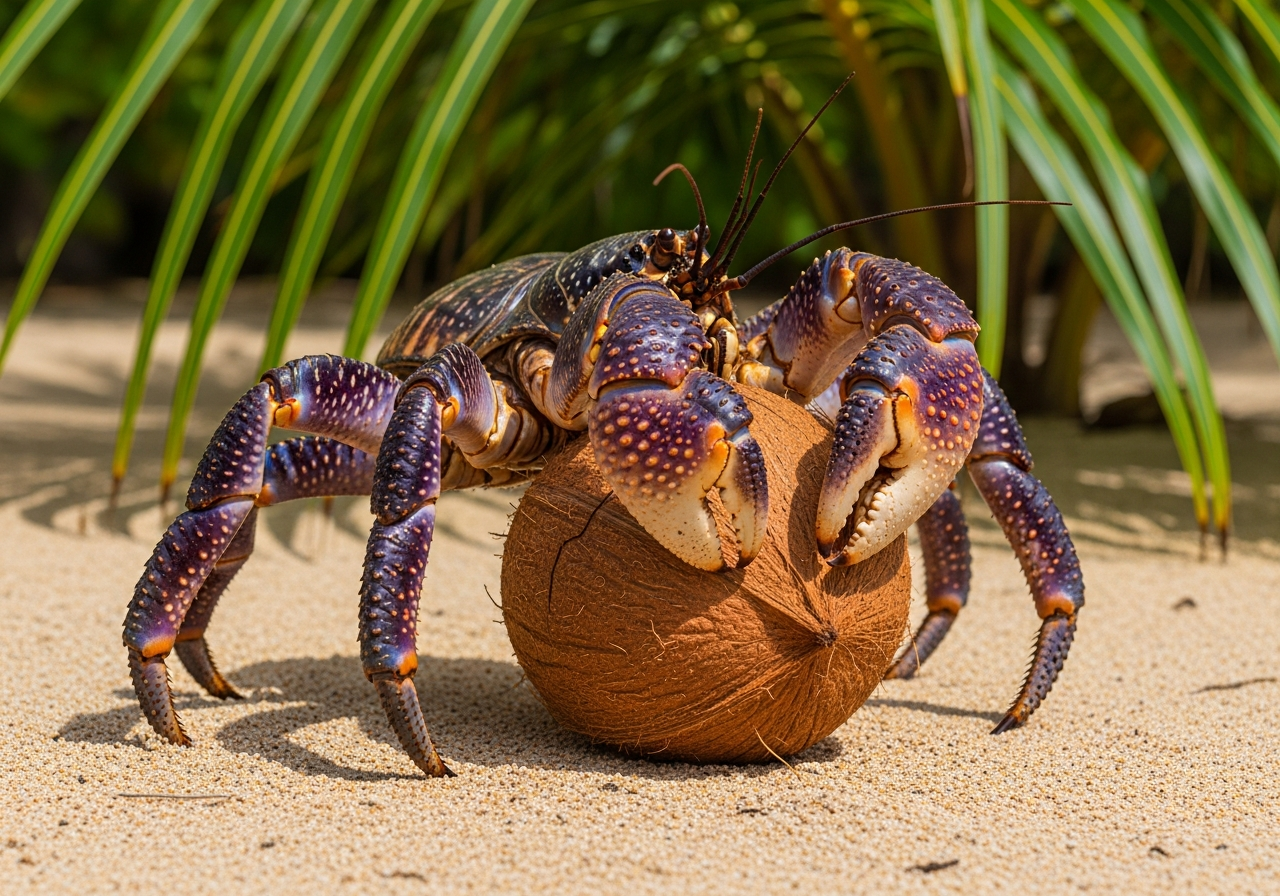
Coconut Crabs (Birgus latro) are invertebrates found across Asia. The world's largest land arthropod and tree-climbing island giant. Adults typically weigh Up to about 4 kg (9 lb), reach speeds of up to 4 km/h (2 mph), and live Possibly 40–60 years. They feed on omnivore (coconuts, fruit, seeds, carrion) and are listed as Vulnerable on the IUCN Red List. Tropical islands across the Indian Ocean and Pacific Ocean, from the Andaman Islands east to the Cook Islands.
Coconut Crab facts at a glance
| Scientific name | Birgus latro |
|---|---|
| Diet | Omnivore (coconuts, fruit, seeds, carrion) |
| Habitat | Tropical islands across the Indo-Pacific |
| Lifespan | Possibly 40–60 years |
| Weight | Up to about 4 kg (9 lb) |
| Leg span | Up to about 1 m (3 ft) |
| Conservation status | Vulnerable (IUCN) |
| Kingdom | Animalia |
|---|---|
| Phylum | Arthropoda |
| Class | Malacostraca |
| Order | Decapoda |
| Family | Coenobitidae |
| Genus | Birgus |
What is a group of coconut crabs called?
Group name (collective noun)
A group of Coconut Crabs is called a cast.
Baby name
A baby Coconut Crab is called a zoea.
Explore more animal collective nouns and baby animal names .
Range and habitat
Coconut Crabs inhabit Tropical islands across the Indian Ocean and Pacific Ocean, from the Andaman Islands east to the Cook Islands. Their preferred habitat includes tropical islands across the indo-pacific, where they find food, shelter, and breeding sites. Population density varies with prey availability, water access, and human disturbance. Protected areas and intact corridors remain essential for long-term persistence across Asia.
Physical characteristics and behaviour
Adult coconut crabs typically measure about 0.4 m in length and weigh Up to about 4 kg (9 lb). They can sprint at up to 4 km/h (2 mph) when hunting or escaping predators. Coconut Crabs are known for the world's largest land arthropod and tree-climbing island giant — social structure, daily activity, and seasonal movements all reflect pressures in their native environment.
Diet and ecological role
Coconut Crabs feed primarily on omnivore (coconuts, fruit, seeds, carrion). Foraging strategy depends on season, local prey or plant abundance, and competition with other species. As invertebrates, they play a measurable role in their ecosystem — controlling prey numbers, dispersing seeds, or shaping habitat through feeding and movement patterns that other wildlife depends on.
Conservation and human interaction
The IUCN lists coconut crabs as Vulnerable. Habitat loss, hunting, climate change, and conflict with people are among the main threats worldwide. Responsible ecotourism, anti-poaching patrols, and community-based conservation help in parts of their range. Never approach or feed wild coconut crabs — observe from a safe distance and support reputable conservation organisations.
Dig deeper into the Coconut Crab
- Are Coconut Crab Endangered
Dig deeper into coconut crab — are coconut crab endangered.
- Coconut Crab Facts 5
Dig deeper into coconut crab — coconut crab facts 5.
- How Long do Coconut Crab Live?
Dig deeper into coconut crab — how long do coconut crab live.
- What do Coconut Crab Eat
Dig deeper into coconut crab — what do coconut crab eat.
- Where do Coconut Crab Live?
Dig deeper into coconut crab — where do coconut crab live.
Explore the Coconut Crab
Compare
Related Invertebrates
Collections
Range & geography
Did you know? Coconut Crab facts
- The coconut crab (Birgus latro) is the largest land-living arthropod on Earth, weighing up to about 4 kg (9 lb) with a leg span approaching 1 m (3 ft).
- Yes. Coconut crabs can crack open a coconut by working their claw through the husk over multiple strikes, or by targeting the soft eye. Their measured grip force is among the highest of any animal.
- Adults cannot swim and will drown if submerged for extended periods. They breathe through a modified lung organ that requires air. Only larval coconut crabs are aquatic.
- Their grip is genuinely powerful and can cause a painful injury, but they are not aggressive toward people. Wild coconut crabs are shy and mostly nocturnal, and will retreat rather than attack when given the chance.
- Coconut crabs grow very slowly and are believed to live for several decades, possibly 40 to 60 years. Their longevity makes them especially vulnerable to hunting, as overharvested populations take a very long time to recover.
- Conservation: Vulnerable (IUCN).
Diet & feeding
Coconut Crab feeds primarily as a omnivore (coconuts, fruit, seeds, carrion). Despite descending from marine ancestors, adult coconut crabs have become fully terrestrial. They breathe air through a branchiostegal lung — a modified gill cavity lined with tissue that absorbs oxygen from air. Paradoxically, an adult cocon
Adaptations
- The coconut crab is the largest terrestrial arthropod alive today. Large adults can weigh around 4 kg and stretch nearly a metre from claw to claw. Their chelae (claws) generate one of the most powerful gripping forces measured in any animal — up to around 3,300 N, comparable in force to the bite of a lion. This grip is strong enough to husk and crack open a coconut, the food that gives the animal its name.
- Despite descending from marine ancestors, adult coconut crabs have become fully terrestrial. They breathe air through a branchiostegal lung — a modified gill cavity lined with tissue that absorbs oxygen from air. Paradoxically, an adult coconut crab will drown if submerged in water for too long. Only females return briefly to the shoreline to release their eggs, which hatch into aquatic larvae that later settle on land and lose their dependence on the sea.
Behaviour & ecology
- The coconut crab is the largest terrestrial arthropod alive today. Large adults can weigh around 4 kg and stretch nearly a metre from claw to claw. Their chelae (claws) generate one of the most powerful gripping forces measured in any animal — up to around 3,300 N, comparable in force to the bite of a lion. This grip is strong enough to husk and crack open a coconut, the food that gives the animal its name.
- Despite descending from marine ancestors, adult coconut crabs have become fully terrestrial. They breathe air through a branchiostegal lung — a modified gill cavity lined with tissue that absorbs oxygen from air. Paradoxically, an adult coconut crab will drown if submerged in water for too long. Only females return briefly to the shoreline to release their eggs, which hatch into aquatic larvae that later settle on land and lose their dependence on the sea.
- Coconut crabs are opportunistic omnivores. They eat fruit, seeds, coconuts, and carrion, and will cache food for later. They crack coconuts by working a claw through the soft eye or repeatedly hammering the shell. They climb palms and other trees several metres high to reach fruit. Their scavenging role helps recycle nutrients across the tropical island ecosystems they inhabit.
Communication
- Coconut Crab uses scent, posture, and vocal signals to mark territory and coordinate social behaviour.
- Communication intensity often peaks during breeding seasons and territorial disputes.
Habitat & range
Tropical islands across the Indo-Pacific
Ecological role
Coconut Crab plays a recognised ecological role in tropical islands across the indo-pacific.
Frequently asked questions about the Coconut Crab
Where do coconut crabs live?
Coconut Crabs are native to Asia. Tropical islands across the Indian Ocean and Pacific Ocean, from the Andaman Islands east to the Cook Islands.
What do coconut crabs eat?
They feed on omnivore (coconuts, fruit, seeds, carrion), adjusting seasonally based on what is available in Tropical islands across the Indo-Pacific.
How long do coconut crabs live?
Possibly 40–60 years. Captive individuals sometimes live longer with veterinary care and steady nutrition.
How big is a coconut crab?
Adults weigh Up to about 4 kg (9 lb) and reach roughly 0.4 metres long; males are often larger than females.
Are coconut crabs endangered?
Coconut Crabs are listed as Vulnerable on the IUCN Red List. Threats include habitat loss, hunting, and human-wildlife conflict.
How fast can a coconut crab run?
Coconut Crabs can reach about 4 km/h (2 mph) in short bursts.
What is a group of coconut crabs called?
A group of Coconut Crabs is called a cast.
What is a baby coconut crab called?
A baby Coconut Crab is called a zoea.
Sources & references
This guide is compiled and reviewed against established zoological and conservation references. Key sources for the Coconut Crab:
-
IUCN Red List of Threatened Species
Conservation status (Vulnerable) reflects the IUCN Red List category for Birgus latro.
- IUCN Red List — Birgus latro.
Conservation status (Vulnerable) and population trends.
- Animal Diversity Web — Birgus latro. University of Michigan Museum of Zoology.
Life history, morphology, and range.
- Wikipedia — Coconut Crab.
General taxonomy and overview (cross-check primary sources).
-
Global Animal Guide editorial standards
How we research, source, review, and update every guide for accuracy.