Rainbow Trout
Oncorhynchus mykiss
Quick answer
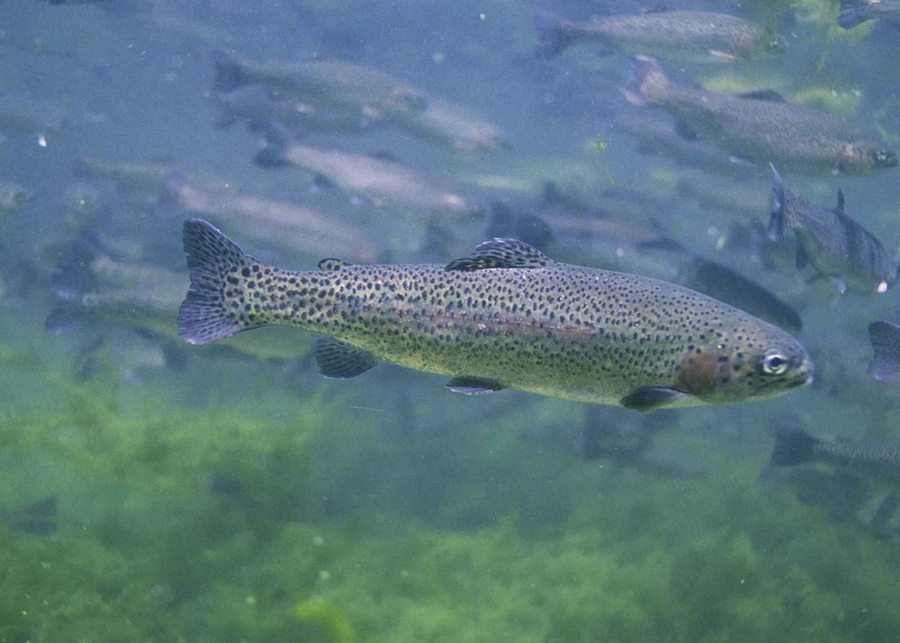
Rainbow trout are salmonid fish native to Pacific North America, named for the pink lateral stripe along silver sides. Stocked worldwide for sport fishing and aquaculture, they grow to 50 cm or more in rivers, leap at flies, and include steelhead populations that migrate to sea before returning to spawn.
Also available in Español (Rainbow Trout)
Rainbow Trout facts at a glance
| Scientific name | Oncorhynchus mykiss |
|---|---|
| Diet | Carnivore — insects, crustaceans, and small fish |
| Habitat | Cold rivers, lakes, and streams; anadromous steelhead in coastal rivers |
| Lifespan | 4–11 years in the wild (varies by population) |
| Weight | 0.5–9 kg (1–20 lb); steelhead and lake fish larger |
| Top speed | Strong swimmer; leaps waterfalls during spawning runs |
| Conservation status | Least Concern (IUCN) |
| Kingdom | Animalia |
|---|---|
| Phylum | Chordata |
| Class | Actinopterygii |
| Order | Salmoniformes |
| Family | Salmonidae |
| Genus | Oncorhynchus |
Where it lives
Pacific drainages from Alaska through California and inland to Idaho and Nevada; introduced worldwide for sport fishing and aquaculture.
What is a group of rainbow trouts called?
Group name (collective noun)
A group of Rainbow Trouts is called a school.
Baby name
A baby Rainbow Trout is called a fry.
Explore more animal collective nouns and baby animal names .
Fly fishing icon
Rainbow trout rise to dry flies on the surface, making them the quintessential fly-fishing species. Clear mountain streams of the American West — Montana, Idaho, Colorado — built a global angling culture around wild rainbow and cutthroat trout.
Steelhead life history
Some coastal populations ('steelhead') migrate to the ocean and return to natal rivers to spawn, growing larger and more silvery than resident river fish. Dams, water extraction, and warming streams threaten these anadromous runs across the Pacific Northwest.
Global stocking
Rainbow trout have been introduced to every continent except Antarctica for food and sport. They can hybridise with native trout and outcompete local species, making introductions controversial in places like New Zealand, Chile, and the Appalachian Mountains.
Aquaculture and wild genetics
Farm-raised rainbow trout supply supermarkets worldwide. Hatchery supplementation of wild streams raises questions about genetic dilution of native strains. Wild populations in the Pacific Northwest remain the evolutionary heartland of the species.
Dig deeper into the Rainbow Trout
- How Long do Trout Live?
Dig deeper into rainbow trout — how long do trout live.
- Trout Facts 4
Dig deeper into rainbow trout — trout facts 4.
- Trout Facts 5
Dig deeper into rainbow trout — trout facts 5.
- What do Trout Eat
Dig deeper into rainbow trout — what do trout eat.
- Where do Trout Live?
Dig deeper into rainbow trout — where do trout live.
Explore the Rainbow Trout
Compare
Related Fishs
Did you know? Rainbow Trout facts
- Rainbow trout are salmonid fish native to Pacific North America, named for the pink lateral stripe along silver sides.
- Rainbow trout are in the same genus as Pacific salmon. Steelhead are sea-run rainbow trout. Salmon typically die after spawning; many trout survive to spawn again.
- A rainbow trout that migrates to the ocean and returns to freshwater to spawn — larger and more silvery than river-resident rainbows.
- Aquatic insects, terrestrial insects that fall on the water, crustaceans, and small fish — diet shifts with size and habitat.
- Pacific drainages from Alaska through California and inland to Idaho and Nevada — not the eastern United States, where they are introduced.
- Conservation: Least Concern (IUCN).
Diet & feeding
Rainbow Trout feeds primarily as a carnivore — insects, crustaceans, and small fish. Some coastal populations ('steelhead') migrate to the ocean and return to natal rivers to spawn, growing larger and more silvery than resident river fish. Dams, water extraction, and warming streams threaten these anadromous runs acros
Adaptations
- Rainbow trout rise to dry flies on the surface, making them the quintessential fly-fishing species. Clear mountain streams of the American West — Montana, Idaho, Colorado — built a global angling culture around wild rainbow and cutthroat trout.
- Some coastal populations ('steelhead') migrate to the ocean and return to natal rivers to spawn, growing larger and more silvery than resident river fish. Dams, water extraction, and warming streams threaten these anadromous runs across the Pacific Northwest.
Behaviour & ecology
- Rainbow trout rise to dry flies on the surface, making them the quintessential fly-fishing species. Clear mountain streams of the American West — Montana, Idaho, Colorado — built a global angling culture around wild rainbow and cutthroat trout.
- Some coastal populations ('steelhead') migrate to the ocean and return to natal rivers to spawn, growing larger and more silvery than resident river fish. Dams, water extraction, and warming streams threaten these anadromous runs across the Pacific Northwest.
- Rainbow trout have been introduced to every continent except Antarctica for food and sport. They can hybridise with native trout and outcompete local species, making introductions controversial in places like New Zealand, Chile, and the Appalachian Mountains.
Communication
- Lateral-line and visual cues coordinate schooling, courtship, or territorial behaviour.
- Some species produce low-frequency sounds or drumming for spawning or defence.
Habitat & range
Cold rivers, lakes, and streams; anadromous steelhead in coastal rivers
Ecological role
Rainbow Trout acts as a predator that helps regulate prey populations and maintain balance in cold rivers, lakes, and streams; anadromous steelhead in coastal rivers.
Frequently asked questions about the Rainbow Trout
Rainbow trout vs salmon?
Rainbow trout are in the same genus as Pacific salmon. Steelhead are sea-run rainbow trout. Salmon typically die after spawning; many trout survive to spawn again.
What is a steelhead?
A rainbow trout that migrates to the ocean and returns to freshwater to spawn — larger and more silvery than river-resident rainbows.
What do rainbow trout eat?
Aquatic insects, terrestrial insects that fall on the water, crustaceans, and small fish — diet shifts with size and habitat.
Where are rainbow trout native?
Pacific drainages from Alaska through California and inland to Idaho and Nevada — not the eastern United States, where they are introduced.
How big do rainbow trout get?
Stream fish often 30–40 cm; lake and steelhead forms can exceed 90 cm and 9 kg in rich waters.
What is a group of rainbow trouts called?
A group of Rainbow Trouts is called a school.
What is a baby rainbow trout called?
A baby Rainbow Trout is called a fry.
Sources & references
This guide is compiled and reviewed against established zoological and conservation references. Key sources for the Rainbow Trout:
-
IUCN Red List of Threatened Species
Conservation status (Least Concern) reflects the IUCN Red List category for Oncorhynchus mykiss.
- IUCN Red List — Oncorhynchus mykiss.
Conservation status (Least Concern) and population trends.
- Animal Diversity Web — Oncorhynchus mykiss. University of Michigan Museum of Zoology.
Life history, morphology, and range.
-
Global Animal Guide editorial standards
How we research, source, review, and update every guide for accuracy.