Quick answer
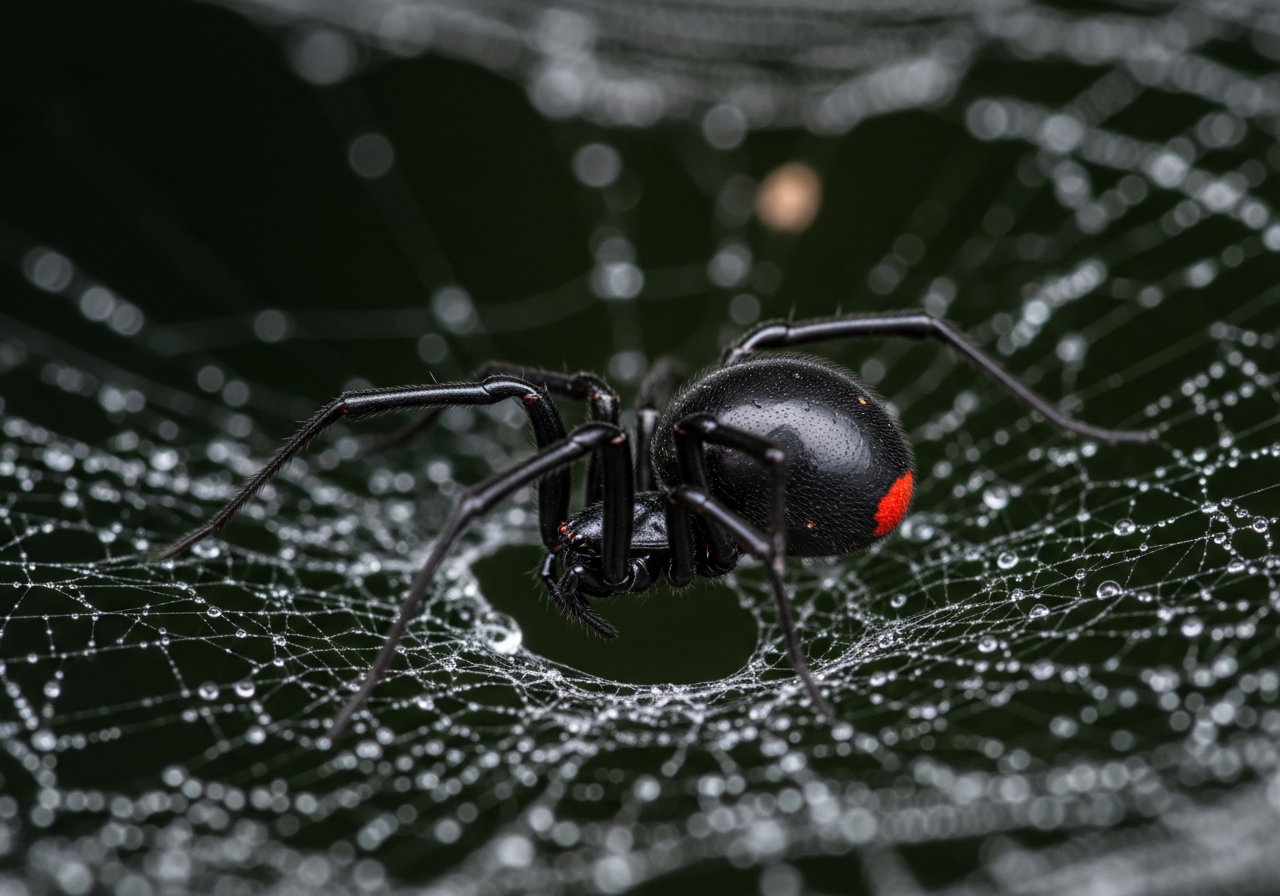
The southern black widow (Latrodectus mactans) is a small, glossy black spider famous for the red hourglass marking on the underside of the female's abdomen. It shelters in dark, undisturbed spots such as sheds, woodpiles and field debris, where it builds a tangled web to trap insects. The female's body is only about 1.3 cm long, yet her venom is a potent neurotoxin. Females live one to three years; males are far smaller and shorter-lived.
Top questions about the Black Widow Spider
Black Widow Spider facts at a glance
- Weight 1 g
- Length 4 cm
- Top speed 2 km/h
- Lifespan 3 years
| Scientific name | Latrodectus mactans |
|---|---|
| Diet | Carnivore (insects and other small arthropods) |
| Habitat | Sheltered, dark spots in fields, sheds, and woodpiles |
| Lifespan | 1–3 years (females; males much shorter) |
| Size | Female body about 1.3 cm (0.5 in); legs wider |
| Venom | Potent neurotoxin; bites rarely fatal with care |
| Conservation status | Least Concern (IUCN) |
| Kingdom | Animalia |
|---|---|
| Phylum | Arthropoda |
| Class | Arachnida |
| Order | Araneae |
| Family | Theridiidae |
| Genus | Latrodectus |
Where it lives
The black widow spider (Latrodectus mactans) is native to Sheltered, dark places across North America, especially the southern and western United States. — recorded across North America in this guide’s range summary.
For occurrence records, see GBIF species search and sources below.
How big is a black widow spider?
An adult black widow spider measures 4 cm long — about 2% of the height of an average adult person (1.73 m) — and weighs around 1 g, a small fraction of an average adult’s body weight (70 kg).
Length vs an average adult’s height (to scale)
What is a group of black widow spiders called?
Group name (collective noun)
A group of Black Widow Spiders is called a clutter. It is also known as a cluster.
Baby name
A baby Black Widow Spider is called a spiderling.
Explore more animal collective nouns and baby animal names .
Appearance and identification
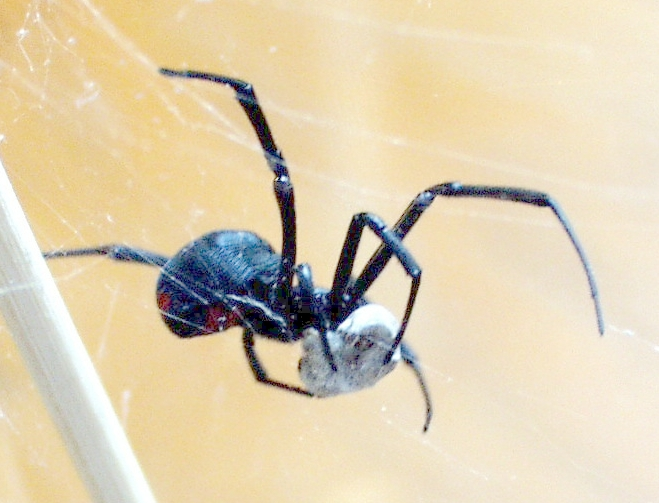
The female black widow is unmistakable: a shiny jet-black body roughly 1.3 cm (0.5 inch) long, with legs spanning wider, and a vivid red hourglass on the underside of her rounded abdomen. Males are much smaller and paler, often marked with red or yellow streaks, and are rarely noticed. The glossy sheen and bold warning colour advertise the spider's toxicity to would-be predators. Juveniles look different again, with lighter, more patterned bodies that darken as they mature.
Web and how it catches prey
Black widows are ambush hunters that rely entirely on their web rather than chasing anything down. They spin an irregular, tangled cobweb of exceptionally strong silk in a sheltered corner, then wait, hanging upside down at its centre. When an insect blunders into the sticky threads, the spider rushes over, wraps it in silk and delivers a paralysing bite. It then injects digestive enzymes and drinks the liquefied remains. Prey is mostly insects and other small arthropods.
Venom and danger to people
Black widow venom is a neurotoxin called latrotoxin, drop for drop far more potent than a rattlesnake's, which is why the spider has such a fearsome reputation. A bite can cause intense muscle pain, cramping, sweating and nausea, a set of symptoms known as latrodectism. In practice, however, the spider injects only a tiny dose, and with modern medical care bites are very rarely fatal. Deaths are extremely uncommon, and most affect the very young, the elderly or those already unwell.
Behaviour and temperament
Despite their reputation, black widows are shy and reclusive, biting people only when accidentally pressed against the skin or trapped. They are largely nocturnal and slow-moving, ambling across their web at little more than 1.5 km/h. Females spend almost their entire lives within a small web, rarely straying far from this sheltered refuge. Left alone, a black widow poses very little threat and would much rather retreat than confront a much larger animal.
Mating and life cycle
The black widow earns its name from the female's occasional habit of eating the much smaller male after mating, though this happens far less often than folklore suggests. After mating, the female produces several round, papery egg sacs, each holding hundreds of eggs, which she guards within her web. The spiderlings hatch and disperse by releasing silk threads that carry them on the breeze, a technique called ballooning. Females can live one to three years, while males survive only a few months.
Dig deeper into the Black Widow Spider
- Are Black Widow Spiders Dangerous?
Are black widow spiders dangerous? Realistic risk, when incidents rise, and safety basics.
- Black Widow Spider: Key Facts
Black Widow Spiders (Latrodectus mactans) are invertebrates found across North America. The glossy black spider with the red hourglass.
- How Long Do Black Widow Spiders Live?
Black Widow Spider lifespan is typically 1–3 years (females; males much shorter). What shortens or extends life, life stages, and status (Least Concern).
- What Do Black Widow Spiders Eat?
What black widow spiders eat: Carnivore (insects and other small arthropods), foraging style, and seasonal shifts in Sheltered, dark spots in fields, sheds, and woodpiles.
- Where Do Black Widow Spiders Live?
Where black widow spiders live: Sheltered, dark spots in fields, sheds, and woodpiles, native range cues, and human overlap. Status Least Concern.
Explore the Black Widow Spider
Related Invertebrates
Range & geography
Did you know? Black Widow Spider facts
- The black widow is a venomous spider recognized by the shiny black body and red hourglass mark on the underside of the female's abdomen.
- A black widow bite injects a potent neurotoxin that can cause pain, cramps, and other symptoms, but it is rarely fatal to healthy adults. With medical care and antivenom, serious outcomes are very uncommon.
- Female black widows are glossy black with a red hourglass mark on the underside of the abdomen. Males are much smaller and lighter and are generally harmless to people.
- The name comes from cases where the female eats the male after mating, but in the wild this is much rarer than the legend suggests. It happens more often in confined laboratory settings.
- Black widows are carnivores that eat insects and other small arthropods caught in their webs. They wrap prey in silk and use venom to subdue it before feeding.
- Conservation: Least Concern (IUCN).
Diet & feeding
Black Widow Spider feeds primarily as a carnivore (insects and other small arthropods). Black widow venom contains a powerful neurotoxin that can cause muscle pain, cramps, sweating, and nausea, a condition sometimes called latrodectism. Despite a fearsome reputation, bites are rarely fatal to healthy adults, and death
Adaptations
- The female black widow is glossy black with a distinctive red hourglass mark on the underside of her rounded abdomen. Males are much smaller, lighter in color, and usually harmless to people. The bold markings serve as a warning of the spider's potent venom.
- Black widow venom contains a powerful neurotoxin that can cause muscle pain, cramps, sweating, and nausea, a condition sometimes called latrodectism. Despite a fearsome reputation, bites are rarely fatal to healthy adults, and deaths are very uncommon where medical care and antivenom are available. The spiders are not aggressive and usually bite only when trapped against the skin.
Behaviour & ecology
- The female black widow is glossy black with a distinctive red hourglass mark on the underside of her rounded abdomen. Males are much smaller, lighter in color, and usually harmless to people. The bold markings serve as a warning of the spider's potent venom.
- Black widow venom contains a powerful neurotoxin that can cause muscle pain, cramps, sweating, and nausea, a condition sometimes called latrodectism. Despite a fearsome reputation, bites are rarely fatal to healthy adults, and deaths are very uncommon where medical care and antivenom are available. The spiders are not aggressive and usually bite only when trapped against the skin.
- Black widows build strong, irregular, tangled webs in sheltered, dark places such as woodpiles, sheds, and rock crevices. They hang upside down in the web and wait for insects to become ensnared, then wrap and bite their prey. The silk is notably tough, helping hold struggling insects until the venom takes effect.
Communication
- Black Widow Spider uses scent, posture, and vocal signals to mark territory and coordinate social behaviour.
- Communication intensity often peaks during breeding seasons and territorial disputes.
Habitat & range
Sheltered, dark spots in fields, sheds, and woodpiles
Ecological role
Black Widow Spider acts as a predator that helps regulate prey populations and maintain balance in sheltered, dark spots in fields, sheds, and woodpiles.
Conservation status of the Black Widow Spider
The black widow spider (Latrodectus mactans) is listed as Least Concern on the IUCN Red List. Least Concern (LC) is the IUCN's lowest-risk category, assigned to widespread, abundant species that have been evaluated and found not to be threatened. It does not mean a species faces no pressures — only that it is not currently at risk of extinction.
The black widow spider (Latrodectus mactans) is assessed on the IUCN Red List. Look up on the IUCN Red List .
Frequently asked questions about the Black Widow Spider
How dangerous is a black widow bite?
A black widow's venom is a potent neurotoxin that can cause severe muscle pain, cramps, sweating and nausea. Despite this, the spider injects only a small dose, and with prompt medical care bites are very rarely fatal.
How do you identify a black widow spider?
Look for a glossy jet-black female about 1.3 cm long with a bright red hourglass marking on the underside of her rounded abdomen. Males are much smaller, paler and usually go unnoticed.
Do female black widows really eat the male?
Sometimes, but far less often than the name implies. Cannibalism after mating does occur in this species, yet in many encounters the male escapes unharmed, and the behaviour is more common in captivity than in the wild.
What do black widow spiders eat?
They are carnivores that feed mainly on insects and other small arthropods caught in their web. The spider waits at the centre of its tangled web, then wraps and bites any prey that becomes stuck.
How long do black widow spiders live?
Females typically live one to three years. Males are much smaller and live only a few months, often dying not long after they mate.
Where do black widow spiders live?
They favour dark, sheltered and undisturbed places such as sheds, woodpiles, rock crevices and debris in fields. There they build a tangled cobweb close to the ground and remain hidden during the day.
What is a group of black widow spiders called?
A group of Black Widow Spiders is called a clutter. It is also known as a cluster.
What is a baby black widow spider called?
A baby Black Widow Spider is called a spiderling.
Sources & references
This guide is compiled and reviewed against established zoological and conservation references. Key sources for the Black Widow Spider:
-
IUCN Red List of Threatened Species
Conservation status (Least Concern) reflects the IUCN Red List category for Latrodectus mactans.
-
iNaturalist — observations & photos
Search citizen-science observations and community IDs for Latrodectus mactans. Useful for range checks and recent sightings — not a substitute for formal Red List status.
-
GBIF — occurrence data
Global Biodiversity Information Facility species search for Latrodectus mactans. Explore published occurrence records used in range research.
- IUCN Red List — Latrodectus mactans.
Conservation status (Least Concern) and population trends.
- Animal Diversity Web — Latrodectus mactans. University of Michigan Museum of Zoology.
Life history, morphology, and range.
- Wikipedia — Black Widow Spider.
General taxonomy and overview (cross-check primary sources).
-
Global Animal Guide editorial standards
How we research, source, review, and update every guide for accuracy.