Wombat
Vombatus ursinus
Quick answer
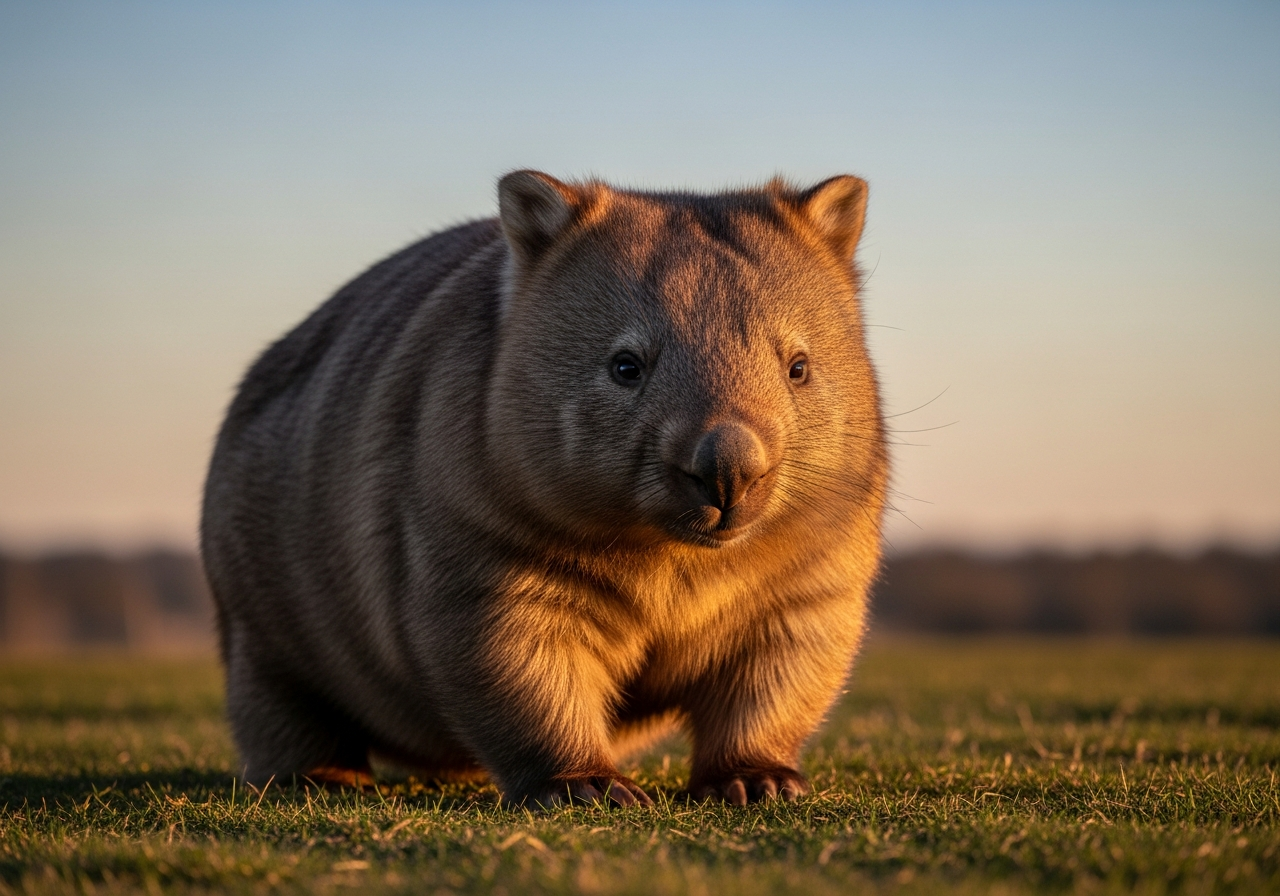
The wombat (Vombatus ursinus) is a stocky, short-legged Australian marsupial and one of the world's largest burrowing animals. It is the only animal known to produce cube-shaped faeces — a result of unique gut elasticity that moulds droppings so they do not roll away. Wombats are herbivores, largely nocturnal, and powerful diggers with a backward-facing pouch.
Wombat facts at a glance
| Scientific name | Vombatus ursinus (Common Wombat) |
|---|---|
| Diet | Herbivore (grasses, roots, bark, sedges) |
| Habitat | Forest, woodland, heath, and alpine grassland |
| Lifespan | 5–15 years in the wild; up to 20+ in captivity |
| Weight | 20–35 kg (44–77 lb) |
| Speed | Up to 40 km/h (25 mph) in short bursts |
| Conservation status | Least Concern (Common Wombat; others vary) |
| Kingdom | Animalia |
|---|---|
| Phylum | Chordata |
| Class | Mammalia |
| Order | Diprotodontia |
| Family | Vombatidae |
| Genus | Vombatus |
Where it lives
Southeastern Australia, including Tasmania; lives in forest, woodland, and heath with soft soils for burrowing.
What is a group of wombats called?
Group name (collective noun)
A group of Wombats is called a wisdom.
Baby name
A baby Wombat is called a joey.
Explore more animal collective nouns and baby animal names .
Cube-shaped poop: how and why
The wombat is the only animal in the world known to produce cube-shaped droppings. The approximately 2 cm cubic faeces are deposited on rocks, logs, and raised surfaces to mark territory. Research published in 2021 (Physical Review Fluids) revealed that the cubes form in the last section of the intestine, where varying elasticity in the gut wall squeezes the faecal matter into a cube shape as it passes through. The cubic form means droppings do not roll off marking surfaces, making them more effective territorial markers than round ones would be.
Built to dig
Wombats are among the most powerful burrowing mammals alive. Their thick, barrel-shaped body, broad flat head, and strong clawed feet are designed for sustained excavation. A wombat burrow can be up to 30 m long and 1.5 m wide. Wombats spend the hottest and coldest parts of the day underground, emerging mainly at night to graze. Their pouches face backward (toward the tail) rather than forward — this prevents soil and debris from falling in while the animal digs.
The armoured rump defence
Wombats have an unusually tough, cartilage-reinforced rump. When a predator (such as a dingo, Tasmanian devil, or introduced fox) pursues a wombat into its burrow, the wombat can use its rump as a plug and crush the attacker's head against the burrow ceiling. This counterattack has been documented in the wild. Despite their round appearance, wombats can sprint at up to 40 km/h (25 mph) in short bursts when threatened above ground.
Diet, digestion, and ecology
Wombats are slow-metabolising herbivores that graze on grasses, roots, sedges, and bark. Their digestion is extremely efficient — food can take up to 14 days to pass through the gut — extracting maximum nutrition from tough, low-energy vegetation. They are significant ecosystem engineers: their large, complex burrow systems provide shelter for dozens of other species, including reptiles, small mammals, and invertebrates, particularly during drought and wildfire when few other refuges exist.
Species and conservation
There are three wombat species. The common wombat is widespread across southeastern Australia and Tasmania and is Least Concern. The northern hairy-nosed wombat (Lasiorhinus krefftii) is Critically Endangered with only around 300 individuals surviving in one protected location in Queensland — one of Australia's rarest mammals. The southern hairy-nosed wombat lives in arid scrub in South Australia. All three produce cube-shaped droppings and have backward-facing pouches.
Dig deeper into the Wombat
- How Fast Is A Wombat
Dig deeper into wombat — how fast is a wombat.
- How Long do Wombat Live?
Dig deeper into wombat — how long do wombat live.
- What do Wombat Eat
Dig deeper into wombat — what do wombat eat.
- Where do Wombat Live?
Dig deeper into wombat — where do wombat live.
- Wombat Facts 5
Dig deeper into wombat — wombat facts 5.
Explore the Wombat
Range & geography
Did you know? Wombat facts
- The wombat (Vombatus ursinus) is a stocky, short-legged Australian marsupial and one of the world's largest burrowing animals.
- Wombat droppings are cube-shaped because the last section of the intestine has varying elasticity that moulds the faecal matter into a cube as it passes through. The wombat is the only known animal to do this. The cubes do not roll off the rocks and logs where wombats leave them, making them effective territorial markers.
- No. Wombats are marsupials and are more closely related to koalas, kangaroos, and Tasmanian devils than to any placental mammal. The bear-like appearance is purely superficial convergent evolution.
- Yes — surprisingly fast for their shape. Common wombats can sprint at around 40 km/h (25 mph) over short distances, faster than most people. They typically rely on retreating to their burrow when threatened rather than running.
- The common wombat is widespread and not at risk. However, the northern hairy-nosed wombat is Critically Endangered with roughly 300 individuals in one protected area in Queensland, making it one of Australia's most threatened mammals.
- Conservation: Least Concern (Common Wombat; others vary).
Diet & feeding
Wombat feeds primarily as a herbivore (grasses, roots, bark, sedges). Wombats are among the most powerful burrowing mammals alive. Their thick, barrel-shaped body, broad flat head, and strong clawed feet are designed for sustained excavation. A wombat burrow can be up to 30 m long and 1.5 m wide. Wombats spend the hott
Adaptations
- The wombat is the only animal in the world known to produce cube-shaped droppings. The approximately 2 cm cubic faeces are deposited on rocks, logs, and raised surfaces to mark territory. Research published in 2021 (Physical Review Fluids) revealed that the cubes form in the last section of the intestine, where varying elasticity in the gut wall squeezes the faecal matter into a cube shape as it passes through. The cubic form means droppings do not roll off marking surfaces, making them more effective territorial markers than round ones would be.
- Wombats are among the most powerful burrowing mammals alive. Their thick, barrel-shaped body, broad flat head, and strong clawed feet are designed for sustained excavation. A wombat burrow can be up to 30 m long and 1.5 m wide. Wombats spend the hottest and coldest parts of the day underground, emerging mainly at night to graze. Their pouches face backward (toward the tail) rather than forward — this prevents soil and debris from falling in while the animal digs.
Behaviour & ecology
- The wombat is the only animal in the world known to produce cube-shaped droppings. The approximately 2 cm cubic faeces are deposited on rocks, logs, and raised surfaces to mark territory. Research published in 2021 (Physical Review Fluids) revealed that the cubes form in the last section of the intestine, where varying elasticity in the gut wall squeezes the faecal matter into a cube shape as it passes through. The cubic form means droppings do not roll off marking surfaces, making them more effective territorial markers than round ones would be.
- Wombats are among the most powerful burrowing mammals alive. Their thick, barrel-shaped body, broad flat head, and strong clawed feet are designed for sustained excavation. A wombat burrow can be up to 30 m long and 1.5 m wide. Wombats spend the hottest and coldest parts of the day underground, emerging mainly at night to graze. Their pouches face backward (toward the tail) rather than forward — this prevents soil and debris from falling in while the animal digs.
- Wombats have an unusually tough, cartilage-reinforced rump. When a predator (such as a dingo, Tasmanian devil, or introduced fox) pursues a wombat into its burrow, the wombat can use its rump as a plug and crush the attacker's head against the burrow ceiling. This counterattack has been documented in the wild. Despite their round appearance, wombats can sprint at up to 40 km/h (25 mph) in short bursts when threatened above ground.
Communication
- Wombat uses scent, posture, and vocal signals to mark territory and coordinate social behaviour.
- Communication intensity often peaks during breeding seasons and territorial disputes.
Habitat & range
Forest, woodland, heath, and alpine grassland
Ecological role
Wombat shapes vegetation through grazing or browsing and serves as prey for larger predators where ranges overlap.
Frequently asked questions about the Wombat
Why does a wombat have square poop?
Wombat droppings are cube-shaped because the last section of the intestine has varying elasticity that moulds the faecal matter into a cube as it passes through. The wombat is the only known animal to do this. The cubes do not roll off the rocks and logs where wombats leave them, making them effective territorial markers.
Are wombats related to bears?
No. Wombats are marsupials and are more closely related to koalas, kangaroos, and Tasmanian devils than to any placental mammal. The bear-like appearance is purely superficial convergent evolution.
Can wombats run fast?
Yes — surprisingly fast for their shape. Common wombats can sprint at around 40 km/h (25 mph) over short distances, faster than most people. They typically rely on retreating to their burrow when threatened rather than running.
Are wombats endangered?
The common wombat is widespread and not at risk. However, the northern hairy-nosed wombat is Critically Endangered with roughly 300 individuals in one protected area in Queensland, making it one of Australia's most threatened mammals.
Can you keep a wombat as a pet?
Wombats are protected wild animals in Australia and it is illegal to keep one as a pet. They have specific nutritional needs, are powerful enough to cause property damage, and live a long time. Orphaned joeys may be cared for by licensed wildlife carers before being released.
What is a group of wombats called?
A group of Wombats is called a wisdom.
What is a baby wombat called?
A baby Wombat is called a joey.
Sources & references
This guide is compiled and reviewed against established zoological and conservation references. Key sources for the Wombat:
-
IUCN Red List of Threatened Species
Conservation status (Least Concern) reflects the IUCN Red List category for Vombatus ursinus.
- IUCN Red List — Vombatus ursinus.
Conservation status (Least Concern) and population trends.
- Animal Diversity Web — Vombatus ursinus. University of Michigan Museum of Zoology.
Life history, morphology, and range.
- Wikipedia — Wombat.
General taxonomy and overview (cross-check primary sources).
-
Global Animal Guide editorial standards
How we research, source, review, and update every guide for accuracy.