Quick answer
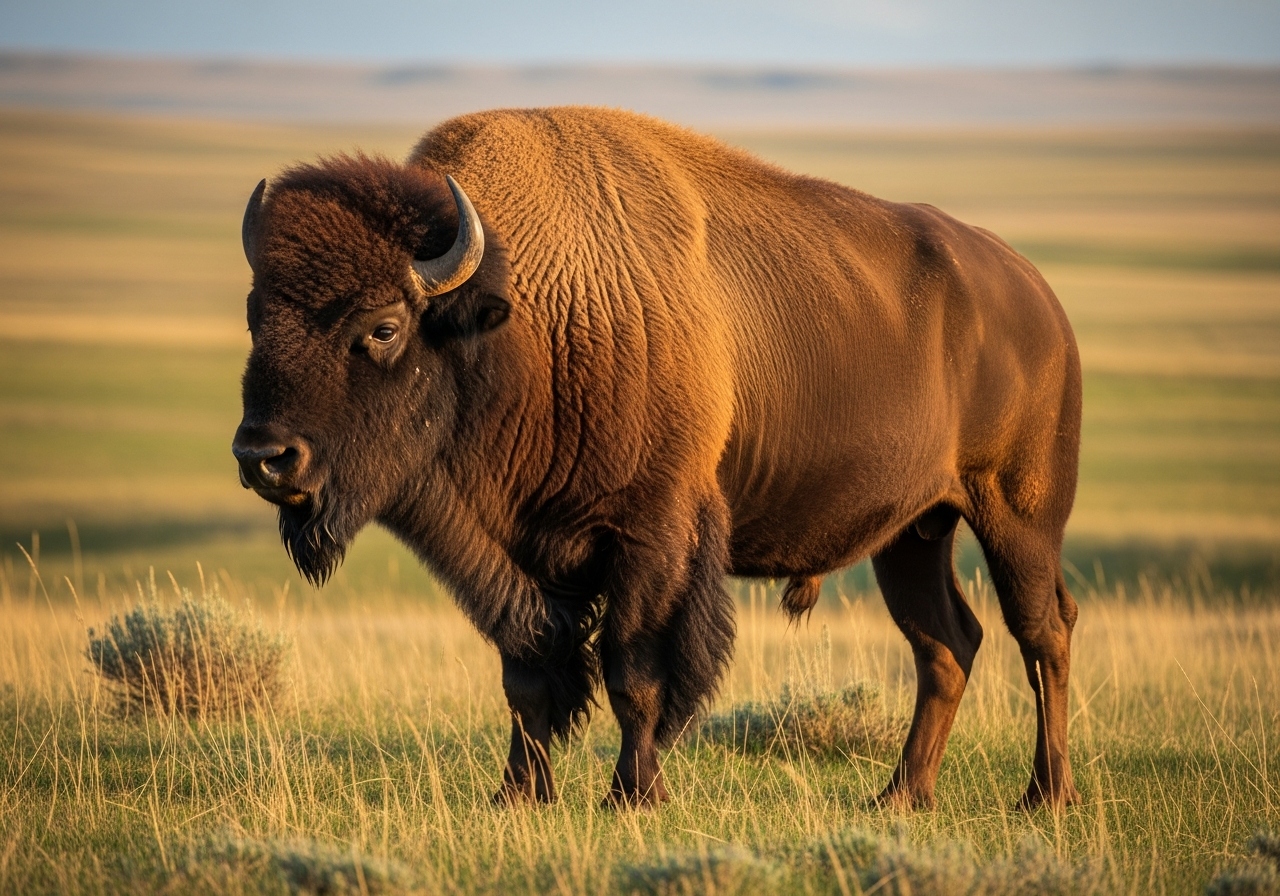
The American bison is North America's largest land mammal, with big bulls weighing up to 1,000 kg (2,200 lb) and standing nearly 2 m (6 ft) at the shoulder. Once numbering in the tens of millions across the Great Plains, bison were hunted nearly to extinction in the 1800s and now live mostly in parks and reserves. They are grazing herbivores that roam grasslands in herds and can run up to 55 km/h (35 mph). Wild bison typically live 15 to 20 years.
Top questions about the American Bison
American Bison facts at a glance
- Weight 1000 kg
- Length 3 m
- Top speed 55 km/h
- Lifespan 18 years
| Scientific name | Bison bison |
|---|---|
| Diet | Herbivore (grazer) |
| Habitat | Grasslands, plains, and prairies |
| Lifespan | 15–20 years in the wild |
| Weight | 450–1,000 kg (1,000–2,200 lb) |
| Top speed | Up to 55 km/h (35 mph) |
| Conservation status | Near Threatened (IUCN) |
| Kingdom | Animalia |
|---|---|
| Phylum | Chordata |
| Class | Mammalia |
| Order | Artiodactyla |
| Family | Bovidae |
| Genus | Bison |
Where it lives
The american bison (Bison bison) is native to Grasslands and plains of North America, now mostly in parks and reserves. — recorded across North America in this guide’s range summary.
For occurrence records, see GBIF species search and sources below.
How big is a american bison?
An adult american bison measures 3 m long — about 1.7× the height of an average adult person (1.73 m) — and weighs around 1000 kg, about 14× an average adult’s body weight (70 kg).
Length vs an average adult’s height (to scale)
What is a group of american bison called?
Group name (collective noun)
A group of American Bison is called a herd. It is also known as a gang.
Baby name
A baby American Bison is called a calf.
Explore more animal collective nouns and baby animal names .
Behavior and herds
Bison are social animals that live in herds, with cows and young in one group and bulls often in smaller bachelor groups or alone outside the breeding season. During the summer rut, bulls bellow, wallow in dust, and clash heads to compete for mates. Despite their bulk, bison are surprisingly fast and agile, capable of sprinting at 55 km/h (35 mph) and jumping fences. They use wallows, shallow dust pits, to deter insects and shed fur.
Diet and grazing
Bison are grazing herbivores that feed mainly on grasses and sedges, moving across the plains as they crop vegetation. Their grazing shapes grassland ecosystems, promoting plant diversity and creating habitat for other species. They have a multi-chambered stomach that ferments tough plant material, and they ruminate, chewing cud, to extract nutrients. In winter they use their massive heads to sweep snow aside and reach buried grass.
History and near extinction
Before European settlement, an estimated 30 to 60 million bison roamed North America in vast herds. In the 1800s they were slaughtered on an enormous scale for hides, meat, and as part of efforts to displace Native American peoples, leaving only a few hundred animals by 1900. Conservation efforts, including protection in Yellowstone National Park, saved the species from extinction. Today bison are a powerful symbol of American wildlife and conservation.
Conservation today
The American bison is listed as Near Threatened, with around 500,000 animals, though most are managed in commercial herds rather than free-ranging wild populations. Genetically pure, conservation herds are far smaller and a focus of recovery efforts. Restoring bison to native grasslands helps rebuild prairie ecosystems. In 2016 the bison was named the national mammal of the United States.
Dig deeper into the American Bison
- Are American Bisons Dangerous?
Are american bisons dangerous? Realistic risk, when incidents rise, and safety basics.
- American Bison: Key Facts
The American bison is North America's largest land mammal, with big bulls weighing up to 1,000 kg (2,200 lb) and standing nearly 2 m (6 ft) at the…
- How Long Do American Bisons Live?
American Bison lifespan is typically 15–20 years in the wild. What shortens or extends life, life stages, and status (Near Threatened).
- What Do American Bisons Eat?
What american bisons eat: Herbivore (grazer), foraging style, and seasonal shifts in Grasslands, plains, and prairies.
- Where Do American Bisons Live?
Where american bisons live: Grasslands, plains, and prairies, native range cues, and human overlap. Status Near Threatened.
Explore the American Bison
Compare
Range & geography
Did you know? American Bison facts
- The American bison is North America's largest land mammal, with big bulls weighing up to 1,000 kg (2,200 lb) and standing nearly 2 m (6 ft) at the shoulder.
- True buffalo are the African Cape buffalo and Asian water buffalo, while the American animal is a bison. The name \
- Bison are grazing herbivores that feed mainly on grasses and sedges. They ruminate to digest tough plant material and can dig through snow to reach grass in winter.
- In the 1800s bison were hunted on a massive scale for hides and meat and as part of policies against Native Americans, reducing tens of millions of animals to only a few hundred by 1900.
- Despite weighing up to a tonne, bison can sprint at around 55 km/h (35 mph) and are agile enough to jump fences, making them far more dangerous to approach than they appear.
- Conservation: Near Threatened (IUCN).
Diet & feeding
American Bison feeds primarily as a herbivore (grazer). Bison are grazing herbivores that feed mainly on grasses and sedges, moving across the plains as they crop vegetation. Their grazing shapes grassland ecosystems, promoting plant diversity and creating habitat for other species. They have a multi-chambered stomach
Adaptations
- Bison are social animals that live in herds, with cows and young in one group and bulls often in smaller bachelor groups or alone outside the breeding season. During the summer rut, bulls bellow, wallow in dust, and clash heads to compete for mates. Despite their bulk, bison are surprisingly fast and agile, capable of sprinting at 55 km/h (35 mph) and jumping fences. They use wallows, shallow dust pits, to deter insects and shed fur.
- Bison are grazing herbivores that feed mainly on grasses and sedges, moving across the plains as they crop vegetation. Their grazing shapes grassland ecosystems, promoting plant diversity and creating habitat for other species. They have a multi-chambered stomach that ferments tough plant material, and they ruminate, chewing cud, to extract nutrients. In winter they use their massive heads to sweep snow aside and reach buried grass.
Behaviour & ecology
- Bison are social animals that live in herds, with cows and young in one group and bulls often in smaller bachelor groups or alone outside the breeding season. During the summer rut, bulls bellow, wallow in dust, and clash heads to compete for mates. Despite their bulk, bison are surprisingly fast and agile, capable of sprinting at 55 km/h (35 mph) and jumping fences. They use wallows, shallow dust pits, to deter insects and shed fur.
- Bison are grazing herbivores that feed mainly on grasses and sedges, moving across the plains as they crop vegetation. Their grazing shapes grassland ecosystems, promoting plant diversity and creating habitat for other species. They have a multi-chambered stomach that ferments tough plant material, and they ruminate, chewing cud, to extract nutrients. In winter they use their massive heads to sweep snow aside and reach buried grass.
- Before European settlement, an estimated 30 to 60 million bison roamed North America in vast herds. In the 1800s they were slaughtered on an enormous scale for hides, meat, and as part of efforts to displace Native American peoples, leaving only a few hundred animals by 1900. Conservation efforts, including protection in Yellowstone National Park, saved the species from extinction. Today bison are a powerful symbol of American wildlife and conservation.
Communication
- American Bison uses scent, posture, and vocal signals to mark territory and coordinate social behaviour.
- Communication intensity often peaks during breeding seasons and territorial disputes.
Habitat & range
Grasslands, plains, and prairies
Ecological role
American Bison shapes vegetation through grazing or browsing and serves as prey for larger predators where ranges overlap.
Conservation status of the American Bison
The american bison (Bison bison) is listed as Near Threatened on the IUCN Red List. Near Threatened (NT) means a species does not yet qualify as threatened but is close to it, or likely to become so in the near future without ongoing conservation. It is a watch-list category just below Vulnerable.
The american bison (Bison bison) is assessed on the IUCN Red List. Look up on the IUCN Red List .
Frequently asked questions about the American Bison
What is the difference between bison and buffalo?
True buffalo are the African Cape buffalo and Asian water buffalo, while the American animal is a bison. The name "buffalo" stuck through history but is technically incorrect.
What do bison eat?
Bison are grazing herbivores that feed mainly on grasses and sedges. They ruminate to digest tough plant material and can dig through snow to reach grass in winter.
Why did bison nearly go extinct?
In the 1800s bison were hunted on a massive scale for hides and meat and as part of policies against Native Americans, reducing tens of millions of animals to only a few hundred by 1900.
How fast can a bison run?
Despite weighing up to a tonne, bison can sprint at around 55 km/h (35 mph) and are agile enough to jump fences, making them far more dangerous to approach than they appear.
Are bison dangerous?
Yes. Bison are wild and unpredictable, and they injure people who get too close, especially in parks. They are fast, powerful, and best viewed from a safe distance.
How long do bison live?
Wild bison typically live 15 to 20 years, and some reach their early twenties. Cows often live longer than bulls, which are worn down by competition during the rut.
What is a group of american bison called?
A group of American Bison is called a herd. It is also known as a gang.
What is a baby american bison called?
A baby American Bison is called a calf.
Sources & references
This guide is compiled and reviewed against established zoological and conservation references. Key sources for the American Bison:
-
IUCN Red List of Threatened Species
Conservation status (Near Threatened) reflects the IUCN Red List category for Bison bison.
-
iNaturalist — observations & photos
Search citizen-science observations and community IDs for Bison bison. Useful for range checks and recent sightings — not a substitute for formal Red List status.
-
GBIF — occurrence data
Global Biodiversity Information Facility species search for Bison bison. Explore published occurrence records used in range research.
- IUCN Red List — Bison bison.
Conservation status (Near Threatened) and population trends.
- Animal Diversity Web — Bison bison. University of Michigan Museum of Zoology.
Life history, morphology, and range.
- Wikipedia — American Bison.
General taxonomy and overview (cross-check primary sources).
-
Global Animal Guide editorial standards
How we research, source, review, and update every guide for accuracy.