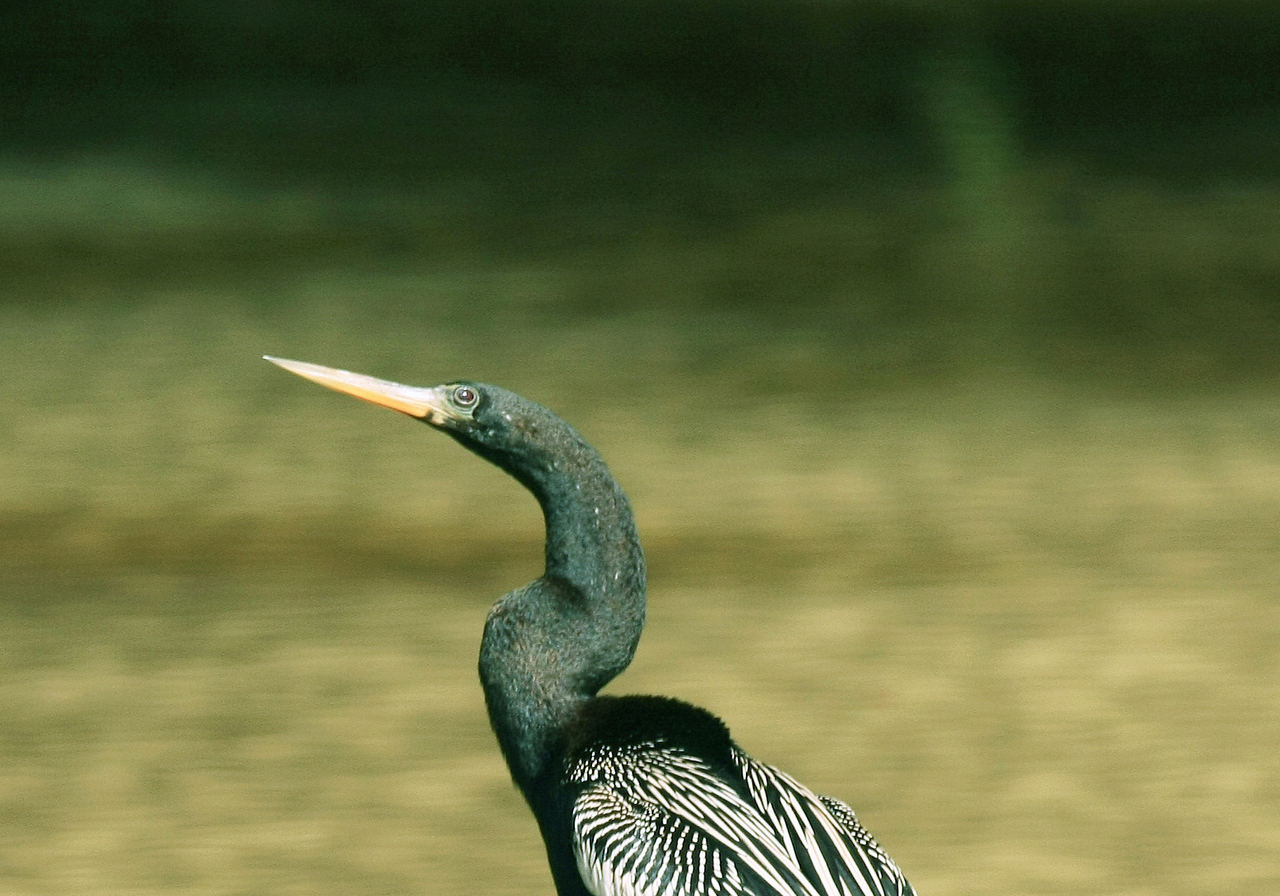
The anhinga (Anhinga anhinga) is a bird of the family Anhingidae, in the order Suliformes.
Quick answer
The anhinga (Anhinga anhinga) is a long-necked waterbird of the Americas that swims with only its snake-like head and neck above water, earning it the name 'snakebird'. It spears fish with its sharp, serrated bill using a hinge in its neck, then perches with wings spread to dry them. It averages 85 cm long and 1.35 kg and is listed as Least Concern.
Top questions about the Anhinga
Anhinga facts at a glance
- Weight 1.4 kg
- Length 85 cm
| Scientific name | Anhinga anhinga |
|---|---|
| Other names | Snakebird, water turkey |
| Diet | Fish; also aquatic insects, crayfish and frogs |
| Habitat | Calm, shallow fresh water: swamps, lakes and slow rivers |
| Size | Average 85 cm long; wingspan about 117 cm |
| Weight | Average about 1.35 kg |
| Conservation status | Least Concern (IUCN Red List, assessed 2025) |
| Kingdom | Animalia |
|---|---|
| Phylum | Chordata |
| Class | Aves |
| Order | Suliformes |
| Family | Anhingidae |
| Genus | Anhinga |
Where it lives
The anhinga (Anhinga anhinga) is native to South-eastern United States and western Mexico through Central America and the Caribbean to northern Argentina. — recorded across North America, South America in this guide’s range summary.
For occurrence records, see GBIF species search and sources below.
How big is a anhinga?
An adult anhinga measures 85 cm long — about 49% of the height of an average adult person (1.73 m) — and weighs around 1.4 kg, about 2% of an average adult’s body weight (70 kg).
Length vs an average adult’s height (to scale)
What is a baby anhinga called?
Baby name
A baby Anhinga is called a chick.
Explore more animal collective nouns and baby animal names .
Spearfishing
Anhingas hunt underwater, stalking slowly among plants. A hinge-like arrangement of the 8th and 9th neck vertebrae lets the neck shoot forward to stab fish with the long, sharp, serrated bill. The bird then surfaces, flips the fish into the air and swallows it head first.
Wet feathers
Anhinga feathers soak up water, which reduces buoyancy and helps the bird swim low. Afterwards it must perch with wings spread to dry them and absorb the sun's warmth.
Identification
Males are glossy greenish-black with silvery-white streaks and spots on the back and wings; females have a buff head and neck. The long, fan-shaped tail and thin neck set them apart from cormorants, which have hooked bills.
Status
BirdLife International lists the anhinga as Least Concern (2025), estimating 33,300 to 133,000 mature birds; the trend is unknown. It ranges from the south-eastern United States through Mexico, Central America and the Caribbean to northern Argentina.
Explore the Anhinga
Close relatives
- Blue-footed Booby Same order
- Magnificent Frigatebird Same order
- Northern Gannet Same order
- Chicken Same class
Did you know? Anhinga facts
- Anhingas flip fish into the air before swallowing them head first.
- Their wet feathers help them stay low in the water.
Conservation status of the Anhinga
The anhinga (Anhinga anhinga) is listed as Least Concern on the IUCN Red List. Least Concern (LC) is the IUCN's lowest-risk category, assigned to widespread, abundant species that have been evaluated and found not to be threatened. It does not mean a species faces no pressures — only that it is not currently at risk of extinction.
Anhinga (Anhinga anhinga) was most recently assessed for the IUCN Red List in 2025. Look up on the IUCN Red List .
Frequently asked questions about the Anhinga
Why is the anhinga called a snakebird?
Because when it swims, only its long, thin neck and head show above the water, looking like a snake.
What is the difference between an anhinga and a cormorant?
Anhingas have a straight, pointed bill for spearing fish and a long, fan-shaped tail; cormorants have a hooked bill and a shorter tail.
Why do anhingas spread their wings?
To dry their feathers, which get waterlogged when they swim, and to warm up in the sun.
Where do anhingas live?
In warm fresh waters from the south-eastern United States to northern Argentina.
What is a baby anhinga called?
A baby Anhinga is called a chick.
Sources & references
This guide is compiled and reviewed against established zoological and conservation references. Key sources for the Anhinga:
-
IUCN Red List of Threatened Species
Conservation status (Least Concern) reflects the IUCN Red List category for Anhinga anhinga, most recently assessed in 2025.
-
iNaturalist — observations & photos
Search citizen-science observations and community IDs for Anhinga anhinga. Useful for range checks and recent sightings — not a substitute for formal Red List status.
-
GBIF — occurrence data
Global Biodiversity Information Facility species search for Anhinga anhinga. Explore published occurrence records used in range research.
-
eBird — bird observations
Cornell Lab eBird target search for Anhinga. Check recent checklists and seasonal abundance where birders report this species.
- BirdLife International (2026). Species factsheet: Anhinga Anhinga anhinga. BirdLife DataZone. Checked 1 November 2026.
IUCN Red List category Least Concern (assessed 2025), population estimate and trend.
- Animal Diversity Web: Anhinga anhinga. University of Michigan Museum of Zoology.
Size, lifespan and behaviour.
- Tobias, J. A. et al. (2022). AVONET: morphological, ecological and geographical data for all birds. Ecology Letters 25: 581–597. doi:10.1111/ele.13898
Average body mass.
- Gill, F., Donsker, D. & Rasmussen, P. (Eds). IOC World Bird List v15.2.
English and scientific name, classification and range.
-
Global Animal Guide editorial standards
How we research, source, review, and update every guide for accuracy.