Image sourcing: see credits & licences
The yak (Bos grunniens) is a mammal of the family Bovidae, in the order Artiodactyla.
Quick answer
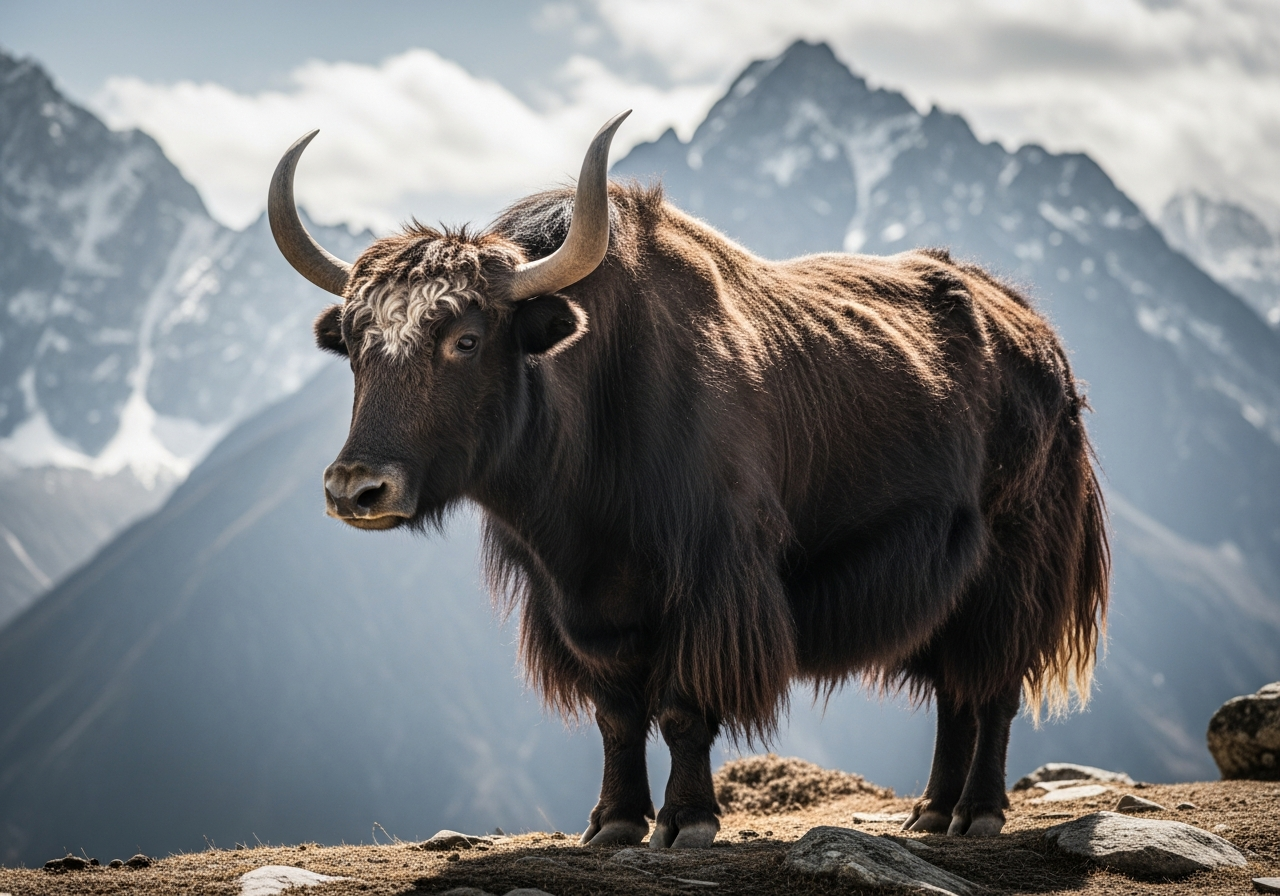
The yak is a large, long-haired ox adapted to the cold, thin air of the Himalayas and Tibetan Plateau. Domestic yaks are vital pack animals that provide milk, meat, and wool, while the larger wild yak is listed as Vulnerable. Yaks thrive above 4,000 m (13,000 ft) and live around 20 years.
Top questions about the Yak
Yak facts at a glance
- Weight 600 kg
- Length 3.3 m
- Top speed 40 km/h
- Lifespan 22 years
| Scientific name | Bos grunniens (domestic), Bos mutus (wild) |
|---|---|
| Diet | Herbivore |
| Habitat | High mountain plateau and alpine tundra |
| Lifespan | About 20 years |
| Weight | 300–1,000 kg (660–2,200 lb) |
| Top speed | Around 40 km/h (25 mph) |
| Conservation status | Wild yak: Vulnerable (IUCN) |
| Kingdom | Animalia |
|---|---|
| Phylum | Chordata |
| Class | Mammalia |
| Order | Artiodactyla |
| Family | Bovidae |
| Genus | Bos |
Where it lives
The yak (Bos grunniens) is native to High mountains and plateaus of Central Asia, especially the Himalayas and the Tibetan Plateau. — recorded across Asia in this guide’s range summary.
For occurrence records, see GBIF species search and sources below.
How big is a yak?
An adult yak measures 3.3 m long — about 1.9× the height of an average adult person (1.73 m) — and weighs around 600 kg, about 8.6× an average adult’s body weight (70 kg).
Length vs an average adult’s height (to scale)
What is a group of yaks called?
Group name (collective noun)
A group of Yaks is called a herd.
Baby name
A baby Yak is called a calf.
Explore more animal collective nouns and baby animal names .
Built for thin, freezing air
Yaks are superbly adapted to high altitude. A dense, shaggy coat and a thick undercoat keep out cold that would kill most cattle, while large lungs and oxygen-rich blood let them work in air too thin for lowland animals. They are most comfortable in the cold and can overheat at low elevations.
The mountain workhorse
For the peoples of the Himalayas and Tibetan Plateau, the domestic yak is indispensable. It carries loads across high passes, plows fields, and provides milk, butter, meat, wool, and even dung for fuel. Yaks grunt rather than moo, which gives the wild species its name, Bos mutus, the 'mute ox.'
Wild yaks
Wild yaks are much larger and darker than their domestic cousins, with bulls standing around 2 m (6.5 ft) at the shoulder. They roam remote, treeless uplands in herds and are far more formidable, capable of defending themselves against wolves.
Conservation
While domestic yaks number in the millions, the wild yak is listed as Vulnerable, reduced by hunting and by competition and interbreeding with domestic herds. Remote protected areas on the Tibetan Plateau are key to the wild yak's future.
Dig deeper into the Yak
- Are Yaks Endangered?
Are yaks endangered? Status Vulnerable, main threats, and what protection means.
- How Long Do Yaks Live?
Yak lifespan is typically About 20 years. What shortens or extends life, life stages, and status (Vulnerable).
- What Do Yaks Eat?
What yaks eat: Herbivore, foraging style, and seasonal shifts in High mountain plateau and alpine tundra.
- Where Do Yaks Live?
Where yaks live: High mountain plateau and alpine tundra, native range cues, and human overlap. Status Vulnerable.
Explore the Yak
Compare
Close relatives
- Cow Same genus
- Wildebeest Same family
- Domestic Goat Same family
- Saiga Antelope Same family
Collections
Range & geography
Did you know? Yak facts
- The yak is a large, long-haired ox adapted to the cold, thin air of the Himalayas and Tibetan Plateau.
- Yaks live on the high mountains and plateaus of Central Asia, especially the Himalayas and the Tibetan Plateau, often above 4,000 m (13,000 ft).
- Domestic yaks are used as pack and plow animals and provide milk, butter, meat, wool, and dung for fuel, making them central to life in the high mountains.
- Domestic yaks are abundant, but the larger wild yak is listed as Vulnerable due to hunting and competition with domestic herds.
- Yaks have large lungs, oxygen-rich blood, and a thick shaggy coat, letting them work and stay warm in cold, thin mountain air where other cattle cannot.
- Conservation: Wild yak: Vulnerable (IUCN).
Diet & feeding
Yak feeds primarily as a herbivore. Yaks are superbly adapted to high altitude. A dense, shaggy coat and a thick undercoat keep out cold that would kill most cattle, while large lungs and oxygen-rich blood let them work in air too thin for lowland animals. They are most comfortable in the cold and can overheat at low e
Adaptations
- Yaks are superbly adapted to high altitude. A dense, shaggy coat and a thick undercoat keep out cold that would kill most cattle, while large lungs and oxygen-rich blood let them work in air too thin for lowland animals. They are most comfortable in the cold and can overheat at low elevations.
- For the peoples of the Himalayas and Tibetan Plateau, the domestic yak is indispensable. It carries loads across high passes, plows fields, and provides milk, butter, meat, wool, and even dung for fuel. Yaks grunt rather than moo, which gives the wild species its name, Bos mutus, the 'mute ox.'
Behaviour & ecology
- Yaks are superbly adapted to high altitude. A dense, shaggy coat and a thick undercoat keep out cold that would kill most cattle, while large lungs and oxygen-rich blood let them work in air too thin for lowland animals. They are most comfortable in the cold and can overheat at low elevations.
- For the peoples of the Himalayas and Tibetan Plateau, the domestic yak is indispensable. It carries loads across high passes, plows fields, and provides milk, butter, meat, wool, and even dung for fuel. Yaks grunt rather than moo, which gives the wild species its name, Bos mutus, the 'mute ox.'
- Wild yaks are much larger and darker than their domestic cousins, with bulls standing around 2 m (6.5 ft) at the shoulder. They roam remote, treeless uplands in herds and are far more formidable, capable of defending themselves against wolves.
Communication
- Yak uses scent, posture, and vocal signals to mark territory and coordinate social behaviour.
- Communication intensity often peaks during breeding seasons and territorial disputes.
Habitat & range
High mountain plateau and alpine tundra
Ecological role
Yak shapes vegetation through grazing or browsing and serves as prey for larger predators where ranges overlap.
Conservation status of the Yak
The yak (Bos grunniens) is listed as Vulnerable on the IUCN Red List. Vulnerable (VU) means a species faces a high risk of extinction in the medium-term future. It is the lowest-risk of the three 'threatened' IUCN categories — one step below Endangered, which is itself below Critically Endangered — and is often an early warning that a population is in trouble.
The yak (Bos grunniens) is assessed on the IUCN Red List. Look up on the IUCN Red List .
Frequently asked questions about the Yak
Where do yaks live?
Yaks live on the high mountains and plateaus of Central Asia, especially the Himalayas and the Tibetan Plateau, often above 4,000 m (13,000 ft).
What are yaks used for?
Domestic yaks are used as pack and plow animals and provide milk, butter, meat, wool, and dung for fuel, making them central to life in the high mountains.
Are yaks endangered?
Domestic yaks are abundant, but the larger wild yak is listed as Vulnerable due to hunting and competition with domestic herds.
How do yaks survive high altitude?
Yaks have large lungs, oxygen-rich blood, and a thick shaggy coat, letting them work and stay warm in cold, thin mountain air where other cattle cannot.
Do yaks moo?
Yaks grunt rather than moo, which is why the wild yak's scientific name, Bos mutus, means the 'mute ox.'
What is a group of yaks called?
A group of Yaks is called a herd.
What is a baby yak called?
A baby Yak is called a calf.
Sources & references
This guide is compiled and reviewed against established zoological and conservation references. Key sources for the Yak:
-
IUCN Red List of Threatened Species
Conservation status (Vulnerable) reflects the IUCN Red List category for Bos grunniens.
-
iNaturalist — observations & photos
Search citizen-science observations and community IDs for Bos grunniens. Useful for range checks and recent sightings — not a substitute for formal Red List status.
-
GBIF — occurrence data
Global Biodiversity Information Facility species search for Bos grunniens. Explore published occurrence records used in range research.
- IUCN Red List — Bos grunniens.
Conservation status (Vulnerable) and population trends.
- Animal Diversity Web — Bos grunniens. University of Michigan Museum of Zoology.
Life history, morphology, and range.
- Wikipedia — Yak.
General taxonomy and overview (cross-check primary sources).
-
Global Animal Guide editorial standards
How we research, source, review, and update every guide for accuracy.