Image sourcing: see credits & licences
Quick answer
The tiger shark (Galeocerdo cuvier) is a large predatory shark of warm coastal and open tropical seas, named for the dark vertical bars that mark young animals. It grows to around 3 to 5 m and can weigh up to about 600 kg, swimming steadily on long-distance patrols and reaching bursts of up to 32 km/h (20 mph). An indiscriminate feeder with an extremely varied diet, it typically lives 20 to 30 years and is listed as Near Threatened.
Top questions about the Tiger Shark
Tiger Shark facts at a glance
- Weight 600 kg
- Length 5 m
- Top speed 32 km/h
- Lifespan 27 years
| Scientific name | Galeocerdo cuvier |
|---|---|
| Diet | Carnivore (highly varied) |
| Habitat | Warm coastal and open tropical seas |
| Lifespan | 20–30 years |
| Length | 3–5 m (10–16 ft), sometimes larger |
| Top speed | Up to 32 km/h (20 mph) in bursts |
| Conservation status | Near Threatened (IUCN) |
| Kingdom | Animalia |
|---|---|
| Phylum | Chordata |
| Class | Chondrichthyes |
| Order | Carcharhiniformes |
| Family | Galeocerdidae |
| Genus | Galeocerdo |
Where it lives
The tiger shark (Galeocerdo cuvier) is native to Warm coastal and open waters of tropical and subtropical oceans worldwide. — recorded across Oceans in this guide’s range summary.
For occurrence records, see GBIF species search and sources below.
How big is a tiger shark?
An adult tiger shark measures 5 m long — about 2.9× the height of an average adult person (1.73 m) — and weighs around 600 kg, about 8.6× an average adult’s body weight (70 kg).
Length vs an average adult’s height (to scale)
What is a group of tiger sharks called?
Group name (collective noun)
A group of Tiger Sharks is called a shiver. It is also known as a school.
Baby name
A baby Tiger Shark is called a pup.
Explore more animal collective nouns and baby animal names .
Appearance and identification
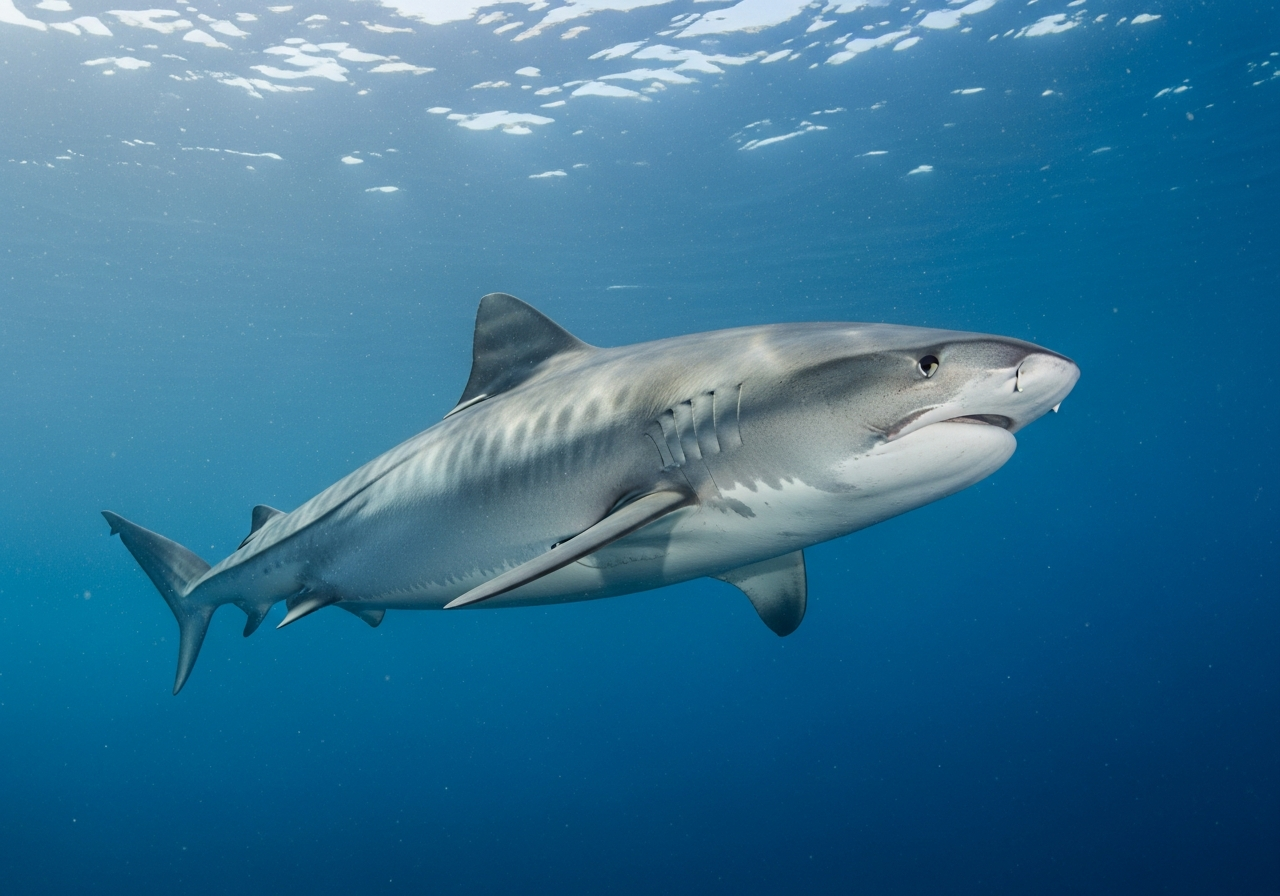
The tiger shark takes its name from the dark vertical stripes along its flanks, boldest in juveniles and fading as the animal matures. It has a broad, blunt snout, a heavy body, and distinctive serrated, cockscomb-shaped teeth that can shear through bone and turtle shell. Adults commonly reach 3 to 5 m, with exceptional individuals larger still, and can weigh up to around 600 kg. Its blue-grey to greenish upper body over a pale belly is typical countershading that hides it from prey above and below.
Diet and feeding
Tiger sharks have one of the most varied diets of any shark, earning a reputation as the ocean's scavengers. They hunt fish, sea turtles, seabirds, seals, rays, and smaller sharks, and readily take carrion and injured animals. Their strong, serrated teeth let them tackle hard-shelled prey such as turtles that most predators cannot handle. They are also notorious for swallowing indigestible rubbish, and stomach contents have included tyres, licence plates, and other human debris.
Habitat and range
Tiger sharks live in warm and tropical waters worldwide, from shallow coastal shelves and river mouths to the open ocean. They favour murky inshore waters, reefs, and lagoons, but range widely and undertake long seasonal migrations across thousands of kilometres. Satellite tracking has shown individuals crossing entire ocean basins between feeding and breeding areas. They tend to move into shallower water at night to hunt and retreat to deeper water by day.
Reproduction and young
Tiger sharks are ovoviviparous: the eggs develop and hatch inside the mother, which then gives birth to live, fully formed pups. Litters are unusually large for a shark, often numbering several dozen and sometimes many more. The young, typically 50 to 75 cm at birth, are independent immediately and receive no parental care. This slow-maturing species takes years to reach breeding age, which makes its populations vulnerable to overfishing.
Behaviour and movement
Tiger sharks are mostly solitary and cover huge distances with a slow, energy-efficient cruising swim. They are capable of sudden acceleration, reaching bursts of up to 32 km/h (20 mph) when striking at prey. Highly sensitive electroreceptors and a keen sense of smell let them detect struggling or wounded animals from a distance. Largely nocturnal hunters, they patrol tirelessly and investigate almost anything they encounter.
Conservation and threats
The tiger shark is listed as Near Threatened by the IUCN, with numbers declining in many regions. It is caught both deliberately and as bycatch, targeted for its fins, skin, liver oil, and flesh, and killed in shark-control programmes near popular beaches. Its late maturity and slow reproduction mean populations recover only slowly once depleted. Reducing targeted fishing and bycatch is central to keeping the species stable.
Dig deeper into the Tiger Shark
- Are Tiger Sharks Dangerous?
Are tiger sharks dangerous? Realistic risk, when incidents rise, and safety basics.
- How Long Do Tiger Sharks Live?
Tiger Shark lifespan is typically 20–30 years. What shortens or extends life, life stages, and status (Near Threatened).
- Tiger Shark: Key Facts
Tiger Sharks (Galeocerdo cuvier) are fish found across multiple regions. The wide-ranging scavenger of warm seas.
- What Do Tiger Sharks Eat?
What tiger sharks eat: Carnivore (highly varied), foraging style, and seasonal shifts in Warm coastal and open tropical seas.
- Where Do Tiger Sharks Live?
Where tiger sharks live: Warm coastal and open tropical seas, native range cues, and human overlap. Status Near Threatened.
Explore the Tiger Shark
Related Fishs
Range & geography
Did you know? Tiger Shark facts
- The tiger shark is a large predatory shark of warm coastal and open waters worldwide, named for the dark vertical stripes on young animals.
- Young tiger sharks have dark vertical bars along their bodies that resemble a tiger's stripes. These markings fade as the shark grows older and larger.
- Tiger sharks have an extremely varied diet that includes fish, seals, sea turtles, seabirds, dolphins, rays, and other sharks, and they sometimes swallow inedible debris.
- Tiger sharks are among the species most often involved in bites on people, but attacks are still rare. Their size, power, and broad diet make caution sensible in areas where they are common.
- Tiger sharks commonly reach 3 to 5 m (10 to 16 ft) long, and exceptional individuals can grow larger and weigh several hundred kilograms.
- Conservation: Near Threatened (IUCN).
Diet & feeding
Tiger Shark feeds primarily as a carnivore (highly varied). Tiger sharks have one of the most varied diets of any shark, eating fish, seals, sea turtles, seabirds, dolphins, rays, and other sharks. They are also notorious for swallowing indigestible objects, which is why they are sometimes called the garbage cans of th
Adaptations
- Tiger sharks are mostly solitary, nocturnal hunters that patrol large areas of coastline and open water, moving between deep and shallow habitats. Young tiger sharks have bold dark stripes that fade as they mature, giving the species its name. They have powerful, serrated teeth capable of cutting through tough material such as sea turtle shells.
- Tiger sharks have one of the most varied diets of any shark, eating fish, seals, sea turtles, seabirds, dolphins, rays, and other sharks. They are also notorious for swallowing indigestible objects, which is why they are sometimes called the garbage cans of the sea. This broad diet lets them thrive in many habitats and adapt to changing prey.
Behaviour & ecology
- Tiger sharks are mostly solitary, nocturnal hunters that patrol large areas of coastline and open water, moving between deep and shallow habitats. Young tiger sharks have bold dark stripes that fade as they mature, giving the species its name. They have powerful, serrated teeth capable of cutting through tough material such as sea turtle shells.
- Tiger sharks have one of the most varied diets of any shark, eating fish, seals, sea turtles, seabirds, dolphins, rays, and other sharks. They are also notorious for swallowing indigestible objects, which is why they are sometimes called the garbage cans of the sea. This broad diet lets them thrive in many habitats and adapt to changing prey.
- Tiger sharks live in tropical and warm-temperate seas around the world, from shallow reefs and lagoons to the open ocean. They often move into coastal waters at night to hunt and retreat to deeper water during the day. Some individuals make long migrations between feeding areas across entire ocean basins.
Communication
- Lateral-line and visual cues coordinate schooling, courtship, or territorial behaviour.
- Some species produce low-frequency sounds or drumming for spawning or defence.
Habitat & range
Warm coastal and open tropical seas
Ecological role
Tiger Shark acts as a predator that helps regulate prey populations and maintain balance in warm coastal and open tropical seas.
Conservation status of the Tiger Shark
The tiger shark (Galeocerdo cuvier) is listed as Near Threatened on the IUCN Red List. Near Threatened (NT) means a species does not yet qualify as threatened but is close to it, or likely to become so in the near future without ongoing conservation. It is a watch-list category just below Vulnerable.
The tiger shark (Galeocerdo cuvier) is assessed on the IUCN Red List. Look up on the IUCN Red List .
Frequently asked questions about the Tiger Shark
How big do tiger sharks get?
Tiger sharks commonly reach 3 to 5 m in length and can weigh up to around 600 kg, with some individuals growing even larger. This makes them one of the biggest predatory sharks, behind the great white and a handful of others.
Why is it called a tiger shark?
The name comes from the dark vertical bars or stripes along its sides, which resemble a tiger's markings. These stripes are boldest in young sharks and gradually fade as the animal grows older and larger.
What do tiger sharks eat?
Tiger sharks are carnivores with an exceptionally varied diet, eating fish, sea turtles, seabirds, seals, rays, and smaller sharks, as well as carrion. Their serrated teeth can crack turtle shells, and they are notorious for swallowing indigestible human litter.
Are tiger sharks dangerous to humans?
Tiger sharks are among the shark species most often involved in bites on people, partly because they hunt in shallow coastal water and investigate unfamiliar objects. Even so, attacks are rare, and the sharks do not deliberately seek out humans as prey.
How fast can a tiger shark swim?
Tiger sharks usually cruise slowly to conserve energy but can reach bursts of up to 32 km/h (20 mph) when attacking prey. They rely on stealth and sudden acceleration rather than sustained high-speed chases.
Are tiger sharks endangered?
Tiger sharks are classified as Near Threatened by the IUCN, meaning they are close to qualifying as threatened. Fishing for their fins and flesh, bycatch, and beach shark-control programmes are the main pressures on their numbers.
What is a group of tiger sharks called?
A group of Tiger Sharks is called a shiver. It is also known as a school.
What is a baby tiger shark called?
A baby Tiger Shark is called a pup.
Sources & references
This guide is compiled and reviewed against established zoological and conservation references. Key sources for the Tiger Shark:
-
IUCN Red List of Threatened Species
Conservation status (Near Threatened) reflects the IUCN Red List category for Galeocerdo cuvier.
-
iNaturalist — observations & photos
Search citizen-science observations and community IDs for Galeocerdo cuvier. Useful for range checks and recent sightings — not a substitute for formal Red List status.
-
GBIF — occurrence data
Global Biodiversity Information Facility species search for Galeocerdo cuvier. Explore published occurrence records used in range research.
- IUCN Red List — Galeocerdo cuvier.
Conservation status (Near Threatened) and population trends.
- Animal Diversity Web — Galeocerdo cuvier. University of Michigan Museum of Zoology.
Life history, morphology, and range.
- Wikipedia — Tiger Shark.
General taxonomy and overview (cross-check primary sources).
-
Global Animal Guide editorial standards
How we research, source, review, and update every guide for accuracy.