Blobfish
Psychrolutes marcidus
Quick answer
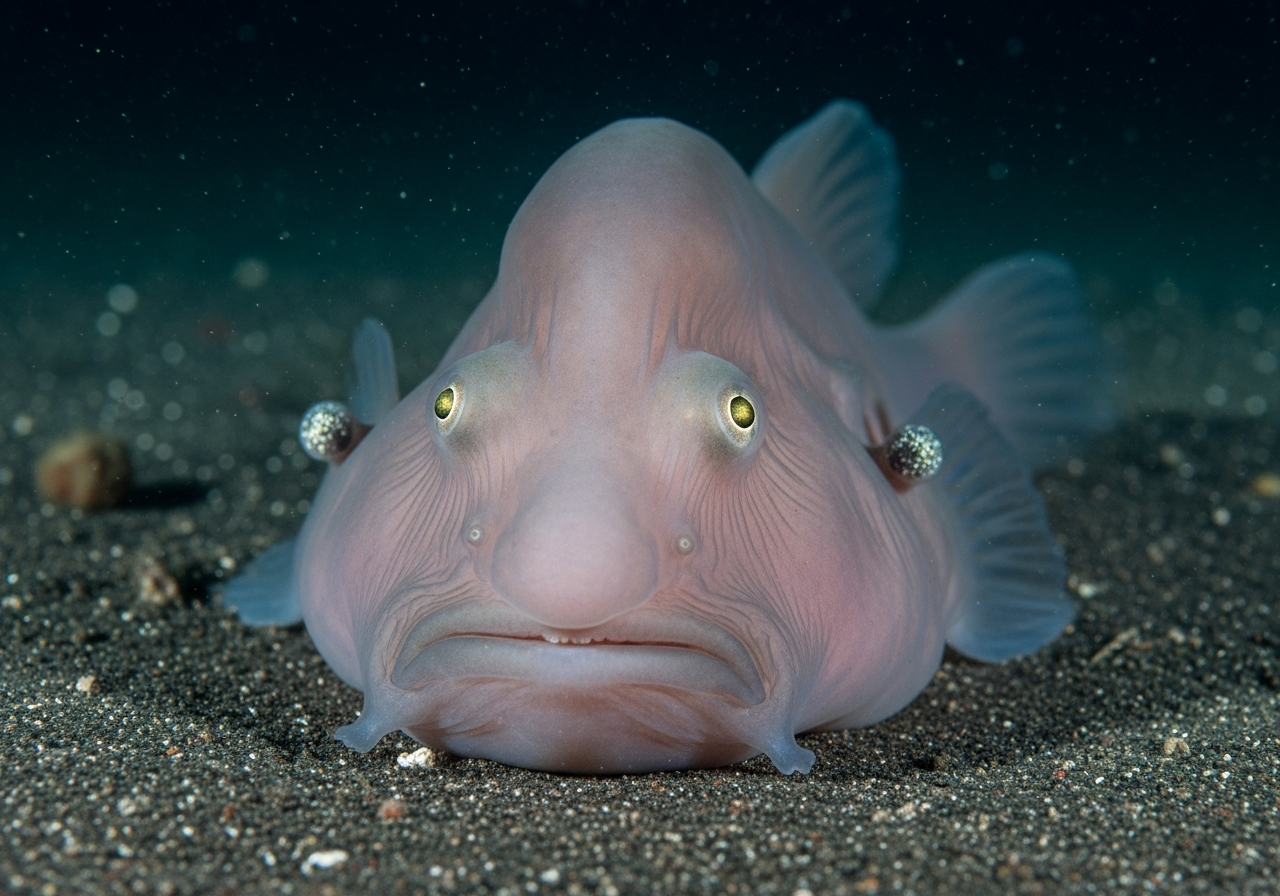
Blobfishs (Psychrolutes marcidus) are fishs found across multiple regions. The deep-sea fish that only looks like a blob out of water. Adults typically weigh roughly 2 kg (4 lb), reach speeds of up to 0.5 km/h (0 mph), and live about 25 years in the wild. They feed on carnivore (passive sit-and-wait feeder) and are listed as Not Evaluated on the IUCN Red List. Deep waters off southern Australia and New Zealand at depths of 600–1,200 m.
Blobfish facts at a glance
| Scientific name | Psychrolutes marcidus |
|---|---|
| Diet | Carnivore (passive sit-and-wait feeder) |
| Habitat | Deep sea, 600–1,200 m depth |
| Depth range | 600–1,200 m (2,000–4,000 ft) |
| Length | Up to about 30 cm (12 in) |
| Conservation status | Not formally assessed (IUCN) |
| Famous for | Voted world's ugliest animal in 2013 |
| Kingdom | Animalia |
|---|---|
| Phylum | Chordata |
| Class | Actinopterygii |
| Order | Scorpaeniformes |
| Family | Psychrolutidae |
| Genus | Psychrolutes |
Where it lives
Deep waters off southern Australia and New Zealand at depths of 600–1,200 m.
What is a group of blobfish called?
Group name (collective noun)
A group of Blobfish is called a school.
Baby name
A baby Blobfish is called a fry.
Explore more animal collective nouns and baby animal names .
Range and habitat
Blobfish inhabit Deep waters off southern Australia and New Zealand at depths of 600–1,200 m. Their preferred habitat includes deep sea, 600–1,200 m depth, where they find food, shelter, and breeding sites. Population density varies with prey availability, water access, and human disturbance. Protected areas and intact corridors remain essential for long-term persistence across multiple regions.
Physical characteristics and behaviour
Adult blobfish typically measure about 0.3 m in length and weigh roughly 2 kg (4 lb). They can sprint at up to 0.5 km/h (0 mph) when hunting or escaping predators. Blobfishs are known for the deep-sea fish that only looks like a blob out of water — social structure, daily activity, and seasonal movements all reflect pressures in their native environment.
Diet and ecological role
Blobfish feed primarily on carnivore (passive sit-and-wait feeder). Foraging strategy depends on season, local prey or plant abundance, and competition with other species. As fishs, they play a measurable role in their ecosystem — controlling prey numbers, dispersing seeds, or shaping habitat through feeding and movement patterns that other wildlife depends on.
Conservation and human interaction
The IUCN lists blobfish as Not Evaluated. Habitat loss, hunting, climate change, and conflict with people are among the main threats worldwide. Responsible ecotourism, anti-poaching patrols, and community-based conservation help in parts of their range. Never approach or feed wild blobfish — observe from a safe distance and support reputable conservation organisations.
Dig deeper into the Blobfish
- Blobfish Facts 4
Dig deeper into blobfish — blobfish facts 4.
- Blobfish Facts 5
Dig deeper into blobfish — blobfish facts 5.
- How Long do Blobfish Live?
Dig deeper into blobfish — how long do blobfish live.
- What do Blobfish Eat
Dig deeper into blobfish — what do blobfish eat.
- Where do Blobfish Live?
Dig deeper into blobfish — where do blobfish live.
Explore the Blobfish
Related Fishs
Collections
Range & geography
Did you know? Blobfish facts
- The blobfish (Psychrolutes marcidus) is a deep-sea fish found off southern Australia and New Zealand at depths of 600–1,200 m.
- Yes. The blobfish is a genuine deep-sea fish. The viral photos show a specimen brought to the surface, where the dramatic pressure change deforms its body into the famous blob shape.
- At its natural depth, the blobfish looks like a small, round-bodied, fairly unremarkable fish. The extreme droopiness only appears when it is removed from the high-pressure environment it evolved for.
- It is not a food fish. Its watery, gelatinous flesh has no culinary appeal, and it is far too deep-living to be commercially targeted. Any specimens caught are almost always accidental bycatch.
- It is not currently on the IUCN Red List, but its slow reproductive rate and vulnerability to deep-sea trawling make it worth monitoring. Its deep habitat offers some protection simply because fishing at those depths is expensive and uncommon.
- Conservation: Not formally assessed (IUCN).
Diet & feeding
Blobfish feeds primarily as a carnivore (passive sit-and-wait feeder). The blobfish is a passive feeder, drifting slowly over the seafloor and engulfing whatever edible matter comes within reach — sea urchins, crustaceans, molluscs, and organic particles that sink from above. It barely moves, which suits the food-scarc
Adaptations
- The blobfish lives where water pressure is 60–120 times higher than at the surface. Its body is made of low-density, gelatinous flesh that is only slightly less dense than seawater, allowing it to hover just above the seabed without a gas-filled swim bladder (which would collapse under such pressure). When trawled to the surface, the sudden pressure drop causes that soft body to expand and collapse into the famous droopy, big-nosed blob. At depth, in its natural environment, it looks like a fairly ordinary, round-bodied fish.
- The blobfish is a passive feeder, drifting slowly over the seafloor and engulfing whatever edible matter comes within reach — sea urchins, crustaceans, molluscs, and organic particles that sink from above. It barely moves, which suits the food-scarce deep sea perfectly: conserving energy is more important than active hunting when meals are rare and far apart.
Behaviour & ecology
- The blobfish lives where water pressure is 60–120 times higher than at the surface. Its body is made of low-density, gelatinous flesh that is only slightly less dense than seawater, allowing it to hover just above the seabed without a gas-filled swim bladder (which would collapse under such pressure). When trawled to the surface, the sudden pressure drop causes that soft body to expand and collapse into the famous droopy, big-nosed blob. At depth, in its natural environment, it looks like a fairly ordinary, round-bodied fish.
- The blobfish is a passive feeder, drifting slowly over the seafloor and engulfing whatever edible matter comes within reach — sea urchins, crustaceans, molluscs, and organic particles that sink from above. It barely moves, which suits the food-scarce deep sea perfectly: conserving energy is more important than active hunting when meals are rare and far apart.
- Blobfish are found in deep waters off the coasts of Australia and New Zealand, at depths of roughly 600 to 1,200 m. They live on soft sediment seabeds where they rest motionless or drift just above the bottom. Because of the extreme depth, very few specimens have ever been observed alive and in situ — most encounters come from deep-sea trawl bycatch.
Communication
- Lateral-line and visual cues coordinate schooling, courtship, or territorial behaviour.
- Some species produce low-frequency sounds or drumming for spawning or defence.
Habitat & range
Deep sea, 600–1,200 m depth
Ecological role
Blobfish acts as a predator that helps regulate prey populations and maintain balance in deep sea, 600–1,200 m depth.
Frequently asked questions about the Blobfish
Where do blobfish live?
Blobfish are native to multiple regions. Deep waters off southern Australia and New Zealand at depths of 600–1,200 m.
What do blobfish eat?
They feed on carnivore (passive sit-and-wait feeder), adjusting seasonally based on what is available in Deep sea.
How long do blobfish live?
about 25 years in the wild. Captive individuals sometimes live longer with veterinary care and steady nutrition.
How big is a blobfish?
Adults weigh roughly 2 kg (4 lb) and reach roughly 0.3 metres long; males are often larger than females.
Are blobfish endangered?
Blobfish are listed as Not Evaluated on the IUCN Red List. Threats include habitat loss, hunting, and human-wildlife conflict.
How fast can a blobfish run?
Blobfish can reach about 0.5 km/h (0 mph) in short bursts.
What is a group of blobfish called?
A group of Blobfish is called a school.
What is a baby blobfish called?
A baby Blobfish is called a fry.
Sources & references
This guide is compiled and reviewed against established zoological and conservation references. Key sources for the Blobfish:
-
IUCN Red List of Threatened Species
Conservation status (Not Evaluated) reflects the IUCN Red List category for Psychrolutes marcidus.
- IUCN Red List — Psychrolutes marcidus.
Conservation status (Not Evaluated) and population trends.
- Animal Diversity Web — Psychrolutes marcidus. University of Michigan Museum of Zoology.
Life history, morphology, and range.
- Wikipedia — Blobfish.
General taxonomy and overview (cross-check primary sources).
-
Global Animal Guide editorial standards
How we research, source, review, and update every guide for accuracy.