Image sourcing: see credits & licences
Quick answer
Stingrays (Myliobatoidei) are flat-bodied fish related to sharks, known for the venomous, barbed spine on their whip-like tails. They swim by rippling their broad, wing-like pectoral fins and live in coastal seas, reefs, and some rivers, with large species spanning up to 2 m across. Bottom-feeders, they eat molluscs, crustaceans, and fish, and can live 15 to 25 years depending on the species. Their conservation status varies from one species to another.
Top questions about the Stingray
Stingray facts at a glance
- Weight 30 kg
- Length 1.5 m
- Top speed 30 km/h
- Lifespan 20 years
| Scientific name | Myliobatoidei |
|---|---|
| Diet | Carnivore (mollusks, crustaceans, fish) |
| Habitat | Coastal seas, reefs, and some rivers |
| Lifespan | 15–25 years by species |
| Length | Varies; up to 2 m (6.5 ft) wide in large species |
| Top speed | Glides; fast burst when alarmed |
| Conservation status | Varies by species |
| Kingdom | Animalia |
|---|---|
| Phylum | Chordata |
| Class | Chondrichthyes |
| Order | Myliobatiformes |
Where it lives
The stingray (Myliobatoidei) is native to Coastal seas, reefs, and some rivers across tropical and temperate waters worldwide. — recorded across Oceans in this guide’s range summary.
For occurrence records, see GBIF species search and sources below.
How big is a stingray?
An adult stingray measures 1.5 m long — about 87% of the height of an average adult person (1.73 m) — and weighs around 30 kg, about 43% of an average adult’s body weight (70 kg).
Length vs an average adult’s height (to scale)
What is a group of stingrays called?
Group name (collective noun)
A group of Stingrays is called a fever. It is also known as a school.
Baby name
A baby Stingray is called a pup.
Explore more animal collective nouns and baby animal names .
Body shape and how they swim
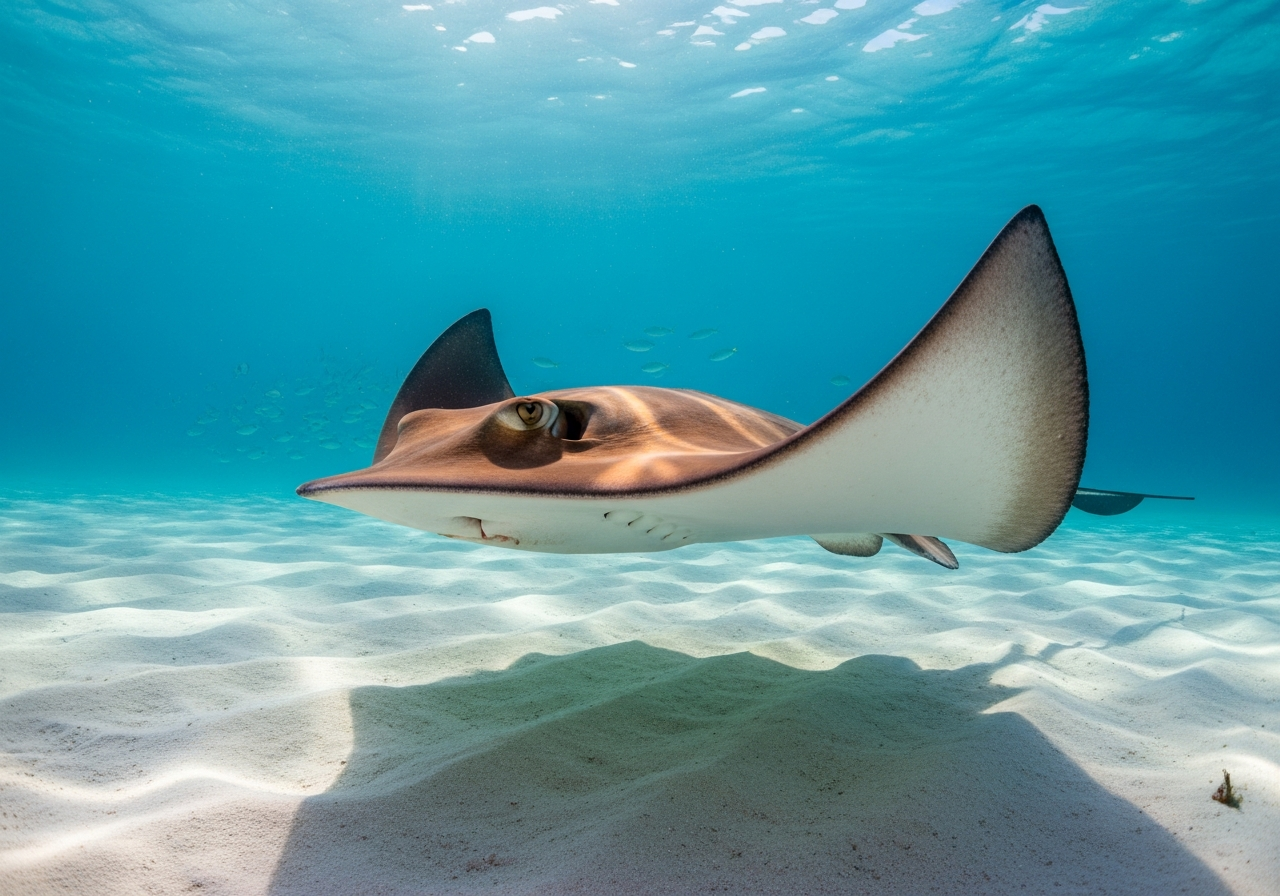
Stingrays are cartilaginous fish, meaning their skeletons are made of cartilage rather than bone, like their shark relatives. Their bodies are flattened into a broad disc, and they swim by rippling the edges of their wide pectoral fins in graceful wave-like motions. Most of the time they glide slowly just above the seabed, but they can produce a fast burst of speed when alarmed. Their eyes sit on top of the body while the mouth and gills are underneath.
The venomous tail
The stingray's defining feature is the barbed spine near the base of its tail, which is coated in venom-producing tissue. The ray uses it purely for defence, whipping the tail upward if a predator or a person steps on it. The wound is intensely painful and, in rare cases involving large rays, can be dangerous. Stingrays are not aggressive and use the sting only when threatened.
Feeding on the seabed
Stingrays are carnivores that feed along the bottom on molluscs, crustaceans, and small fish. Special sensory organs called ampullae of Lorenzini let them detect the faint electrical fields given off by prey hidden in sand. Many species have flattened, plate-like teeth built for crushing shells and hard-bodied invertebrates. They often flap their fins to uncover buried prey before feeding.
Where stingrays live
Stingrays are found in coastal seas and around reefs worldwide, and some species live in freshwater rivers. They favour shallow, sandy areas where they can bury themselves with only their eyes exposed. This camouflage hides them from predators and helps them ambush prey. River stingrays in South America and elsewhere have adapted fully to fresh water.
Reproduction and lifespan
Stingrays give birth to live young rather than laying eggs, with the embryos nourished inside the mother before being born as miniature versions of the adults. Litters are usually small. Depending on the species, stingrays live roughly 15 to 25 years. Large species can grow up to 2 m across the disc.
Conservation across species
Because 'stingray' covers many different species, conservation status varies widely from one to another. Some are common and secure, while others, especially certain freshwater and heavily fished species, face pressure from habitat loss and overfishing. There is no single status for the group as a whole. Assessing each species individually is the only accurate way to judge its risk.
Dig deeper into the Stingray
- How Fast Is A Stingray?
Stingray top speed is about Glides; fast burst when alarmed. Sprint vs endurance and what limits pace.
- How Long Do Stingrays Live?
Stingray lifespan is typically 15–25 years by species. What shortens or extends life, life stages, and status (Least Concern).
- Stingray: Key Facts
Stingrays (Myliobatoidei) are fish found across multiple regions. The flat-bodied ray with a venomous tail.
- What Do Stingrays Eat?
What stingrays eat: Carnivore (mollusks, crustaceans, fish), foraging style, and seasonal shifts in Coastal seas, reefs, and some rivers.
- Where Do Stingrays Live?
Where stingrays live: Coastal seas, reefs, and some rivers, native range cues, and human overlap. Status Least Concern.
Explore the Stingray
Related Fishs
Range & geography
Did you know? Stingray facts
- Stingrays are a group of flattened, cartilaginous fish related to sharks, found in coastal seas, reefs, and some rivers across tropical and temperate waters worldwide.
- Stingrays are not aggressive but can deliver a painful venomous sting in self-defense if stepped on or threatened. Serious injuries are uncommon, and shuffling your feet in shallow water helps avoid stepping on them.
- Most stingrays are carnivores that feed on bottom-dwelling animals such as clams, snails, shrimp, crabs, and small fish, crushing shells with flat, plate-like teeth.
- Yes. Stingrays are cartilaginous fish closely related to sharks, sharing skeletons made of cartilage and the ability to sense the electrical fields of prey.
- Many stingrays have one or more barbed, venomous spines on the tail that they whip upward when threatened. The spines are used only for defense, not for hunting.
- Conservation: Varies by species.
Diet & feeding
Stingray feeds primarily as a carnivore (mollusks, crustaceans, fish). Stingrays are bottom-dwelling fish that swim by rippling or flapping their broad pectoral fins, which form a flat disc shape. They often bury themselves in sand or mud with only their eyes and spiracles showing, both to hide from predators and to am
Adaptations
- Stingrays are bottom-dwelling fish that swim by rippling or flapping their broad pectoral fins, which form a flat disc shape. They often bury themselves in sand or mud with only their eyes and spiracles showing, both to hide from predators and to ambush prey. Like sharks, they sense the faint electrical signals of hidden animals using special organs around the mouth.
- Most stingrays are carnivores that feed on bottom-living animals such as clams, snails, shrimp, crabs, and small fish. They use their flattened bodies to pin prey against the seafloor and crush hard shells with strong, plate-like teeth. Their downward-facing mouths are well suited to feeding along the bottom.
Behaviour & ecology
- Stingrays are bottom-dwelling fish that swim by rippling or flapping their broad pectoral fins, which form a flat disc shape. They often bury themselves in sand or mud with only their eyes and spiracles showing, both to hide from predators and to ambush prey. Like sharks, they sense the faint electrical signals of hidden animals using special organs around the mouth.
- Most stingrays are carnivores that feed on bottom-living animals such as clams, snails, shrimp, crabs, and small fish. They use their flattened bodies to pin prey against the seafloor and crush hard shells with strong, plate-like teeth. Their downward-facing mouths are well suited to feeding along the bottom.
- Many stingrays carry one or more barbed, venomous spines partway along the tail, used purely for defense against predators such as sharks. When stepped on or threatened, a stingray can whip its tail upward and drive the spine into an attacker, delivering painful venom. Most injuries to people happen when waders accidentally step on a hidden ray.
Communication
- Lateral-line and visual cues coordinate schooling, courtship, or territorial behaviour.
- Some species produce low-frequency sounds or drumming for spawning or defence.
Habitat & range
Coastal seas, reefs, and some rivers
Ecological role
Stingray acts as a predator that helps regulate prey populations and maintain balance in coastal seas, reefs, and some rivers.
Conservation status of the Stingray
The stingray (Myliobatoidei) is listed as Least Concern on the IUCN Red List. Least Concern (LC) is the IUCN's lowest-risk category, assigned to widespread, abundant species that have been evaluated and found not to be threatened. It does not mean a species faces no pressures — only that it is not currently at risk of extinction.
The stingray (Myliobatoidei) is assessed on the IUCN Red List. Look up on the IUCN Red List .
Frequently asked questions about the Stingray
Are stingrays dangerous to humans?
Stingrays are not aggressive and only sting in self-defence, usually when accidentally stepped on. The barbed, venomous tail spine can cause an intensely painful wound, and injuries from large rays can occasionally be serious, but most encounters are harmless if the ray is left alone.
What do stingrays eat?
Stingrays are carnivores that feed on the seabed, eating molluscs, crustaceans, and small fish. Many have flat, plate-like teeth for crushing shells, and they use electrical sensors to find prey buried in the sand.
How do stingrays swim?
Stingrays swim by rippling their broad, wing-like pectoral fins in smooth wave motions, gliding just above the seabed. When alarmed, they can produce a quick burst of speed to escape.
How long do stingrays live?
Depending on the species, stingrays typically live around 15 to 25 years. Larger species tend to be among the longer-lived.
Do stingrays live in fresh water?
Most stingrays live in coastal seas and around reefs, but some species have adapted fully to fresh water and live in rivers, including parts of South America. So stingrays occur in both marine and freshwater habitats.
Are stingrays related to sharks?
Yes. Stingrays are cartilaginous fish, meaning their skeletons are made of cartilage rather than bone, the same as sharks. Rays and sharks are close relatives within the same broad group of fish.
What is a group of stingrays called?
A group of Stingrays is called a fever. It is also known as a school.
What is a baby stingray called?
A baby Stingray is called a pup.
Sources & references
This guide is compiled and reviewed against established zoological and conservation references. Key sources for the Stingray:
-
IUCN Red List of Threatened Species
Conservation status (Least Concern) reflects the IUCN Red List category for Myliobatoidei.
-
iNaturalist — observations & photos
Search citizen-science observations and community IDs for Myliobatoidei. Useful for range checks and recent sightings — not a substitute for formal Red List status.
-
GBIF — occurrence data
Global Biodiversity Information Facility species search for Myliobatoidei. Explore published occurrence records used in range research.
- IUCN Red List — Myliobatoidei.
Conservation status (Least Concern) and population trends.
- Wikipedia — Stingray.
General taxonomy and overview (cross-check primary sources).
-
Global Animal Guide editorial standards
How we research, source, review, and update every guide for accuracy.