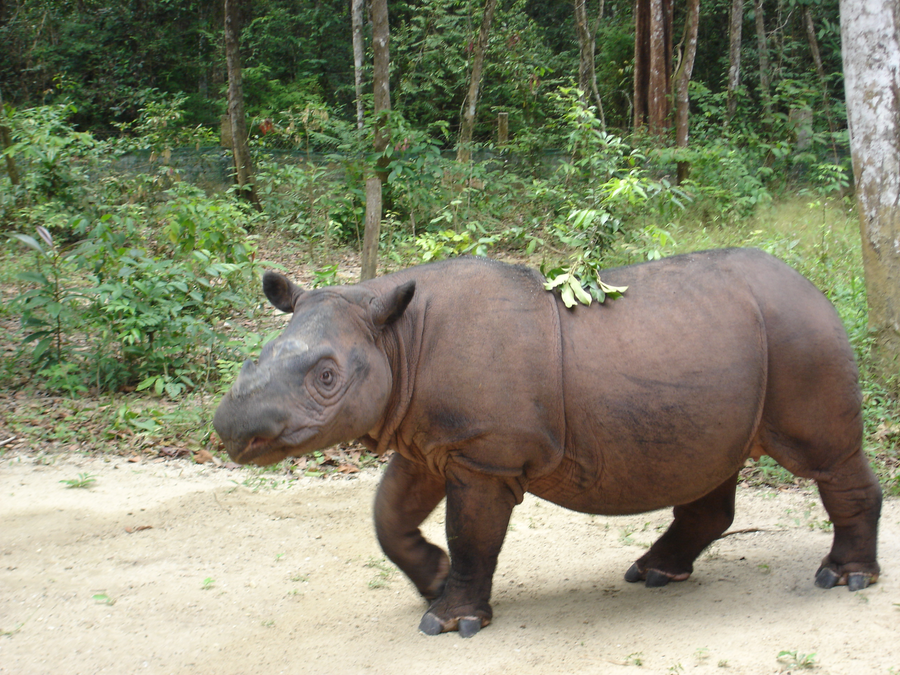
The Sumatran rhinoceros (Dicerorhinus sumatrensis) is a mammal of the rhinoceros family, Rhinocerotidae, in the order Perissodactyla.
Quick answer
The Sumatran rhinoceros (Dicerorhinus sumatrensis) is the smallest and hairiest living rhino, a two-horned rainforest species now reduced to fewer than about 80 animals, nearly all on the island of Sumatra. Weighing 500–960 kg (1,100–2,100 lb), it is the closest living relative of the extinct woolly rhinoceros and is Critically Endangered.
Top questions about the Sumatran Rhinoceros
Also available in Español (Rinoceronte de Sumatra)
Sumatran Rhinoceros facts at a glance
- Weight 800 kg
- Length 2.8 m
- Top speed 40 km/h
- Lifespan 35 years
| Scientific name | Dicerorhinus sumatrensis |
|---|---|
| Diet | Leaves, twigs, shoots, fruit, and sapling bark |
| Habitat | Dense lowland and montane rainforest of Sumatra |
| Lifespan | Around 35–40 years |
| Weight | 500–960 kg (1,100–2,100 lb) |
| Top speed | Agile for a rhino — moves fast through steep forest terrain |
| Conservation status | Critically Endangered (IUCN) |
| Kingdom | Animalia |
|---|---|
| Phylum | Chordata |
| Class | Mammalia |
| Order | Perissodactyla |
| Family | Rhinocerotidae |
| Genus | Dicerorhinus |
Where it lives
The sumatran rhinoceros (Dicerorhinus sumatrensis) is native to Remnant rainforest of Sumatra; formerly across Southeast Asia from India to Borneo. — recorded across Asia in this guide’s range summary.
For occurrence records, see GBIF species search and sources below.
How big is a sumatran rhinoceros?
An adult sumatran rhinoceros measures 2.8 m long — about 1.6× the height of an average adult person (1.73 m) — and weighs around 800 kg, about 11× an average adult’s body weight (70 kg).
Length vs an average adult’s height (to scale)
The hairy rhino
The Sumatran rhino is a forest rhino in miniature: shoulder height of about a metre to a metre and a half, reddish-brown skin with a fringe of hair on the ears and tail, and two horns, the front one far longer than the rear. Calves are born conspicuously woolly, and adults in damp mountain forest keep a noticeable coat.
A relic of the Ice Age
Genetic studies show the Sumatran rhino is the closest living relative of the extinct woolly rhinoceros of Ice Age Eurasia, and its lineage has changed little in millions of years. Within the last two centuries it ranged from India and Bhutan through mainland Southeast Asia to Borneo; now it hangs on in a handful of Sumatran forests.
Solitary forest life
Sumatran rhinos live alone in dense forest, feeding before dawn and at dusk and spending midday submerged in mud wallows that cool the skin and deter parasites. They mark trails with dung and bent saplings, climb steep slopes with ease, and are among the most vocal rhinos, producing eerie whistles and song-like calls.
Diet
A browser of the understorey, it eats the leaves and shoots of saplings, figs and other fallen fruit, and bark, felling young trees by walking over them. A daily intake of around 50 kg of vegetation sustains a body that, while small for a rhino, still weighs up to nearly a tonne.
Reproduction
Breeding is slow even by rhino standards: a single calf after roughly fifteen to sixteen months of gestation, then several years before the next. Breeding remained elusive in zoos for a century until 2001, when a calf was born at Cincinnati Zoo — knowledge that now underpins the Sumatran Rhino Sanctuary programme in Way Kambas, which has produced several calves.
Conservation
With fewer than about 80 individuals scattered in tiny, isolated groups, the Sumatran rhino is Critically Endangered. The greatest danger is no longer only poaching but sheer rarity — groups are so small and dispersed that breeding has nearly stopped in the wild. Indonesia's emergency strategy captures wild rhinos into fenced sanctuaries to form an insurance breeding population alongside habitat protection.
Explore the Sumatran Rhinoceros
Close relatives
- Indian Rhinoceros Same family
- Rhinoceros Same family
- Black Rhinoceros Same family
- White Rhinoceros Same family
Collections
Conservation status of the Sumatran Rhinoceros
The sumatran rhinoceros (Dicerorhinus sumatrensis) is listed as Critically Endangered on the IUCN Red List. Critically Endangered (CR) is the highest-risk category the IUCN Red List assigns to a wild species before Extinct in the Wild. It means a species faces an extremely high probability of extinction — usually because its population has collapsed, its range has shrunk drastically, or very few mature individuals remain. Species at this level typically depend on active conservation to survive.
The sumatran rhinoceros (Dicerorhinus sumatrensis) is assessed on the IUCN Red List. Look up on the IUCN Red List .
Frequently asked questions about the Sumatran Rhinoceros
How many Sumatran rhinos are left?
Fewer than about 80, almost all on the Indonesian island of Sumatra, split between a handful of forest reserves. A tiny remnant may persist in Borneo.
Why is the Sumatran rhino hairy?
Its reddish hair, thickest on the ears and tail, is a legacy of its ancestry — it is the closest living relative of the Ice Age woolly rhinoceros — suited to cool, damp mountain forest.
Where does the Sumatran rhino live?
Today almost entirely in Sumatra's remaining rainforests, including Gunung Leuser, Way Kambas, and Bukit Barisan Selatan national parks. It once ranged across Southeast Asia to India and Borneo.
Can Sumatran rhinos be bred in captivity?
Yes, with great difficulty. The first success came at Cincinnati Zoo in 2001 after years of hormone research, and the Sumatran Rhino Sanctuary in Way Kambas has since produced several calves.
How is it different from other rhinos?
It is by far the smallest living rhino, the only Asian rhino with two horns, the only hairy one, and a forest browser rather than a grassland grazer.
Sources & references
This guide is compiled and reviewed against established zoological and conservation references. Key sources for the Sumatran Rhinoceros:
-
IUCN Red List of Threatened Species
Conservation status (Critically Endangered) reflects the IUCN Red List category for Dicerorhinus sumatrensis.
-
iNaturalist — observations & photos
Search citizen-science observations and community IDs for Dicerorhinus sumatrensis. Useful for range checks and recent sightings — not a substitute for formal Red List status.
-
GBIF — occurrence data
Global Biodiversity Information Facility species search for Dicerorhinus sumatrensis. Explore published occurrence records used in range research.
-
Global Animal Guide editorial standards
How we research, source, review, and update every guide for accuracy.