Image sourcing: see credits & licences
Quick answer
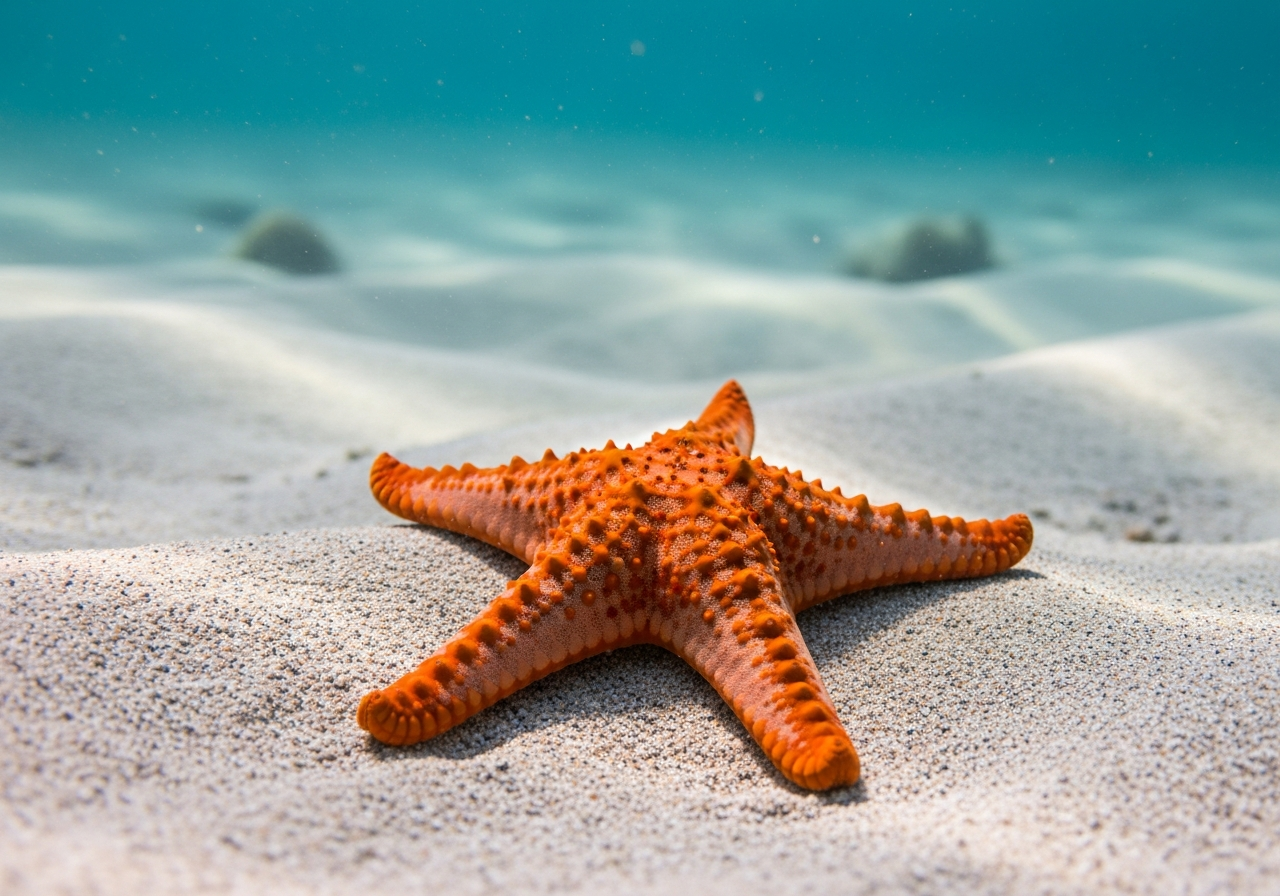
Starfish, also called sea stars, are marine invertebrates of the class Asteroidea, easily recognised by the five arms radiating from a central disc. They are echinoderms rather than fish, and creep slowly across the seabed on hundreds of tiny tube feet. Most species measure 12 to 25 cm across, prey on clams and mussels, and can regrow lost arms. Depending on the species they live anywhere from about 5 to 35 years.
Top questions about the Starfish
Starfish facts at a glance
- Weight 500 g
- Length 25 cm
- Top speed 0 km/h
- Lifespan 35 years
| Scientific name | Asteroidea (class) |
|---|---|
| Diet | Carnivore (mollusks, clams, mussels) |
| Habitat | Ocean floors, from tide pools to the deep sea |
| Lifespan | 5–35 years depending on species |
| Size | Commonly 12–25 cm (5–10 in) across |
| Top speed | Very slow; centimeters per minute |
| Conservation status | Least Concern (IUCN, most species) |
| Kingdom | Animalia |
|---|---|
| Phylum | Echinodermata |
| Class | Asteroidea |
Where it lives
The starfish (Asteroidea) is native to Ocean floors worldwide, from tide pools and coral reefs to the cold deep sea. — recorded across Oceans in this guide’s range summary.
For occurrence records, see GBIF species search and sources below.
How big is a starfish?
An adult starfish measures 25 cm long — about 14% of the height of an average adult person (1.73 m) — and weighs around 500 g, about 1% of an average adult’s body weight (70 kg).
Length vs an average adult’s height (to scale)
What is a group of starfish called?
Group name (collective noun)
A group of Starfish is called a constellation.
Baby name
A baby Starfish is called a larva.
Explore more animal collective nouns and baby animal names .
An echinoderm, not a fish
Although they are often called starfish, sea stars are not fish at all but echinoderms, relatives of sea urchins and sand dollars. There are roughly 2,000 species in the class Asteroidea, found in every ocean from shallow tide pools to the deep sea. Most have five arms arranged around a central disc, though some species carry many more. Instead of a backbone they have a tough, spiny skin and a body plan built around radial symmetry.
Life on tube feet
A sea star moves using a unique hydraulic system called the water vascular system, which powers hundreds of tiny tube feet on the underside of its arms. By pumping seawater through this network, it extends and grips with these feet to crawl slowly across the seabed. Movement is gentle and unhurried, measured in centimetres per minute rather than any real speed. The same tube feet also grip prey and help the animal cling to rocks against the pull of waves.
Feeding on shellfish
Sea stars are carnivores, and many specialise in eating molluscs such as clams, mussels and oysters. To open a shell, a sea star wraps its arms around the prey and uses its tube feet to prise the two halves slightly apart. It then pushes its stomach out through its mouth and into the gap, digesting the soft body inside the shell before drawing the stomach back in. This unusual method lets it feed on prey far larger than its own mouth.
Regeneration and survival
One of the sea star's most remarkable abilities is regeneration. If it loses an arm to a predator, it can slowly regrow the missing limb over months, and in some species a detached arm containing part of the central disc can even grow into a whole new animal. This power helps sea stars survive attacks that would kill many other creatures. Combined with lifespans that reach up to about 35 years in some species, it makes them tough, long-lived residents of the seabed.
Habitat and diversity
Sea stars live on ocean floors worldwide, from rocky tide pools exposed at low tide to the cold, dark depths thousands of metres down. They come in a huge range of colours and sizes, though most species measure about 12 to 25 cm from arm tip to arm tip. Some are drab and well camouflaged while others are vivid orange, red, blue or purple. Their spiny skin and, in some species, mild toxins help protect them from predators.
Reproduction
Most sea stars reproduce by releasing eggs and sperm into the water, where fertilisation takes place and tiny larvae drift as plankton before settling on the seabed. Many species can also reproduce asexually by splitting or by regenerating from a fragment of the body. A single large female may release millions of eggs in a season, though very few survive to adulthood. This mix of sexual and asexual strategies helps sea stars colonise new areas and recover from losses.
Dig deeper into the Starfish
- How Long Do Starfish Live?
Starfish lifespan is typically 5–35 years depending on species. What shortens or extends life, life stages, and status (Least Concern).
- Starfish: Key Facts
Starfish (Asteroidea) are invertebrates found across multiple regions. The five-armed drifter that regrows its limbs.
- What Do Starfish Eat?
What starfish eat: Carnivore (mollusks, clams, mussels), foraging style, and seasonal shifts in Ocean floors, from tide pools to the deep sea.
- Where Do Starfish Live?
Where starfish live: Ocean floors, from tide pools to the deep sea, native range cues, and human overlap. Status Least Concern.
Explore the Starfish
Related Invertebrates
Range & geography
Did you know? Starfish facts
- Starfish, also called sea stars, are marine invertebrates in the class Asteroidea, named for their typically five-armed, star-shaped bodies.
- No. Despite the name, a starfish is not a fish. It is a marine invertebrate called an echinoderm, related to sea urchins and sand dollars, which is why many people now call them sea stars.
- Yes. Most starfish can regrow arms lost to predators or injury, a process that can take months to more than a year. In some species, a single arm with part of the central disc can even regenerate an entire new starfish.
- Many starfish push their stomach out through their mouth to digest prey like clams and mussels outside their body, then pull the partly digested food back in. They use their tube feet to pry shells open first.
- No. Starfish have no brain and no blood. They use a simple ring of nerves and a water-filled vascular system to sense their surroundings and move their tube feet.
- Conservation: Least Concern (IUCN, most species).
Diet & feeding
Starfish feeds primarily as a carnivore (mollusks, clams, mussels). Many starfish feed by pushing their stomach out through their mouth to digest prey such as mussels and clams outside the body, then drawing the liquefied meal back in. They live on ocean floors worldwide, from shallow tide pools and reefs to the cold d
Adaptations
- A starfish has no brain and no blood. Instead of blood it pumps filtered seawater through a water vascular system that powers movement and circulation. A simple nerve ring and nerves running down each arm let it sense light, touch, and chemicals, and a tiny eyespot at the tip of each arm detects light and dark.
- The underside of each arm is lined with hundreds of small tube feet that extend and grip using water pressure and suction. These let a starfish creep slowly across the seabed and pry open the shells of clams and mussels. Movement is gradual, measured in centimeters per minute rather than any quick dash.
Behaviour & ecology
- A starfish has no brain and no blood. Instead of blood it pumps filtered seawater through a water vascular system that powers movement and circulation. A simple nerve ring and nerves running down each arm let it sense light, touch, and chemicals, and a tiny eyespot at the tip of each arm detects light and dark.
- The underside of each arm is lined with hundreds of small tube feet that extend and grip using water pressure and suction. These let a starfish creep slowly across the seabed and pry open the shells of clams and mussels. Movement is gradual, measured in centimeters per minute rather than any quick dash.
- Starfish are famous for regrowing arms lost to predators or injury, a process that can take months to over a year. In some species a severed arm that keeps part of the central disc can grow into a whole new animal. This regenerative ability is one of the most remarkable in the animal kingdom.
Communication
- Starfish uses scent, posture, and vocal signals to mark territory and coordinate social behaviour.
- Communication intensity often peaks during breeding seasons and territorial disputes.
Habitat & range
Ocean floors, from tide pools to the deep sea
Ecological role
Starfish acts as a predator that helps regulate prey populations and maintain balance in ocean floors, from tide pools to the deep sea.
Conservation status of the Starfish
The starfish (Asteroidea) is listed as Least Concern on the IUCN Red List. Least Concern (LC) is the IUCN's lowest-risk category, assigned to widespread, abundant species that have been evaluated and found not to be threatened. It does not mean a species faces no pressures — only that it is not currently at risk of extinction.
The starfish (Asteroidea) is assessed on the IUCN Red List. Look up on the IUCN Red List .
Frequently asked questions about the Starfish
Is a starfish a fish?
No. Despite the name, a starfish is not a fish but an echinoderm, in the class Asteroidea. It is more closely related to sea urchins and sand dollars, and it crawls on tube feet rather than swimming.
How do starfish move?
Starfish move using hundreds of tiny tube feet on the underside of their arms, powered by a water vascular system. They crawl very slowly across the seabed, measured in centimetres per minute.
What do starfish eat?
Starfish are carnivores that often feed on molluscs such as clams, mussels and oysters. A sea star prises the shell open and pushes its stomach out to digest the soft body inside.
Can a starfish regrow a lost arm?
Yes. Starfish can regenerate arms lost to predators over several months. In some species, a detached arm that includes part of the central disc can even grow into an entirely new animal.
How long do starfish live?
Lifespan varies by species, ranging from about 5 to 35 years. Larger, deep-water species tend to be the longest-lived.
How big do starfish get?
Most starfish measure about 12 to 25 cm across from arm tip to arm tip, though size varies widely between the roughly 2,000 species.
What is a group of starfish called?
A group of Starfish is called a constellation.
What is a baby starfish called?
A baby Starfish is called a larva.
Sources & references
This guide is compiled and reviewed against established zoological and conservation references. Key sources for the Starfish:
-
IUCN Red List of Threatened Species
Conservation status (Least Concern) reflects the IUCN Red List category for Asteroidea.
-
iNaturalist — observations & photos
Search citizen-science observations and community IDs for Asteroidea. Useful for range checks and recent sightings — not a substitute for formal Red List status.
-
GBIF — occurrence data
Global Biodiversity Information Facility species search for Asteroidea. Explore published occurrence records used in range research.
- IUCN Red List — Asteroidea.
Conservation status (Least Concern) and population trends.
- Wikipedia — Starfish.
General taxonomy and overview (cross-check primary sources).
-
Global Animal Guide editorial standards
How we research, source, review, and update every guide for accuracy.