Quick answer
The Asian giant hornet (Vespa mandarinia) is the world's largest hornet, with queens reaching up to 5 cm long and a wingspan close to 7.5 cm. Native to the forests and low mountains of East and Southeast Asia, it is a powerful predator that hunts other insects and can fly at up to 40 km/h. Colonies last a single year, and despite its fearsome reputation the species is common and listed as Least Concern.
Top questions about the Asian Giant Hornet
Asian Giant Hornet facts at a glance
- Weight 1 g
- Length 5 cm
- Top speed 40 km/h
- Lifespan 1 years
| Scientific name | Vespa mandarinia |
|---|---|
| Diet | Carnivore (insects, especially other bees and wasps) |
| Habitat | Forests and low mountains |
| Lifespan | Workers a few weeks; queens about a year |
| Length | 3.5–5 cm (1.4–2 in) |
| Wingspan | Up to about 7.5 cm (3 in) |
| Conservation status | Least Concern (IUCN) |
| Kingdom | Animalia |
|---|---|
| Phylum | Arthropoda |
| Class | Insecta |
| Order | Hymenoptera |
| Family | Vespidae |
| Genus | Vespa |
Where it lives
The asian giant hornet (Vespa mandarinia) is native to Forests and low mountains of East and Southeast Asia; the world's largest hornet. — recorded across Asia in this guide’s range summary.
For occurrence records, see GBIF species search and sources below.
How big is a asian giant hornet?
An adult asian giant hornet measures 5 cm long — about 3% of the height of an average adult person (1.73 m) — and weighs around 1 g, a small fraction of an average adult’s body weight (70 kg).
Length vs an average adult’s height (to scale)
What is a group of asian giant hornets called?
Group name (collective noun)
A group of Asian Giant Hornets is called a swarm. It is also known as a nest.
Baby name
A baby Asian Giant Hornet is called a larva.
Explore more animal collective nouns and baby animal names .
The world's largest hornet
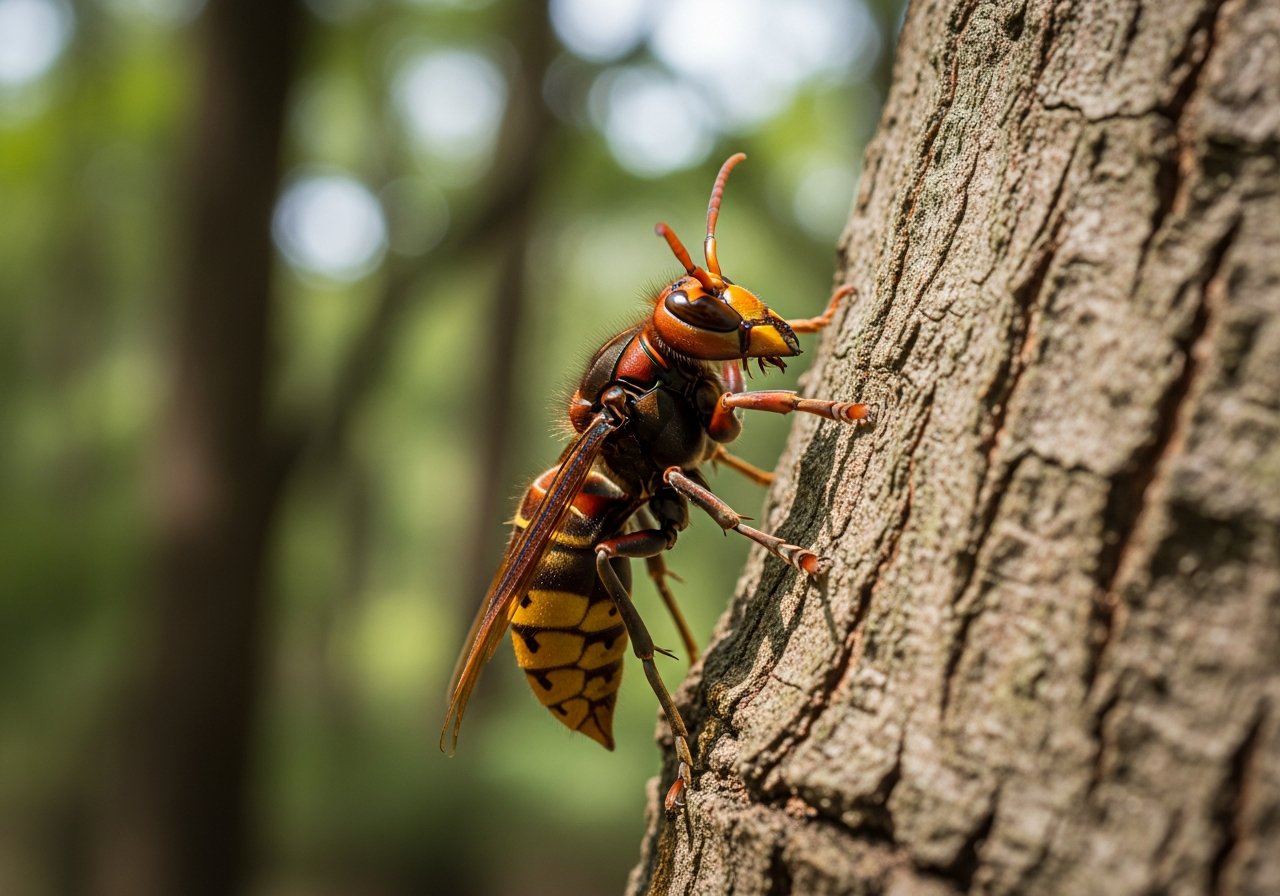
The Asian giant hornet earns its name: queens can reach about 5 cm in length, with workers a little smaller at around 3.5 to 4.5 cm, and a wingspan approaching 7.5 cm. Its large orange-yellow head, dark thorax and boldly banded abdomen make it unmistakable. Powerful wings let it fly at speeds of up to 40 km/h and cover long distances in a day. This impressive size and strength make it a formidable hunter of other insects.
Hunting and diet
Asian giant hornets are carnivores that prey on other insects, particularly bees and wasps. Adults hunt widely, using their large jaws to dismember prey, and carry protein-rich meat back to feed the colony's developing larvae. They are best known for raiding honeybee hives, where a small group of hornets can slaughter thousands of bees to seize the brood inside. In turn the adult hornets feed largely on sugary secretions produced by their own larvae.
Colony life and life cycle
Like other social wasps, the Asian giant hornet lives in an annual colony that lasts a single year. A mated queen emerges in spring to found a nest, usually in a burrow or hollow at ground level, and raises the first workers herself. Through summer the colony grows as sterile female workers, which live only a few weeks each, expand the nest and gather food. In autumn the colony produces new queens and males; the old colony then dies, and only young mated queens survive the winter to start again.
The sting and danger to people
The Asian giant hornet has a sting several millimetres long that can pierce ordinary clothing, delivering a potent venom. A single sting is very painful, and multiple stings can be dangerous, especially to people who are allergic. In parts of its range it is responsible for a number of deaths each year, usually where victims disturb a nest and are stung many times. That said, the hornet is not aggressive away from its nest and generally ignores people who leave it alone.
Range and habitat
The species is native to eastern and southern Asia, from Japan and the Korean Peninsula through China to parts of Southeast Asia. It favours forests and low mountains, where it can find both prey and suitable ground sites for nesting. Nests are typically hidden underground in abandoned rodent burrows or among tree roots. The hornet is widespread across this range and is classed as Least Concern by the IUCN.
The "murder hornet" reputation
The Asian giant hornet drew worldwide attention when a few individuals turned up in North America, earning it the sensational nickname 'murder hornet'. The alarm centres on its ability to devastate honeybee colonies, which threatens both wild pollinators and beekeeping. Interestingly, some Asian honeybees have evolved a defence, swarming over an intruding hornet and cooking it to death with their combined body heat. Efforts to detect and remove any nests outside its native range aim to protect local bees.
Dig deeper into the Asian Giant Hornet
- Asian Giant Hornet: Key Facts
Asian Giant Hornets (Vespa mandarinia) are insects found across Asia. The world's largest hornet.
- How Fast Is An Asian Giant Hornet?
Asian Giant Hornet top speed is about about 40 km/h. Sprint vs endurance and what limits pace.
- What Do Asian Giant Hornets Eat?
What asian giant hornets eat: Carnivore (insects, especially other bees and wasps), foraging style, and seasonal shifts in Forests and low mountains.
- Where Do Asian Giant Hornets Live?
Where asian giant hornets live: Forests and low mountains, native range cues, and human overlap. Status Least Concern.
Explore the Asian Giant Hornet
Compare
Related Insects
Range & geography
Did you know? Asian Giant Hornet facts
- The Asian giant hornet is the largest hornet in the world, with queens reaching about 5 cm (2 in) long and a wingspan near 7.5 cm (3 in).
- Queens can reach about 5 cm (2 in) long with a wingspan near 7.5 cm (3 in), making it the largest hornet in the world. Workers are somewhat smaller but still much bigger than common wasps.
- They are predators that hunt other large insects, including wasps, mantises, and honey bees, to feed their larvae. Adults themselves feed largely on sugary fluids such as sap and the juices of their prey.
- Their sting is painful and the venom is potent, and many stings can be dangerous, especially to people who are allergic. They are not usually aggressive toward people, though, and tend to sting only when their nest is disturbed.
- Yes. A small group of hornets can raid a honey bee colony and kill thousands of bees to take the nest and feed on the brood. This is a serious threat to honey bees that lack defenses against them.
- Conservation: Least Concern (IUCN).
Diet & feeding
Asian Giant Hornet feeds primarily as a carnivore (insects, especially other bees and wasps). These hornets are predators that hunt large insects, including other wasps, mantises, and especially honey bees, which they carry back to feed their larvae. A small group can raid a honey bee hive, decapitating thousands of be
Adaptations
- The Asian giant hornet is a formidable insect, with queens growing to about 5 cm (2 in) long and large orange heads with prominent jaws. Its body is banded in orange and dark brown, and its wingspan can approach 7.5 cm (3 in). This size makes it the largest hornet species in the world.
- These hornets are predators that hunt large insects, including other wasps, mantises, and especially honey bees, which they carry back to feed their larvae. A small group can raid a honey bee hive, decapitating thousands of bees to claim the nest and its brood. Adult hornets themselves feed largely on sugary fluids from prey and sap.
Behaviour & ecology
- The Asian giant hornet is a formidable insect, with queens growing to about 5 cm (2 in) long and large orange heads with prominent jaws. Its body is banded in orange and dark brown, and its wingspan can approach 7.5 cm (3 in). This size makes it the largest hornet species in the world.
- These hornets are predators that hunt large insects, including other wasps, mantises, and especially honey bees, which they carry back to feed their larvae. A small group can raid a honey bee hive, decapitating thousands of bees to claim the nest and its brood. Adult hornets themselves feed largely on sugary fluids from prey and sap.
- The Asian giant hornet has a long stinger and potent venom that makes its sting very painful. While a single sting is rarely dangerous to a healthy adult, multiple stings can be serious, and people who are allergic are at higher risk. The hornet usually stings only when it or its nest is threatened.
Communication
- Asian Giant Hornet uses scent, posture, and vocal signals to mark territory and coordinate social behaviour.
- Communication intensity often peaks during breeding seasons and territorial disputes.
Habitat & range
Forests and low mountains
Ecological role
Asian Giant Hornet acts as a predator that helps regulate prey populations and maintain balance in forests and low mountains.
Conservation status of the Asian Giant Hornet
The asian giant hornet (Vespa mandarinia) is listed as Least Concern on the IUCN Red List. Least Concern (LC) is the IUCN's lowest-risk category, assigned to widespread, abundant species that have been evaluated and found not to be threatened. It does not mean a species faces no pressures — only that it is not currently at risk of extinction.
The asian giant hornet (Vespa mandarinia) is assessed on the IUCN Red List. Look up on the IUCN Red List .
Frequently asked questions about the Asian Giant Hornet
How big is the Asian giant hornet?
It is the largest hornet in the world. Queens reach up to about 5 cm long, workers are around 3.5 to 4.5 cm, and the wingspan can approach 7.5 cm.
What do Asian giant hornets eat?
They are carnivores that hunt other insects, especially bees and wasps. They famously raid honeybee hives to seize the brood, and adults also feed on sugary fluids produced by their own larvae.
How dangerous is an Asian giant hornet sting?
A single sting is extremely painful and its long stinger can pierce ordinary clothing. Multiple stings can be dangerous, particularly to people with allergies, though the hornet is not aggressive when away from its nest.
How fast can an Asian giant hornet fly?
Asian giant hornets are strong fliers and can reach speeds of up to about 40 km/h, allowing them to cover long distances while hunting.
How long do Asian giant hornets live?
Colonies last a single year. Workers live only a few weeks each, while a queen lives about a year, founding a nest in spring and dying after new queens are produced in autumn.
Why is it called the murder hornet?
The nickname comes from its ability to wipe out honeybee colonies, with a small group killing thousands of bees to reach the brood. It gained the name after a few appeared in North America, raising fears for local bees.
What is a group of asian giant hornets called?
A group of Asian Giant Hornets is called a swarm. It is also known as a nest.
What is a baby asian giant hornet called?
A baby Asian Giant Hornet is called a larva.
Sources & references
This guide is compiled and reviewed against established zoological and conservation references. Key sources for the Asian Giant Hornet:
-
IUCN Red List of Threatened Species
Conservation status (Least Concern) reflects the IUCN Red List category for Vespa mandarinia.
-
iNaturalist — observations & photos
Search citizen-science observations and community IDs for Vespa mandarinia. Useful for range checks and recent sightings — not a substitute for formal Red List status.
-
GBIF — occurrence data
Global Biodiversity Information Facility species search for Vespa mandarinia. Explore published occurrence records used in range research.
- IUCN Red List — Vespa mandarinia.
Conservation status (Least Concern) and population trends.
- Animal Diversity Web — Vespa mandarinia. University of Michigan Museum of Zoology.
Life history, morphology, and range.
- Wikipedia — Asian Giant Hornet.
General taxonomy and overview (cross-check primary sources).
-
Global Animal Guide editorial standards
How we research, source, review, and update every guide for accuracy.