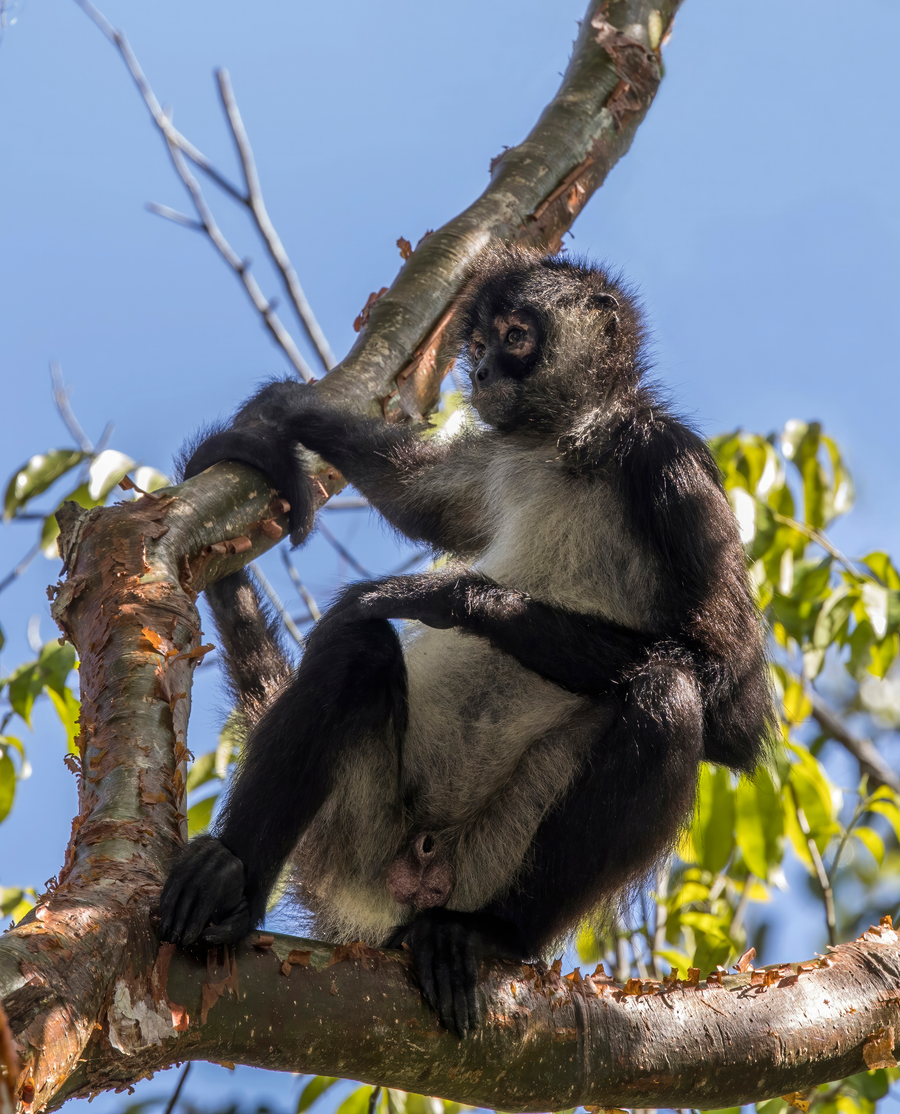
The geoffroy's spider monkey (Ateles geoffroyi) is a mammal of the family Atelidae, in the order Primates.
Quick answer
Geoffroy's spider monkey (Ateles geoffroyi) is a large, long-limbed monkey of Central American rainforests that swings through the canopy using a prehensile tail as a fifth limb. It weighs 6–9 kg (13–20 lb), lives around 25 years in the wild, and is listed Endangered because of deforestation and hunting.
Top questions about the Geoffroy's Spider Monkey
Also available in Español (Mono araña de Geoffroy)
Geoffroy's Spider Monkey facts at a glance
- Weight 8 kg
- Length 1.3 m
- Top speed 16 km/h
- Lifespan 25 years
| Scientific name | Ateles geoffroyi |
|---|---|
| Diet | Mostly ripe fruit, plus leaves, flowers, seeds, and nuts |
| Habitat | Tropical rainforest canopy from southern Mexico through Central America to Panama |
| Lifespan | Around 25 years in the wild; over 30 years in captivity |
| Weight | 6–9 kg (13–20 lb) |
| Top speed | A rapid brachiator — swings arm-over-arm through the canopy far faster than it moves on the ground |
| Conservation status | Endangered (IUCN) |
| Kingdom | Animalia |
|---|---|
| Phylum | Chordata |
| Class | Mammalia |
| Order | Primates |
| Family | Atelidae |
| Genus | Ateles |
Where it lives
The geoffroy's spider monkey (Ateles geoffroyi) is native to Rainforests from southern Mexico through Central America to Panama. — recorded across North America, South America in this guide’s range summary.
For occurrence records, see GBIF species search and sources below.
How big is a geoffroy's spider monkey?
An adult geoffroy's spider monkey measures 1.3 m long — about 75% of the height of an average adult person (1.73 m) — and weighs around 8.0 kg, about 11% of an average adult’s body weight (70 kg).
Length vs an average adult’s height (to scale)
Built for the canopy
Spider monkeys are named for the spindly silhouette made by their long limbs and tail when they hang. Their hands are hook-like with the thumb greatly reduced, an adaptation for swinging, and the prehensile tail — longer than the body, with a naked gripping pad near the tip — can support the animal's full weight, leaving hands free to feed.
Fission–fusion society
A community of 20–40 spider monkeys splits each day into small, shifting foraging parties and rejoins later — a 'fission–fusion' pattern that demands sharp social memory. Females leave their birth community at maturity, so the stable core of the group is male; greetings involve embraces, tail-twining, and loud whinnying calls.
Fruit specialists and seed dispersers
Ripe fruit can make up 90% of the diet, swallowed with the seeds and deposited across the forest in dung. Because spider monkeys range widely and disperse the seeds of many large-seeded trees, they are considered keystone species for rainforest regeneration.
Arboreal daily life
Spider monkeys feed and travel by day and almost never descend to the ground, sleeping high in emergent trees. Mothers carry infants for well over a year — first clinging to the belly, later riding on the back — and give birth only once every two to four years, one reason populations recover slowly.
Habitat and range
Geoffroy's spider monkey lives from the Yucatán Peninsula of southern Mexico through Belize, Guatemala, Honduras, Nicaragua, Costa Rica, and Panama, in mature evergreen and semi-deciduous forest. Several subspecies are recognised, and it is the only spider monkey found naturally in North America.
Conservation
Listed as Endangered, Geoffroy's spider monkey has vanished from many areas as rainforest is cleared for ranching and farms, and it is still hunted for bushmeat and the pet trade. All spider monkey species are now threatened, and protecting large, connected blocks of mature forest is the key to their survival.
Explore the Geoffroy's Spider Monkey
Close relatives
- Howler Monkey Same family
- Mountain Gorilla Same order
- Aye-aye Same order
- Japanese Macaque Same order
Collections
Range & geography
Conservation status of the Geoffroy's Spider Monkey
The geoffroy's spider monkey (Ateles geoffroyi) is listed as Endangered on the IUCN Red List. Endangered (EN) means a species faces a very high risk of extinction in the wild. Populations are usually declining sharply due to habitat loss, hunting, disease, or climate pressure. It sits one level below Critically Endangered on the IUCN Red List.
The geoffroy's spider monkey (Ateles geoffroyi) is assessed on the IUCN Red List. Look up on the IUCN Red List .
Frequently asked questions about the Geoffroy's Spider Monkey
Why is it called a spider monkey?
When the monkey hangs by its tail with all four limbs dangling, its long, thin proportions resemble a spider's legs — the likeness that early naturalists used to name it.
Do spider monkeys have thumbs?
Only a tiny vestigial stub. The thumb is so reduced that the hand works as a hook for swinging; the gripping work is done by the fingers and the prehensile tail.
What do spider monkeys eat?
Primarily ripe fruit — up to 90% of feeding time — supplemented with young leaves, flowers, seeds, and occasional nuts or insects.
How does the prehensile tail work?
The tail is muscular and longer than the body, with a bare, fingerprint-like pad on its underside near the tip. It wraps around branches and can hold the monkey's entire weight, effectively acting as a fifth hand.
Why are spider monkeys endangered?
They need large areas of tall, unbroken rainforest, which is being cleared throughout Central America; they are also hunted for meat and captured for the pet trade. Slow breeding — one infant every two to four years — makes recovery difficult.
Sources & references
This guide is compiled and reviewed against established zoological and conservation references. Key sources for the Geoffroy's Spider Monkey:
-
IUCN Red List of Threatened Species
Conservation status (Endangered) reflects the IUCN Red List category for Ateles geoffroyi.
-
iNaturalist — observations & photos
Search citizen-science observations and community IDs for Ateles geoffroyi. Useful for range checks and recent sightings — not a substitute for formal Red List status.
-
GBIF — occurrence data
Global Biodiversity Information Facility species search for Ateles geoffroyi. Explore published occurrence records used in range research.
-
Global Animal Guide editorial standards
How we research, source, review, and update every guide for accuracy.