Image sourcing: see credits & licences
The satin bowerbird (Ptilonorhynchus violaceus) is a bird of the family Ptilonorhynchidae, in the order Passeriformes.
Quick answer
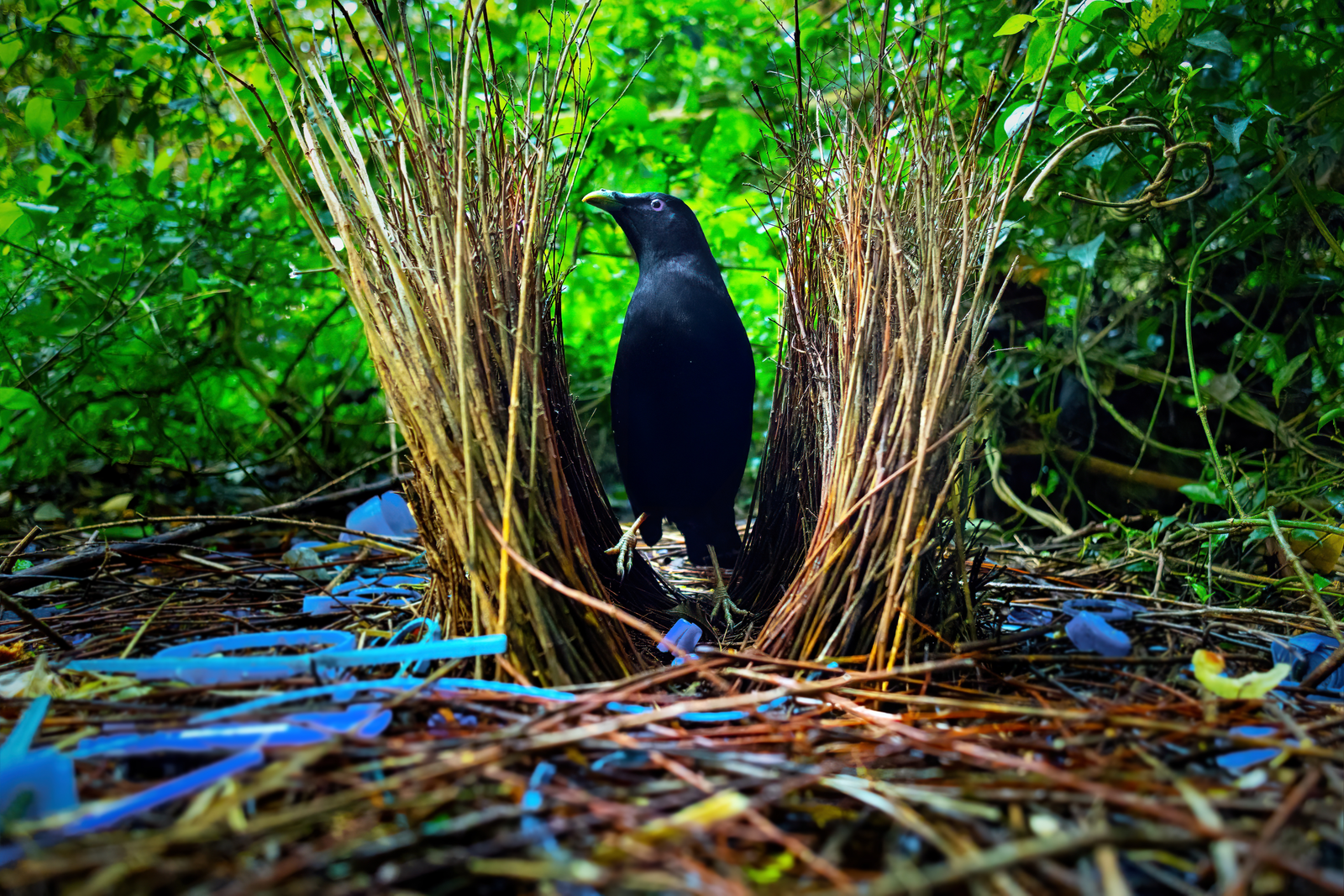
The satin bowerbird (Ptilonorhynchus violaceus) is an Australian forest bird whose males build decorated bowers to court females. Males shine iridescent blue-black, females are green, and the species is listed Least Concern in eastern rainforests.
Top questions about the Satin Bowerbird
Satin Bowerbird facts at a glance
- Weight 200 g
- Length 32 cm
- Top speed 30 km/h
- Lifespan 25 years
| Scientific name | Ptilonorhynchus violaceus |
|---|---|
| Diet | Omnivore |
| Habitat | Rainforest and wet sclerophyll forest |
| Lifespan | 20–30 years |
| Weight | 0.17–0.23 kg |
| Top speed | up to 30 km/h |
| Conservation status | Least Concern (IUCN) |
| Kingdom | Animalia |
|---|---|
| Phylum | Chordata |
| Class | Aves |
| Order | Passeriformes |
| Family | Ptilonorhynchidae |
| Genus | Ptilonorhynchus |
Where it lives
The satin bowerbird (Ptilonorhynchus violaceus) is native to Eastern Australian forests. — recorded across Oceania in this guide’s range summary.
For occurrence records, see GBIF species search and sources below.
How big is a satin bowerbird?
An adult satin bowerbird measures 32 cm long — about 18% of the height of an average adult person (1.73 m) — and weighs around 200 g, a small fraction of an average adult’s body weight (70 kg).
Length vs an average adult’s height (to scale)
What is a group of satin bowerbirds called?
Group name (collective noun)
A group of Satin Bowerbirds is called a colony.
Baby name
A baby Satin Bowerbird is called a chick.
Explore more animal collective nouns and baby animal names .
Bower-building courtship
Males construct U-shaped avenue bowers from sticks and decorate them with blue objects — feathers, berries, bottle caps — to impress visiting females. Display includes mimicry of other birds and dramatic posturing.
Fruit, leaves, and insects
Omnivorous diet spans fruits, flowers, leaves, and insects. Males maintain bowers for years within forest territories while females build cup nests in nearby trees.
Eastern Australian forests
Rainforest and wet sclerophyll from Queensland to Victoria. They need intact understory for bower sites and fruiting trees for food.
Adaptable showman
Least Concern and common in many protected forests. Suburban edges attract birds that steal blue litter for bower decoration, a quirky sign of cultural learning.
Explore the Satin Bowerbird
Close relatives
- Canary Same order
- House Sparrow Same order
- Superb Lyrebird Same order
- Blue Tit Same order
Range & geography
Conservation status of the Satin Bowerbird
The satin bowerbird (Ptilonorhynchus violaceus) is listed as Least Concern on the IUCN Red List. Least Concern (LC) is the IUCN's lowest-risk category, assigned to widespread, abundant species that have been evaluated and found not to be threatened. It does not mean a species faces no pressures — only that it is not currently at risk of extinction.
The satin bowerbird (Ptilonorhynchus violaceus) is assessed on the IUCN Red List. Look up on the IUCN Red List .
Frequently asked questions about the Satin Bowerbird
Why do satin bowerbirds collect blue objects?
Males decorate bowers with blue items because females prefer well-stocked, vividly coloured display courts.
Do female satin bowerbirds build bowers?
No — only males build and maintain bowers; females visit to choose mates and then nest alone.
Can satin bowerbirds mimic other birds?
Yes — males copy calls of honeyeaters, currawongs, and other species during courtship displays.
Where do satin bowerbirds live?
Eastern Australian rainforests and wet forests from Queensland through New South Wales to Victoria.
Why are males satin blue-black?
Iridescent plumage signals male quality; females remain camouflaged green for nesting.
What is a group of satin bowerbirds called?
A group of Satin Bowerbirds is called a colony.
What is a baby satin bowerbird called?
A baby Satin Bowerbird is called a chick.
Sources & references
This guide is compiled and reviewed against established zoological and conservation references. Key sources for the Satin Bowerbird:
-
IUCN Red List of Threatened Species
Conservation status (Least Concern) reflects the IUCN Red List category for Ptilonorhynchus violaceus.
-
iNaturalist — observations & photos
Search citizen-science observations and community IDs for Ptilonorhynchus violaceus. Useful for range checks and recent sightings — not a substitute for formal Red List status.
-
GBIF — occurrence data
Global Biodiversity Information Facility species search for Ptilonorhynchus violaceus. Explore published occurrence records used in range research.
-
eBird — bird observations
Cornell Lab eBird target search for Satin Bowerbird. Check recent checklists and seasonal abundance where birders report this species.
-
Global Animal Guide editorial standards
How we research, source, review, and update every guide for accuracy.