Image sourcing: see credits & licences
The house sparrow (Passer domesticus) is a bird of the family Passeridae, in the order Passeriformes.
Quick answer
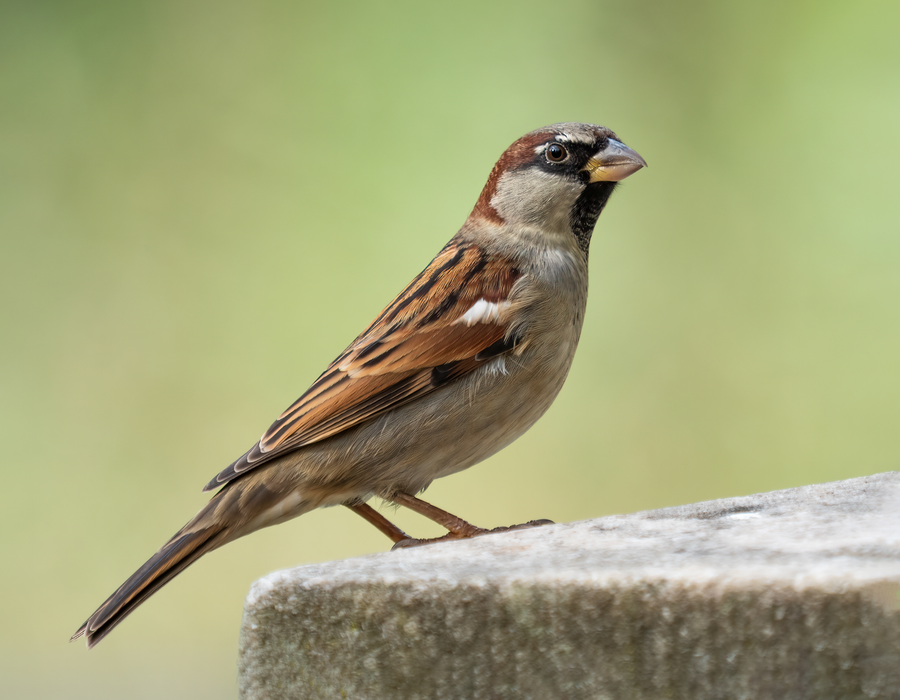
The house sparrow (Passer domesticus) is a stocky, human-commensal songbird native to Eurasia and North Africa and introduced nearly worldwide. Males have grey caps and black bibs; birds eat seeds and scraps in towns and farms. Globally Least Concern, yet sharp urban declines in parts of western Europe sparked research into nest sites and invertebrate chick food.
Top questions about the House Sparrow
House Sparrow facts at a glance
- Weight 30 g
- Length 16 cm
- Top speed 45 km/h
- Lifespan 5 years
| Scientific name | Passer domesticus |
|---|---|
| Diet | Omnivore |
| Habitat | Towns, farms, and human settlements |
| Lifespan | Around 5 years in the wild (varies by population and captivity). |
| Weight | About 0.03 kg typical adult mass (sex and region vary). |
| Top speed | Up to roughly 45 km/h when moving at speed. |
| Conservation status | Least Concern (IUCN) |
| Kingdom | Animalia |
|---|---|
| Phylum | Chordata |
| Class | Aves |
| Order | Passeriformes |
| Family | Passeridae |
| Genus | Passer |
Where it lives
The house sparrow (Passer domesticus) is native to Native to Eurasia and North Africa; introduced nearly worldwide in cities and farms. — recorded across Europe, Asia, Africa, North America, South America, Oceania in this guide’s range summary.
For occurrence records, see GBIF species search and sources below.
How big is a house sparrow?
An adult house sparrow measures 16 cm long — about 9% of the height of an average adult person (1.73 m) — and weighs around 30 g, a small fraction of an average adult’s body weight (70 kg).
Length vs an average adult’s height (to scale)
What is a group of house sparrows called?
Group name (collective noun)
A group of House Sparrows is called a flock.
Baby name
A baby House Sparrow is called a chick.
Explore more animal collective nouns and baby animal names .
Companion of human settlements
Few birds are more tied to buildings, grain stores, and farmyards. Males show a black bib whose size relates to status; females are plainer brown. Chirping colonies nest in cavities and eaves.
Seeds, scraps, and chick insects
Adults take seeds and human food waste; nestlings need soft-bodied insects. Lack of urban invertebrates can starve chicks even when adult seed food seems plentiful.
Nearly global towns and farms
Native across Eurasia and North Africa; introduced to the Americas, Australia, Africa, and islands with European settlement. Across its range it is tied to towns, farms, and human settlements, and field accounts emphasise this species’ distinctive ecology rather than generic habitat labels.
Global LC, local crashes
Still Least Concern worldwide thanks to huge range, but London and other European cities saw dramatic falls linked to building design, pollution, and chick-food shortages.
Explore the House Sparrow
Close relatives
- Canary Same order
- Superb Lyrebird Same order
- Blue Tit Same order
- Barn Swallow Same order
Conservation status of the House Sparrow
The house sparrow (Passer domesticus) is listed as Least Concern on the IUCN Red List. Least Concern (LC) is the IUCN's lowest-risk category, assigned to widespread, abundant species that have been evaluated and found not to be threatened. It does not mean a species faces no pressures — only that it is not currently at risk of extinction.
The house sparrow (Passer domesticus) is assessed on the IUCN Red List. Look up on the IUCN Red List .
Frequently asked questions about the House Sparrow
Why are house sparrows declining in some cities?
Loss of nest cavities in modern buildings and scarce insect food for chicks are leading explanations in western Europe.
Are house sparrows native to North America?
No — they were introduced from Europe in the nineteenth century and spread widely.
What do baby house sparrows eat?
Mostly insects and other soft invertebrates brought by parents — that is the usual English name for a young house sparrow.
How can you tell male and female house sparrows apart?
Males have a grey crown and black bib; females are uniformly brown and streaky without the bib.
Do house sparrows migrate?
Most populations are resident around human settlements year-round.
What is a group of house sparrows called?
A group of House Sparrows is called a flock.
What is a baby house sparrow called?
A baby House Sparrow is called a chick.
Sources & references
This guide is compiled and reviewed against established zoological and conservation references. Key sources for the House Sparrow:
-
IUCN Red List of Threatened Species
Conservation status (Least Concern) reflects the IUCN Red List category for Passer domesticus.
-
iNaturalist — observations & photos
Search citizen-science observations and community IDs for Passer domesticus. Useful for range checks and recent sightings — not a substitute for formal Red List status.
-
GBIF — occurrence data
Global Biodiversity Information Facility species search for Passer domesticus. Explore published occurrence records used in range research.
-
eBird — bird observations
Cornell Lab eBird target search for House Sparrow. Check recent checklists and seasonal abundance where birders report this species.
-
Global Animal Guide editorial standards
How we research, source, review, and update every guide for accuracy.