Image sourcing: see credits & licences
Quick answer
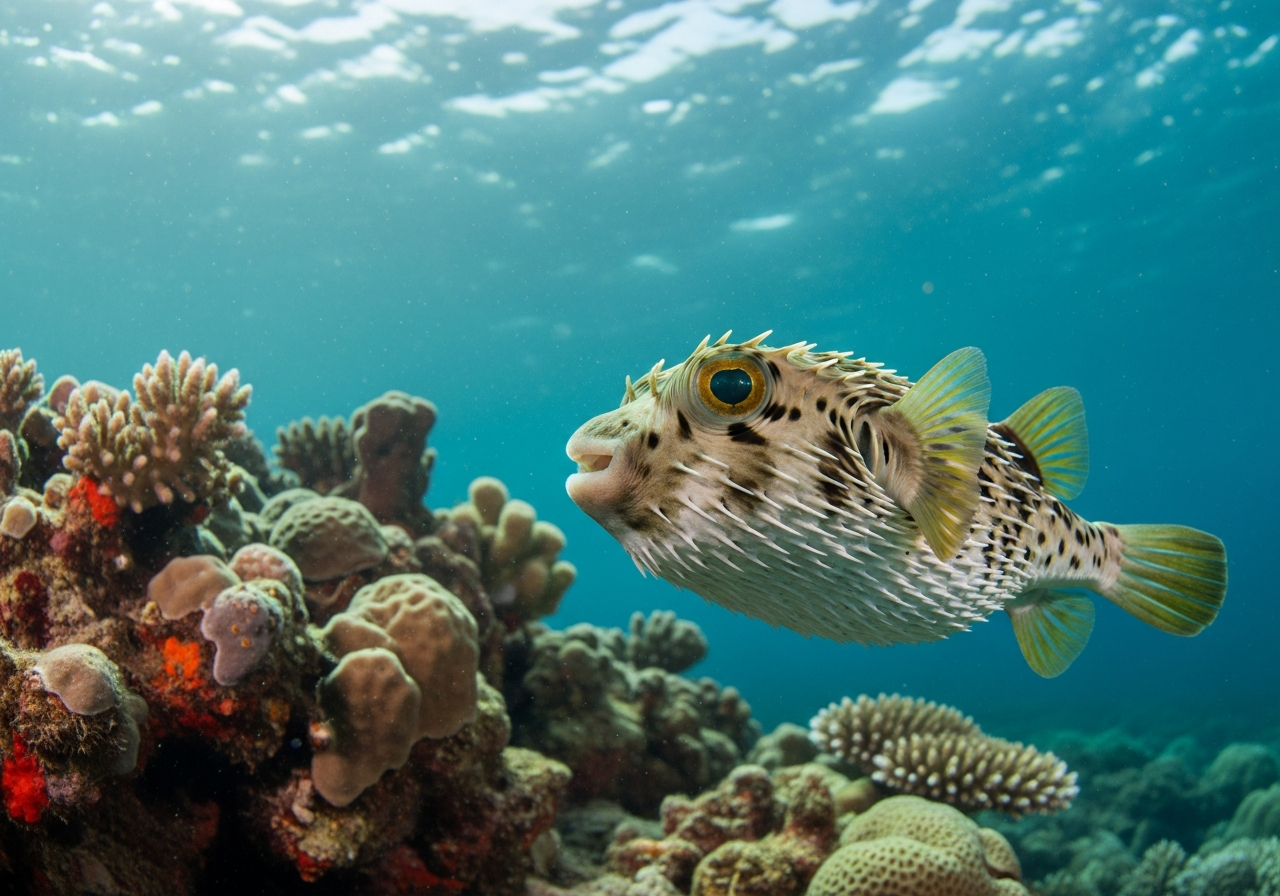
Pufferfish are a family of tropical fish (Tetraodontidae) famous for inflating their stretchy stomachs with water into a spiny ball when threatened. They swim slowly and manoeuvrably through warm seas, and a few species live in fresh water. Most reach around 30 cm long, weigh roughly 1.2 kg, and live about 10 years. Many carry tetrodotoxin, one of the deadliest natural poisons, which makes them among the most toxic animals in the sea.
Top questions about the Pufferfish
Pufferfish facts at a glance
- Weight 1.2 kg
- Length 30 cm
- Top speed 12 km/h
- Lifespan 10 years
| Scientific name | Tetraodontidae (family) |
|---|---|
| Diet | Carnivore / omnivore |
| Habitat | Tropical and subtropical seas, some freshwater |
| Lifespan | Around 10 years for many species |
| Length | 2.5 cm to over 60 cm by species |
| Top speed | Slow, maneuverable swimmer |
| Conservation status | Varies by species (most Least Concern) |
| Kingdom | Animalia |
|---|---|
| Phylum | Chordata |
| Class | Actinopterygii |
| Order | Tetraodontiformes |
| Family | Tetraodontidae |
Where it lives
The pufferfish (Tetraodontidae) is native to Tropical and subtropical seas worldwide, with some species in brackish and freshwater of Asia and Africa. — recorded across Oceans, Asia in this guide’s range summary.
For occurrence records, see GBIF species search and sources below.
How big is a pufferfish?
An adult pufferfish measures 30 cm long — about 17% of the height of an average adult person (1.73 m) — and weighs around 1.2 kg, about 2% of an average adult’s body weight (70 kg).
Length vs an average adult’s height (to scale)
What is a group of pufferfish called?
Group name (collective noun)
A group of Pufferfish is called a school.
Baby name
A baby Pufferfish is called a fry.
Explore more animal collective nouns and baby animal names .
How pufferfish inflate
A pufferfish cannot swim away quickly, so its defence is to become impossible to swallow. When alarmed it gulps large amounts of water (or air, if pulled from the sea) into a highly elastic stomach, swelling into a ball several times its normal size. In many species this exposes spines that lie flat against the body until inflation makes them stand out. A predator faced with a spiky, ballooned mouthful usually gives up and moves on.
One of the most poisonous fish
Most pufferfish contain tetrodotoxin, a poison up to 1,200 times more toxic to humans than cyanide, concentrated in the liver, ovaries, and skin. The toxin blocks nerve signals and there is no known antidote, so a single fish can carry enough to kill several people. The poison is produced by bacteria the fish accumulate through their diet rather than made by the fish itself. Its bright warnings and foul taste deter most would-be predators.
How they swim and feed
Pufferfish are slow but highly manoeuvrable swimmers, sculling with their pectoral, dorsal, and anal fins rather than their tail, which they save for quick bursts. This lets them hover and turn precisely among reefs and seagrass. They feed on hard-shelled prey such as molluscs, crustaceans, and coral, along with algae and invertebrates, crushing shells with four fused, beak-like teeth that give the family its name Tetraodontidae, meaning four teeth. Those teeth grow continuously and are worn down by their hard diet.
Habitat and diversity
There are around 120 species of pufferfish, ranging from tiny forms just 2.5 cm long to giants over 60 cm. Most live in tropical and subtropical seas, favouring coral reefs, estuaries, and shallow coastal waters, but some species have adapted to brackish or fresh water in rivers and lakes. They are found across the Atlantic, Pacific, and Indian Oceans. This wide variety means size, colour, and habitat differ greatly from one species to another.
Pufferfish and people
In Japan, pufferfish is served as the delicacy fugu, which must be prepared by specially licensed chefs who remove the toxic organs. Even so, poorly prepared fugu still causes fatal poisonings, and the dish is banned or restricted in several countries. Some pufferfish are also kept in aquariums, prized for their expressive faces and curious behaviour. Most species are currently listed as Least Concern, though status varies from one species to the next.
Dig deeper into the Pufferfish
- Are Pufferfish Dangerous?
Are pufferfish dangerous? Realistic risk, when incidents rise, and safety basics.
- How Long Do Pufferfish Live?
Pufferfish lifespan is typically Around 10 years for many species. What shortens or extends life, life stages, and status (Least Concern).
- Pufferfish: Key Facts
Pufferfish (Tetraodontidae) are fish found across Asia. The fish that inflates into a spiky ball.
- What Do Pufferfish Eat?
What pufferfish eat: Carnivore / omnivore, foraging style, and seasonal shifts in Tropical and subtropical seas, some freshwater.
- Where Do Pufferfish Live?
Where pufferfish live: Tropical and subtropical seas, some freshwater, native range cues, and human overlap. Status Least Concern.
Explore the Pufferfish
Related Fishs
Collections
Range & geography
Did you know? Pufferfish facts
- Pufferfish are a family of fish famous for inflating into a round, often spiny ball when threatened by gulping water to make themselves hard to swallow.
- Pufferfish inflate by gulping water to turn themselves into a large, round, hard-to-swallow ball when a predator threatens them. In spiny species this also exposes sharp spines for extra protection.
- Many pufferfish contain tetrodotoxin, a powerful poison with no known antidote, concentrated in organs like the liver and ovaries. This makes them one of the most poisonous animals in the ocean.
- Yes, but only when prepared by trained, licensed chefs. In Japan the dish is called fugu, and the toxic organs must be removed precisely because eating them can be deadly.
- Pufferfish use strong, beak-like teeth to crush hard-shelled prey such as clams, crabs, mussels, and snails. Some species also feed on algae and other small invertebrates.
- Conservation: Varies by species (most Least Concern).
Diet & feeding
Pufferfish feeds primarily as a carnivore / omnivore. When threatened, a pufferfish rapidly swallows water, or sometimes air, to swell into a round ball several times its normal size. This makes it awkward to bite and, in spiny species, presents a wall of sharp spines. Inflating is stressful and is used only as a last
Adaptations
- When threatened, a pufferfish rapidly swallows water, or sometimes air, to swell into a round ball several times its normal size. This makes it awkward to bite and, in spiny species, presents a wall of sharp spines. Inflating is stressful and is used only as a last resort when the fish cannot escape.
- Many pufferfish carry tetrodotoxin, a poison far more potent than cyanide that the fish accumulate from their diet and gut bacteria. It is concentrated in organs such as the liver, ovaries, and skin, and there is no antidote. This chemical defense makes most predators avoid them entirely.
Behaviour & ecology
- When threatened, a pufferfish rapidly swallows water, or sometimes air, to swell into a round ball several times its normal size. This makes it awkward to bite and, in spiny species, presents a wall of sharp spines. Inflating is stressful and is used only as a last resort when the fish cannot escape.
- Many pufferfish carry tetrodotoxin, a poison far more potent than cyanide that the fish accumulate from their diet and gut bacteria. It is concentrated in organs such as the liver, ovaries, and skin, and there is no antidote. This chemical defense makes most predators avoid them entirely.
- Pufferfish have strong, beak-like fused teeth that keep growing and are used to crush hard-shelled prey such as clams, mussels, crabs, and snails. Some also eat algae and invertebrates. They are generally slow swimmers but are very maneuverable, steering precisely with their fins to hover and dart.
Communication
- Lateral-line and visual cues coordinate schooling, courtship, or territorial behaviour.
- Some species produce low-frequency sounds or drumming for spawning or defence.
Habitat & range
Tropical and subtropical seas, some freshwater
Ecological role
Pufferfish acts as a predator that helps regulate prey populations and maintain balance in tropical and subtropical seas, some freshwater.
Conservation status of the Pufferfish
The pufferfish (Tetraodontidae) is listed as Least Concern on the IUCN Red List. Least Concern (LC) is the IUCN's lowest-risk category, assigned to widespread, abundant species that have been evaluated and found not to be threatened. It does not mean a species faces no pressures — only that it is not currently at risk of extinction.
The pufferfish (Tetraodontidae) is assessed on the IUCN Red List. Look up on the IUCN Red List .
Frequently asked questions about the Pufferfish
Why do pufferfish puff up?
Pufferfish puff up as a defence against predators. Because they are slow swimmers, they gulp water into an elastic stomach and balloon into a spiny sphere that is hard to bite or swallow, encouraging attackers to give up.
Are pufferfish poisonous?
Yes. Most pufferfish contain tetrodotoxin, one of the most powerful natural poisons known, with no antidote. A single fish can hold enough toxin to kill several adults, which makes them among the most poisonous animals in the sea.
Can you eat pufferfish?
Pufferfish is eaten in Japan as the delicacy fugu, but only chefs with special training and licences may prepare it, because the toxic organs must be removed precisely. Even so, careless preparation still causes deaths, and the dish is banned in some countries.
How big do pufferfish get?
It depends on the species. The smallest are only about 2.5 cm long, while the largest exceed 60 cm. A typical pufferfish is around 30 cm and weighs roughly 1.2 kg.
What do pufferfish eat?
Pufferfish feed mainly on hard-shelled prey such as molluscs, crustaceans, and coral, along with algae and small invertebrates. They crush shells with four strong, fused teeth that grow continuously throughout their lives.
How long do pufferfish live?
Many pufferfish species live around 10 years. Lifespan varies with species and conditions, and fish kept in well-managed aquariums can sometimes reach the upper end of that range.
What is a group of pufferfish called?
A group of Pufferfish is called a school.
What is a baby pufferfish called?
A baby Pufferfish is called a fry.
Sources & references
This guide is compiled and reviewed against established zoological and conservation references. Key sources for the Pufferfish:
-
IUCN Red List of Threatened Species
Conservation status (Least Concern) reflects the IUCN Red List category for Tetraodontidae.
-
iNaturalist — observations & photos
Search citizen-science observations and community IDs for Tetraodontidae. Useful for range checks and recent sightings — not a substitute for formal Red List status.
-
GBIF — occurrence data
Global Biodiversity Information Facility species search for Tetraodontidae. Explore published occurrence records used in range research.
- IUCN Red List — Tetraodontidae.
Conservation status (Least Concern) and population trends.
- Wikipedia — Pufferfish.
General taxonomy and overview (cross-check primary sources).
-
Global Animal Guide editorial standards
How we research, source, review, and update every guide for accuracy.