Image sourcing: see credits & licences
Quick answer
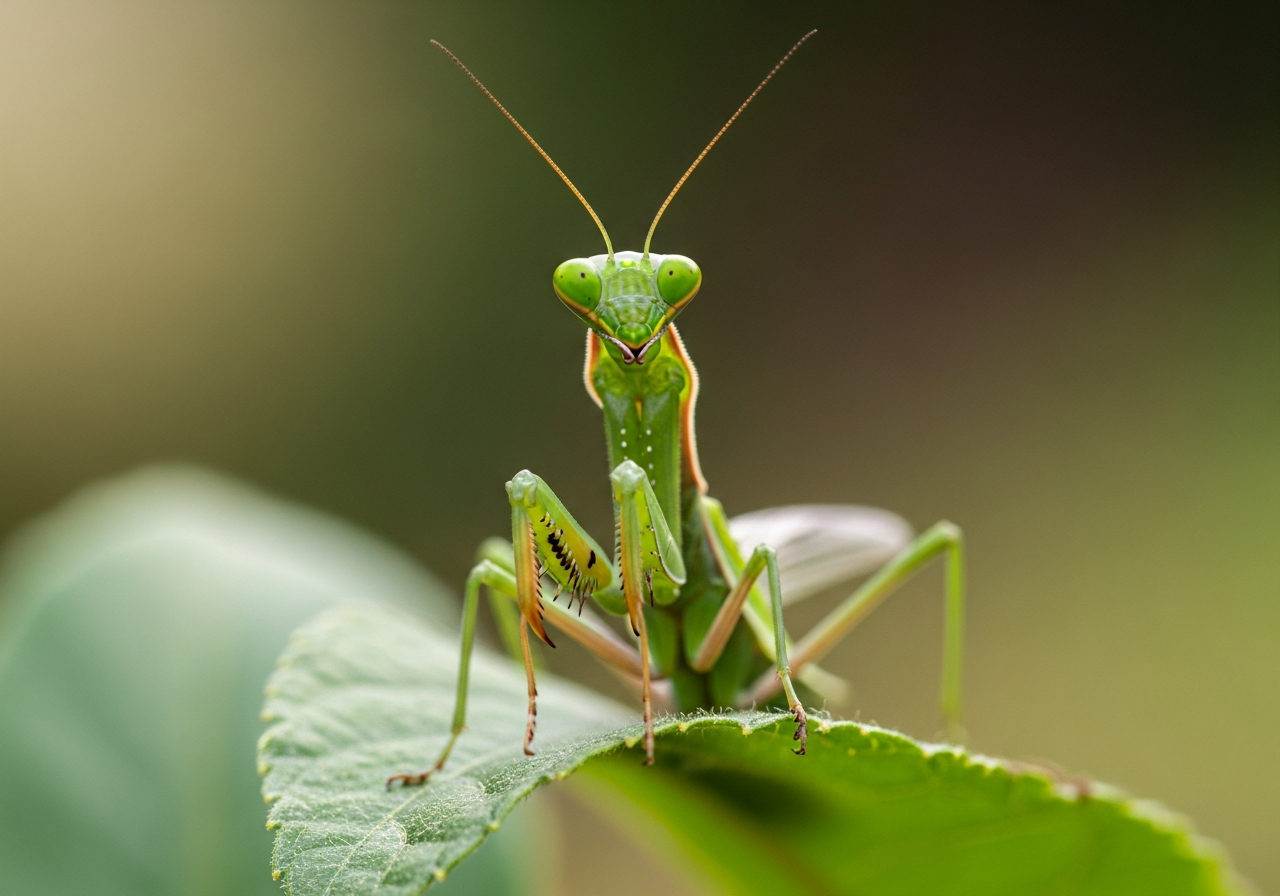
The praying mantis (Mantis religiosa) is a predatory insect named for the way it holds its spined front legs folded as if in prayer. It is a patient ambush hunter of gardens, meadows, and shrubland, seizing insects and other small prey with a lightning strike. Most are 5 to 15 cm long, and adults typically live for about a year. The species is listed as Least Concern by the IUCN.
Top questions about the Praying Mantis
Praying Mantis facts at a glance
- Weight 5 g
- Length 8 cm
- Top speed 11 km/h
- Lifespan 1 years
| Scientific name | Mantis religiosa |
|---|---|
| Diet | Carnivore (insects and other small prey) |
| Habitat | Gardens, meadows, shrubs, woodlands |
| Lifespan | Up to about 1 year |
| Size | 5–15 cm (2–6 in) depending on species |
| Vision | Can rotate head nearly 180° |
| Conservation status | Least Concern (IUCN) |
| Kingdom | Animalia |
|---|---|
| Phylum | Arthropoda |
| Class | Insecta |
| Order | Mantodea |
| Family | Mantidae |
Where it lives
The praying mantis (Mantis religiosa) is native to Warm and temperate regions worldwide, including Europe, Africa, and Asia, with species introduced to North America. — recorded across Africa, Asia, Europe, North America, South America, Oceania in this guide’s range summary.
For occurrence records, see GBIF species search and sources below.
How big is a praying mantis?
An adult praying mantis measures 8 cm long — about 4% of the height of an average adult person (1.73 m) — and weighs around 5 g, a small fraction of an average adult’s body weight (70 kg).
Length vs an average adult’s height (to scale)
What is a baby praying mantis called?
Baby name
A baby Praying Mantis is called a nymph.
Explore more animal collective nouns and baby animal names .
The ambush predator
A praying mantis hunts by stillness rather than pursuit, waiting motionless until prey wanders within reach. Its raptorial front legs are lined with sharp spines and snap shut in around a tenth of a second, far faster than the eye can follow, pinning the victim securely. Mantises eat insects such as flies, moths, crickets, and grasshoppers, and larger species will tackle spiders, small lizards, or even hummingbirds. They usually begin feeding while the prey is still alive, holding it firmly in those folded arms.
Extraordinary eyesight
The mantis has large compound eyes set on a triangular head that it can swivel nearly 180 degrees, giving it a wide field of view unmatched among insects. It is the only insect known to have true stereoscopic vision, judging distance with both eyes at once, much as humans do. This depth perception is what makes its ambush strikes so precise. A dark false pupil seems to follow an observer around, a trick of the eye's structure rather than a moving pupil.
Camouflage and defence
Mantises are masters of disguise, with bodies shaped and coloured to blend into leaves, grass, bark, or flowers. Some tropical species mimic blossoms so closely that they lure pollinating insects straight into their grasp. This camouflage hides the mantis from both prey and its own predators, which include birds, bats, and spiders. When discovered, a cornered mantis may rear up, spread its front legs, and flash bright colours to appear larger and more threatening.
Mating and sexual cannibalism
Praying mantises are infamous for sexual cannibalism, in which the female sometimes eats the male during or after mating. This does not happen every time, but where it does the meal can boost the number and health of her eggs. After mating the female lays her eggs in a frothy case called an ootheca, which hardens to protect them through winter. A single case can hold dozens to hundreds of eggs.
Life cycle and lifespan
Young mantises, called nymphs, hatch in spring as miniature versions of the adults and immediately begin hunting small insects. They grow through a series of moults, shedding their exoskeleton several times before reaching full size and gaining wings as adults. The whole life cycle is short, and most mantises live for only about a year, with adults dying off after the breeding season as the weather turns cold. In colder climates it is the egg case, not the adult, that survives the winter.
Dig deeper into the Praying Mantis
- Praying Mantis: Key Facts
Praying Mantises (Mantis religiosa) are insects found across Africa, Asia, Europe, North America, South America, Oceania.
- What Do Praying Mantises Eat?
What praying mantises eat: Carnivore (insects and other small prey), foraging style, and seasonal shifts in Gardens, meadows, shrubs, woodlands.
- Where Do Praying Mantises Live?
Where praying mantises live: Gardens, meadows, shrubs, woodlands, native range cues, and human overlap. Status Least Concern.
Explore the Praying Mantis
Related Insects
Did you know? Praying Mantis facts
- The praying mantis is a predatory insect named for the way it holds its spiny front legs together as if praying.
- Praying mantises are carnivores that mostly eat other insects such as flies, crickets, moths, and beetles. Larger species can occasionally catch small lizards, frogs, or even hummingbirds.
- Yes. The praying mantis is one of the few insects that can rotate its head nearly 180 degrees, letting it look over its shoulder to spot prey and predators.
- A mantis may grab or give a small nip if handled, but it is not venomous and poses no real danger to people. Any bite is harmless and at most a minor pinch.
- Most praying mantises live less than a year. They hatch in spring, grow through the summer, and the adults usually die off as cold weather arrives.
- Conservation: Least Concern (IUCN).
Diet & feeding
Praying Mantis feeds primarily as a carnivore (insects and other small prey). The praying mantis is a sit-and-wait predator that stays perfectly still, often camouflaged among leaves, until prey comes close. It then snaps out its spiny front legs in a fraction of a second to grab the victim. Mantises eat insects such a
Adaptations
- The praying mantis is a sit-and-wait predator that stays perfectly still, often camouflaged among leaves, until prey comes close. It then snaps out its spiny front legs in a fraction of a second to grab the victim. Mantises eat insects such as flies, crickets, and moths, and larger species occasionally take small lizards or hummingbirds.
- A mantis has large compound eyes and is one of the few insects that can rotate its head to look over its shoulder, helping it track prey and threats. It has stereo vision that lets it judge distance accurately before striking. Most of the time it moves slowly and deliberately to avoid being noticed.
Behaviour & ecology
- The praying mantis is a sit-and-wait predator that stays perfectly still, often camouflaged among leaves, until prey comes close. It then snaps out its spiny front legs in a fraction of a second to grab the victim. Mantises eat insects such as flies, crickets, and moths, and larger species occasionally take small lizards or hummingbirds.
- A mantis has large compound eyes and is one of the few insects that can rotate its head to look over its shoulder, helping it track prey and threats. It has stereo vision that lets it judge distance accurately before striking. Most of the time it moves slowly and deliberately to avoid being noticed.
- Many mantises blend in with green or brown vegetation, and some tropical species mimic flowers, leaves, or twigs so closely that they are nearly invisible. If discovered, a mantis may rear up and spread its forelegs and wings to look larger and more threatening to a predator.
Communication
- Praying Mantis uses scent, posture, and vocal signals to mark territory and coordinate social behaviour.
- Communication intensity often peaks during breeding seasons and territorial disputes.
Habitat & range
Gardens, meadows, shrubs, woodlands
Ecological role
Praying Mantis acts as a predator that helps regulate prey populations and maintain balance in gardens, meadows, shrubs, woodlands.
Conservation status of the Praying Mantis
The praying mantis (Mantis religiosa) is listed as Least Concern on the IUCN Red List. Least Concern (LC) is the IUCN's lowest-risk category, assigned to widespread, abundant species that have been evaluated and found not to be threatened. It does not mean a species faces no pressures — only that it is not currently at risk of extinction.
The praying mantis (Mantis religiosa) is assessed on the IUCN Red List. Look up on the IUCN Red List .
Frequently asked questions about the Praying Mantis
Why is it called a praying mantis?
The name comes from the way the insect holds its spined front legs folded together beneath its head, a posture that looks like hands clasped in prayer. Those same legs are actually its hunting weapons, used to snatch prey.
What do praying mantises eat?
Praying mantises are carnivores that eat mainly insects such as flies, moths, crickets, and grasshoppers. Larger species also take spiders, small lizards, frogs, and occasionally hummingbirds, seizing them with a rapid strike of their front legs.
Do female praying mantises eat the males?
Sometimes. Females may eat males during or after mating, a behaviour called sexual cannibalism, though it does not happen every time. When it does, the extra nutrition can increase the number and quality of the eggs she produces.
How long do praying mantises live?
Most praying mantises live for about a year. They hatch in spring, grow through several moults over the summer, breed in late summer or autumn, and the adults die as winter arrives, leaving egg cases to carry on the next generation.
Can a praying mantis hurt you?
Not really. Praying mantises are harmless to people, with no venom and no sting. A large one might deliver a mild pinch with its spined front legs if handled roughly, but it cannot cause any real injury.
How big do praying mantises get?
Depending on the species, praying mantises measure from about 5 to 15 cm (2 to 6 in) long. Females are generally larger and bulkier than males, which are more slender and better fliers.
What is a baby praying mantis called?
A baby Praying Mantis is called a nymph.
Sources & references
This guide is compiled and reviewed against established zoological and conservation references. Key sources for the Praying Mantis:
-
IUCN Red List of Threatened Species
Conservation status (Least Concern) reflects the IUCN Red List category for Mantis religiosa.
-
iNaturalist — observations & photos
Search citizen-science observations and community IDs for Mantis religiosa. Useful for range checks and recent sightings — not a substitute for formal Red List status.
-
GBIF — occurrence data
Global Biodiversity Information Facility species search for Mantis religiosa. Explore published occurrence records used in range research.
- IUCN Red List — Mantis religiosa.
Conservation status (Least Concern) and population trends.
- Animal Diversity Web — Mantis religiosa. University of Michigan Museum of Zoology.
Life history, morphology, and range.
- Wikipedia — Praying Mantis.
General taxonomy and overview (cross-check primary sources).
-
Global Animal Guide editorial standards
How we research, source, review, and update every guide for accuracy.