Quick answer
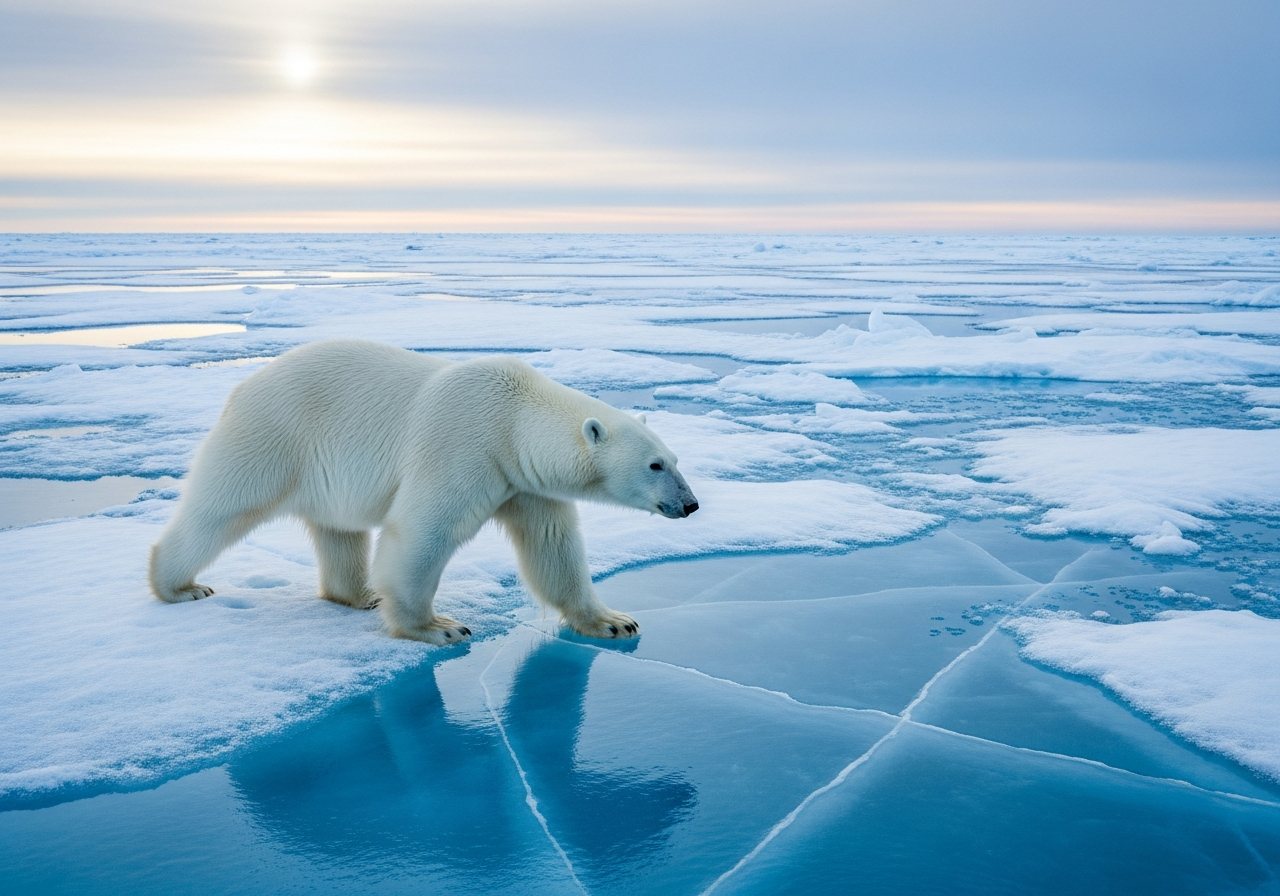
Polar bears live on Arctic sea ice and coasts — Canada, Greenland, Russia, Svalbard and Alaska. They are not in Antarctica. IUCN lists them Vulnerable because that ice is shrinking. “Farms, suburbs and roads” is the wrong habitat sentence. Figures checked 13 August 2026.
Arctic, not Antarctica — which coasts?
Circumpolar sea ice of the northern hemisphere, plus adjacent tundra coasts for maternity dens and ice-free summers. Five range states: Canada, Greenland (Denmark), Russia, Norway (Svalbard) and the United States (Alaska). They are not evenly spread; PBSG maps 20 relatively discrete subpopulations, not one nomadic herd.
What microhabitats do they actually use?
Active ice for still-hunting seals, snow dens for cubs, and coastal travel routes. Some southeast Greenland bears use freshwater fjord ice when sea ice fails — an exception that proves the rule that ice, not open water alone, is the habitat. Edge towns are conflict zones, not “opportunity.”
How do people change the map?
Greenhouse emissions shrink the hunting platform. Industrial activity, shipping and some harvest add local pressure. This is not a “farms, suburbs and roads create opportunity” story. Hungry bears on land near communities raise defence kills — a range-edge problem caused by missing ice, not by suburban bird feeders.
What does Vulnerable geography require?
Status: Vulnerable. A fenced reserve cannot replace sea ice. Watch from a distance; never feed wild polar bears. Global abundance remains on the order of 22,000–31,000 — a threatened species with a still-large count, which is exactly why the ice forecast sits in the Red List rationale.
Why is ice the habitat, not just the scenery?
Ringed and bearded seals are taken at breathing holes and lairs. No ice, no blubber economy. That is why this page refuses a generic terrestrial habitat template.
Marine mammals on a shrinking map
Classed as marine mammals because the ocean feeds them. They swim long distances when ice gaps open. WARN’s habitat appeal funds partners — World Animal Rescue Network does not run Arctic field camps.
Sources
Polar Bear FAQs
Where do polar bears live?
Circumpolar Arctic only: sea ice and adjacent coasts of Canada, Greenland, Russia, Svalbard (Norway) and Alaska. IUCN lists them Vulnerable. They do not live in Antarctica. “Farms, suburbs and roads” is the wrong habitat paragraph for this species.
Do polar bears live in Antarctica?
No. Penguins are the Antarctic icon; polar bears are Arctic. Mixing the poles is the most common error on this page. There is no wild polar bear south of the equator.
How many polar bears are there across that range?
The Polar Bear Specialist Group still cites about 26,000 globally (95% CI 22,000–31,000). They are split among 20 subpopulations, not one nomadic herd. Some units are data deficient. Figures checked 13 August 2026.
What actually protects polar bear range?
Sea ice that lasts long enough to hunt seals. World Animal Rescue Network’s habitat appeal funds partners; WARN does not run Arctic field camps.
Who this page is for. This page is native range and habitat, not a sighting hotline.