Image sourcing: see credits & licences
Quick answer
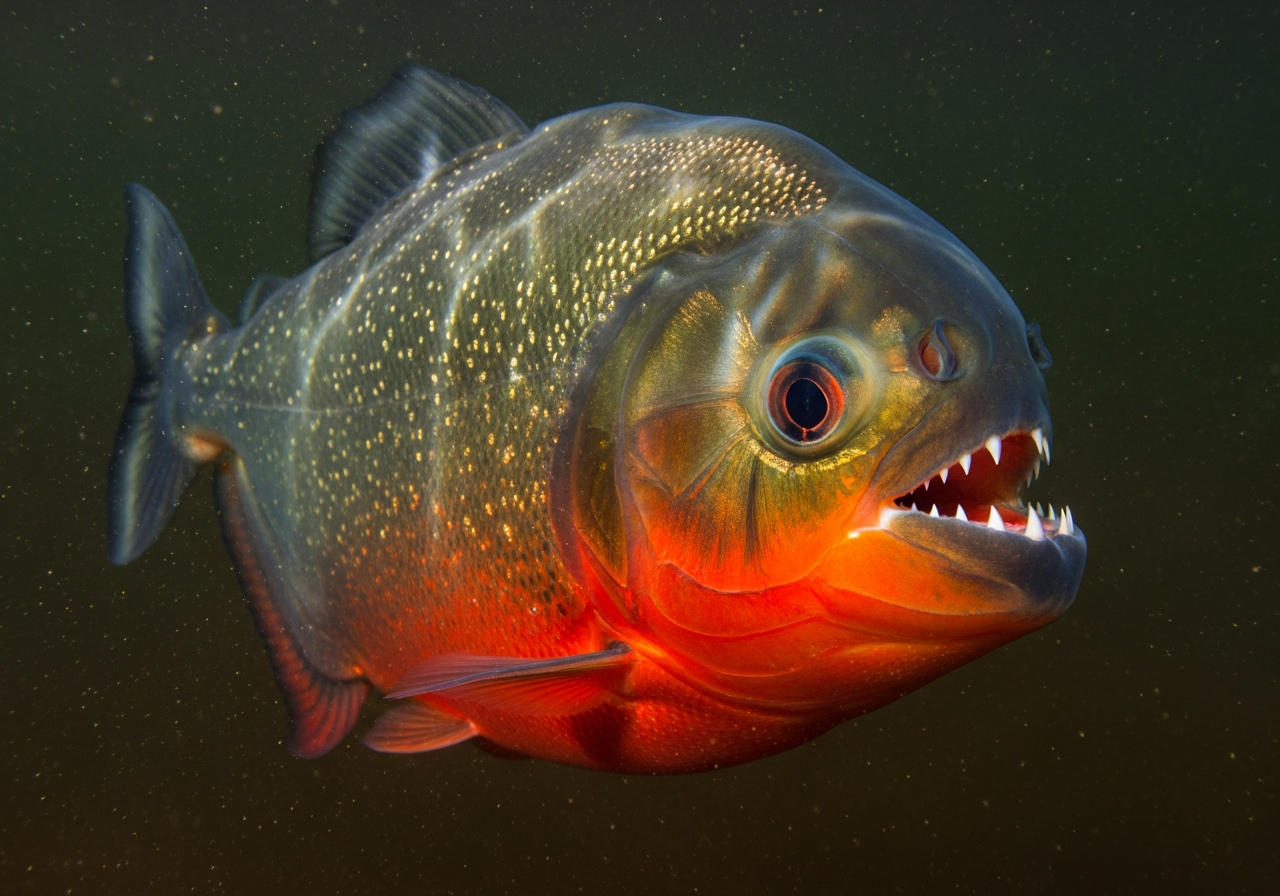
The red-bellied piranha (Pygocentrus nattereri) is a freshwater fish of the Amazon basin, famous for its interlocking triangular teeth and reddish belly. Adults grow to about 20 to 35 cm long and weigh up to roughly 1.5 kg, swimming in large shoals through rivers, streams and flooded forests. Despite their fearsome reputation, they are mainly scavengers and opportunistic feeders. They are common and listed as Least Concern.
Top questions about the Red-bellied Piranha
Red-bellied Piranha facts at a glance
- Weight 1.5 kg
- Length 33 cm
- Top speed 25 km/h
- Lifespan 10 years
| Scientific name | Pygocentrus nattereri |
|---|---|
| Diet | Omnivore (mostly carnivorous) |
| Habitat | Amazon rivers, streams, and floodplains |
| Lifespan | About 10 years |
| Length | 20–35 cm (8–14 in) |
| Top speed | Fast in short bursts |
| Conservation status | Least Concern (IUCN) |
| Kingdom | Animalia |
|---|---|
| Phylum | Chordata |
| Class | Actinopterygii |
| Order | Characiformes |
| Family | Serrasalmidae |
| Genus | Pygocentrus |
Where it lives
The red-bellied piranha (Pygocentrus nattereri) is native to Rivers, streams, and floodplains of the Amazon basin and other river systems of tropical South America. — recorded across South America in this guide’s range summary.
For occurrence records, see GBIF species search and sources below.
How big is a red-bellied piranha?
An adult red-bellied piranha measures 33 cm long — about 19% of the height of an average adult person (1.73 m) — and weighs around 1.5 kg, about 2% of an average adult’s body weight (70 kg).
Length vs an average adult’s height (to scale)
What is a group of red-bellied piranhas called?
Group name (collective noun)
A group of Red-bellied Piranhas is called a shoal. It is also known as a school.
Baby name
A baby Red-bellied Piranha is called a fry.
Explore more animal collective nouns and baby animal names .
Teeth and feeding
Red-bellied piranhas have a single row of sharp, triangular teeth in each jaw that lock together like a pair of scissors, letting them shear off pieces of flesh with a single snap. They are omnivores that are mostly carnivorous, eating fish, insects, crustaceans, worms and carrion, along with seeds and plant matter when animal food is scarce. Feeding frenzies do occur, but usually only when food is limited or a shoal encounters an easy meal such as a dead or injured animal. Much of the time they nip fins and scales from other fish rather than consuming whole prey.
Life in a shoal
Red-bellied piranhas gather in shoals that can number from a handful to several hundred fish. Rather than being packs of coordinated hunters, these groups are thought to offer protection from predators such as caimans, larger fish, river dolphins and birds. Fish on the edge of a shoal stay more alert, and the group provides safety in numbers for an animal that is itself widely eaten. Shoaling also helps them locate food and defend feeding sites.
Habitat and range
This species lives throughout the Amazon river basin and other river systems of tropical South America, favouring slow-moving rivers, streams, oxbow lakes and seasonally flooded forest. During the wet season they spread out across the inundated floodplain, where food is abundant and breeding takes place. As waters recede in the dry season, they become concentrated in shrinking pools, which is when reports of aggressive feeding are most common. They tolerate warm, oxygen-poor water better than many fish.
Reproduction
Breeding peaks in the wet season, when females scatter thousands of eggs among submerged vegetation in the flooded forest. Unusually for fish, red-bellied piranhas guard their nests, with parents defending the eggs and clearing a patch of plants to lay them on. The eggs hatch within a few days, and the fry shelter among plant cover until they are large enough to join a shoal. This parental care improves the survival of the young in predator-rich waters.
Reputation versus reality
Piranhas have a reputation as bloodthirsty killers that can strip an animal to the bone in minutes, an image cemented by adventure stories and film. In reality they are timid fish that spend much of their time avoiding predators, and healthy large animals crossing a river are usually ignored. Serious bites to people are rare and typically happen when fish are crowded into low water or handled by anglers. They do have genuinely powerful jaws, and a careless hand near a caught piranha can be badly nipped.
Dig deeper into the Red-bellied Piranha
- How Long Do Red-bellied Piranhas Live?
Red-bellied Piranha lifespan is typically About 10 years. What shortens or extends life, life stages, and status (Least Concern).
- Red-bellied Piranha: Key Facts
Red-bellied Piranhas (Pygocentrus nattereri) are fish found across South America. The sharp-toothed fish of the Amazon.
- What Do Red-bellied Piranhas Eat?
What red-bellied piranhas eat: Omnivore (mostly carnivorous), foraging style, and seasonal shifts in Amazon rivers, streams, and floodplains.
- Where Do Red-bellied Piranhas Live?
Where red-bellied piranhas live: Amazon rivers, streams, and floodplains, native range cues, and human overlap. Status Least Concern.
Explore the Red-bellied Piranha
Related Fishs
Range & geography
Did you know? Red-bellied Piranha facts
- The red-bellied piranha is a freshwater fish of South America's Amazon basin, known for its sharp, interlocking teeth and reddish belly.
- Attacks on people are uncommon and rarely serious, usually limited to nips on the feet or hands in shallow water. Most reported bites happen when fish are stressed, crowded, or food is scarce.
- Red-bellied piranhas are omnivores that mostly eat fish, insects, and crustaceans, and they also scavenge dead animals and consume seeds, fruit, and plants.
- Red-bellied piranhas usually grow 20 to 35 cm (8 to 14 in) long. They are powerful for their size but are not large fish.
- Piranhas form shoals mainly for protection from predators such as larger fish, caimans, and birds, rather than to hunt cooperatively.
- Conservation: Least Concern (IUCN).
Diet & feeding
Red-bellied Piranha feeds primarily as a omnivore (mostly carnivorous). Red-bellied piranhas live in groups called shoals, which is thought to offer protection from predators such as larger fish, caimans, and birds rather than being a hunting strategy. They communicate with barking and croaking sounds, especially when
Adaptations
- Red-bellied piranhas live in groups called shoals, which is thought to offer protection from predators such as larger fish, caimans, and birds rather than being a hunting strategy. They communicate with barking and croaking sounds, especially when threatened or competing for food. Despite their reputation, they are often skittish and can be more prey than predator in the rivers they inhabit.
- Piranhas are omnivores that lean toward a carnivorous diet of fish, insects, crustaceans, and worms, and they also eat seeds, fruit, and plant matter. They are important scavengers, cleaning up dead and dying animals in the water. Their sharp, triangular teeth and strong jaws allow them to bite off pieces of flesh quickly.
Behaviour & ecology
- Red-bellied piranhas live in groups called shoals, which is thought to offer protection from predators such as larger fish, caimans, and birds rather than being a hunting strategy. They communicate with barking and croaking sounds, especially when threatened or competing for food. Despite their reputation, they are often skittish and can be more prey than predator in the rivers they inhabit.
- Piranhas are omnivores that lean toward a carnivorous diet of fish, insects, crustaceans, and worms, and they also eat seeds, fruit, and plant matter. They are important scavengers, cleaning up dead and dying animals in the water. Their sharp, triangular teeth and strong jaws allow them to bite off pieces of flesh quickly.
- The red-bellied piranha lives in the Amazon basin and other river systems of tropical South America, including parts of Brazil, Venezuela, and Argentina. It favors slow-moving rivers, streams, oxbow lakes, and flooded forests. During the dry season, falling water levels can concentrate piranhas in shrinking pools.
Communication
- Lateral-line and visual cues coordinate schooling, courtship, or territorial behaviour.
- Some species produce low-frequency sounds or drumming for spawning or defence.
Habitat & range
Amazon rivers, streams, and floodplains
Ecological role
Red-bellied Piranha acts as a predator that helps regulate prey populations and maintain balance in amazon rivers, streams, and floodplains.
Conservation status of the Red-bellied Piranha
The red-bellied piranha (Pygocentrus nattereri) is listed as Least Concern on the IUCN Red List. Least Concern (LC) is the IUCN's lowest-risk category, assigned to widespread, abundant species that have been evaluated and found not to be threatened. It does not mean a species faces no pressures — only that it is not currently at risk of extinction.
The red-bellied piranha (Pygocentrus nattereri) is assessed on the IUCN Red List. Look up on the IUCN Red List .
Frequently asked questions about the Red-bellied Piranha
Do piranhas really attack humans?
Attacks on people are rare and rarely serious. Most bites happen when piranhas are trapped in shrinking dry-season pools or when anglers handle them. Healthy swimmers are generally ignored, though a caught piranha can deliver a painful nip.
What do red-bellied piranhas eat?
They are omnivores that feed mostly on animal matter, including fish, insects, crustaceans, worms and carrion. They also eat seeds and plants when other food is scarce. Much of their diet comes from scavenging and nipping the fins of other fish.
How big do red-bellied piranhas get?
Adults typically reach about 20 to 35 cm in length and weigh up to around 1.5 kg. They are stocky, deep-bodied fish, but they are far smaller than their fearsome reputation suggests.
Why do piranhas swim in groups?
Piranhas form shoals mainly for protection rather than for hunting. Grouping together reduces each fish's chance of being taken by predators such as caimans, birds and larger fish. The shoal also helps them find food and defend feeding areas.
Are piranhas endangered?
No. The red-bellied piranha is common and widespread across the Amazon basin and is listed as Least Concern by the IUCN. It is not considered threatened and remains an abundant fish across its range.
How long do piranhas live?
Red-bellied piranhas live for about 10 years. They can live longer in aquariums with good care, where they are sometimes kept, though their strong jaws demand caution from keepers.
What is a group of red-bellied piranhas called?
A group of Red-bellied Piranhas is called a shoal. It is also known as a school.
What is a baby red-bellied piranha called?
A baby Red-bellied Piranha is called a fry.
Sources & references
This guide is compiled and reviewed against established zoological and conservation references. Key sources for the Red-bellied Piranha:
-
IUCN Red List of Threatened Species
Conservation status (Least Concern) reflects the IUCN Red List category for Pygocentrus nattereri.
-
iNaturalist — observations & photos
Search citizen-science observations and community IDs for Pygocentrus nattereri. Useful for range checks and recent sightings — not a substitute for formal Red List status.
-
GBIF — occurrence data
Global Biodiversity Information Facility species search for Pygocentrus nattereri. Explore published occurrence records used in range research.
- IUCN Red List — Pygocentrus nattereri.
Conservation status (Least Concern) and population trends.
- Animal Diversity Web — Pygocentrus nattereri. University of Michigan Museum of Zoology.
Life history, morphology, and range.
- Wikipedia — Red-bellied Piranha.
General taxonomy and overview (cross-check primary sources).
-
Global Animal Guide editorial standards
How we research, source, review, and update every guide for accuracy.