Hammerhead Shark
Sphyrnidae
Quick answer
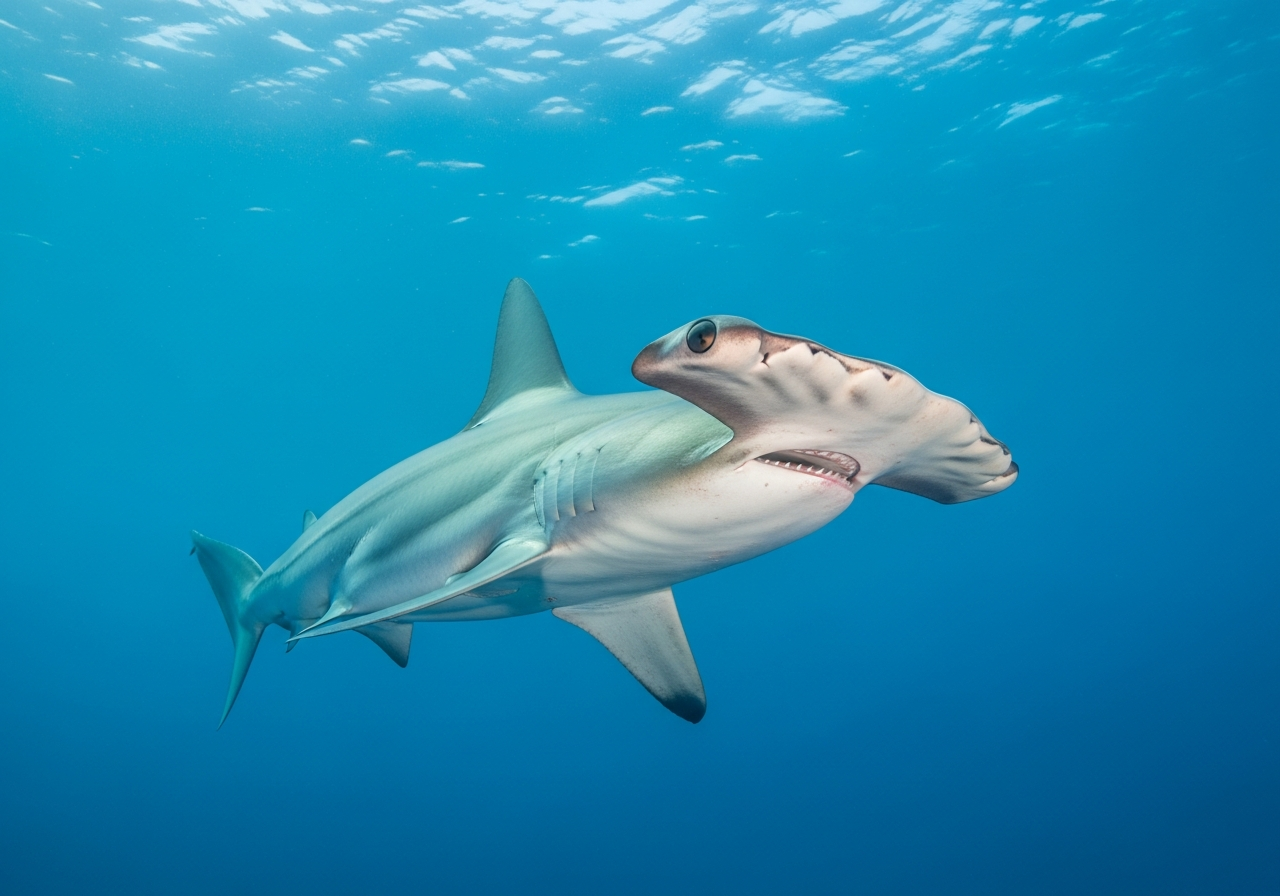
Hammerhead sharks are a family of coastal and open-ocean sharks (Sphyrnidae) instantly recognised by the flattened, hammer-shaped head, or cephalofoil, that spreads their eyes and sensory organs wide apart. Species range from under a metre to more than 6 m long, with large individuals weighing around 230 kg. They swim through warm seas worldwide, hunting fish, squid and rays, and can live 20 to 30 years or more. The great hammerhead is listed as Critically Endangered.
Hammerhead Shark facts at a glance
| Scientific name | Sphyrnidae (family) |
|---|---|
| Diet | Carnivore |
| Habitat | Warm coastal and open oceans worldwide |
| Lifespan | 20–30 years or more |
| Length | 0.9 m to over 6 m by species |
| Top speed | Around 40 km/h (25 mph) in bursts |
| Conservation status | Critically Endangered (great hammerhead) |
| Kingdom | Animalia |
|---|---|
| Phylum | Chordata |
| Class | Chondrichthyes |
| Order | Carcharhiniformes |
| Family | Sphyrnidae |
| Genus | Sphyrna |
Where it lives
Warm coastal and open waters worldwide, in temperate and tropical seas of all major oceans.
What is a group of hammerhead sharks called?
Group name (collective noun)
A group of Hammerhead Sharks is called a shiver. It is also known as a school.
Baby name
A baby Hammerhead Shark is called a pup.
Explore more animal collective nouns and baby animal names .
The hammer-shaped head
The wide, flattened head that gives these sharks their name is called a cephalofoil, and it is more than an odd silhouette. Spacing the eyes far apart gives the shark a broader field of vision, while the underside is packed with electroreceptors called ampullae of Lorenzini that detect the faint electrical signals of buried prey. Sweeping the head from side to side lets a hammerhead scan the seabed like a metal detector. The shape also acts as a hydrofoil, helping the shark bank and turn sharply as it swims.
Hunting and diet
Hammerheads are carnivores that feed on bony fish, squid, octopus, crustaceans and other sharks, but they are best known for hunting stingrays. A hammerhead will pin a ray to the seabed with the edge of its head, then pivot to take bites from the disc. Many individuals seem largely unbothered by the venomous barbs of their prey, and rays recovered from their stomachs are sometimes studded with spines. Larger species hunt alone, cruising close to the bottom where their electrical sense works best.
Size and species
The family Sphyrnidae contains around nine species, and they vary enormously in size. The small bonnethead reaches under a metre, while the great hammerhead can exceed 6 m and weigh in the region of 230 kg, making it one of the largest predatory sharks. The scalloped and smooth hammerheads fall between these extremes. Despite their formidable appearance, hammerheads pose little danger to people, and unprovoked bites are very rare.
Where they live
Hammerheads swim through warm temperate and tropical waters around the world, along coastlines, over continental shelves and out into the open ocean. They are found from shallow lagoons and coral reefs to depths of several hundred metres. Some species, notably the scalloped hammerhead, gather in large schools around seamounts and offshore islands, particularly by day. These aggregations can number in the hundreds and are a famous sight for divers.
Reproduction
Hammerheads give birth to live young rather than laying eggs, nourishing the developing pups through a placenta-like connection inside the mother. Litters range from around a dozen to more than 40 pups depending on the species. The newborns are miniature versions of the adults, with heads that are more rounded at birth and flatten as they grow. Coastal nursery areas in shallow water shelter the young from larger predators during their vulnerable first months.
Why the great hammerhead is Critically Endangered
The great hammerhead is listed as Critically Endangered by the IUCN, and several other hammerhead species are also threatened. Their large fins are highly valued in the shark-fin trade, and the sharks are frequently caught both deliberately and as bycatch in commercial fisheries. Hammerheads are especially vulnerable because they are slow to mature and produce relatively few young. They also suffer very high stress levels when hooked, so many die even when released.
Dig deeper into the Hammerhead Shark
- Are Hammerhead Shark Endangered
Dig deeper into hammerhead shark — are hammerhead shark endangered.
- Hammerhead Shark Guide 5
Dig deeper into hammerhead shark — hammerhead shark guide 5.
- How Long do Hammerhead Shark Live?
Dig deeper into hammerhead shark — how long do hammerhead shark live.
- What do Hammerhead Shark Eat
Dig deeper into hammerhead shark — what do hammerhead shark eat.
- Where do Hammerhead Shark Live?
Dig deeper into hammerhead shark — where do hammerhead shark live.
Explore the Hammerhead Shark
Compare
Related Fishs
Collections
Range & geography
Did you know? Hammerhead Shark facts
- The hammerhead's wide head, called a cephalofoil, spreads its senses far apart.
- This gives hammerheads exceptional 360-degree vertical vision.
- Electroreceptors across the head help detect prey hidden in the sand.
- Some hammerheads form large schools by day, unusual among sharks.
- Great hammerheads are powerful predators of rays, which they pin with the head.
- Several hammerhead species are now endangered from overfishing.
Diet & feeding
Hammerheads prey on fish, cephalopods, crustaceans, and especially rays — great hammerheads are ray specialists, using the broad head to pin prey against the seabed.
Adaptations
- The wide cephalofoil spreads electroreceptors and eyes to improve prey detection. (Compagno 2001)
- Widely spaced eyes provide an exceptional field of view.
- Enhanced electroreception locates rays and other prey buried in sediment.
- A manoeuvrable body lets great hammerheads pin stingrays with the head.
Behaviour & ecology
- Some hammerheads school in large numbers during the day, dispersing to hunt at night.
- Great hammerheads specialise on rays, using the head to trap them.
- They patrol reefs, seamounts, and coastal waters in search of prey.
- Many undertake seasonal migrations.
Communication
- Hammerheads rely on body posture and movement in social and threat contexts.
- Electroreception and other senses dominate prey detection over signalling.
- Schooling behaviour is coordinated by shared cues rather than vocalisation.
Habitat & range
Hammerhead sharks occupy warm coastal and offshore waters worldwide, frequenting reefs, continental shelves, and seamounts.
Ecological role
As mid-to-apex marine predators, hammerheads regulate populations of rays, fish, and cephalopods, helping maintain reef and coastal ecosystem balance.
Conservation status of the Hammerhead Shark
Critically Endangered (CR) is the highest-risk category the IUCN Red List assigns to a wild species before Extinct in the Wild. It means a species faces an extremely high probability of extinction — usually because its population has collapsed, its range has shrunk drastically, or very few mature individuals remain. Species at this level typically depend on active conservation to survive.
The hammerhead shark (Sphyrnidae) is assessed on the IUCN Red List. Look up on the IUCN Red List .
Frequently asked questions about the Hammerhead Shark
Why do hammerhead sharks have such strange heads?
The wide, flattened head, called a cephalofoil, spreads the eyes and electrical sensors far apart. This gives the shark a wider field of vision and a better ability to detect prey hidden in the sand. The shape also helps the shark turn quickly as it swims.
Are hammerhead sharks dangerous to humans?
Hammerheads look intimidating but rarely pose a threat to people. Unprovoked bites are extremely uncommon, and most encounters involve the shark simply swimming away. Only the largest species could realistically injure a swimmer, and they show little interest in humans.
How big do hammerhead sharks get?
Size varies greatly by species. The small bonnethead stays under a metre, while the great hammerhead can exceed 6 m and weigh around 230 kg. This makes the great hammerhead one of the largest predatory sharks in the ocean.
What do hammerhead sharks eat?
Hammerheads are carnivores that eat fish, squid, octopus, crustaceans and other sharks. They are particularly known for hunting stingrays, which they pin to the seabed with their broad heads. They often appear immune to the rays' venomous barbs.
How long do hammerhead sharks live?
Hammerheads are long-lived sharks, typically reaching 20 to 30 years and sometimes more. Their slow growth and late maturity are part of why overfishing has hit their populations so hard, as they cannot replace their numbers quickly.
Why are hammerhead sharks endangered?
The great hammerhead is Critically Endangered, mainly because of the shark-fin trade and heavy accidental capture in fisheries. Hammerheads mature slowly and have small litters, so populations recover slowly. They also die easily from the stress of being hooked, even when released.
What is a group of hammerhead sharks called?
A group of Hammerhead Sharks is called a shiver. It is also known as a school.
What is a baby hammerhead shark called?
A baby Hammerhead Shark is called a pup.
Sources & references
This guide is compiled and reviewed against established zoological and conservation references. Key sources for the Hammerhead Shark:
-
IUCN Red List of Threatened Species
Conservation status (Critically Endangered) reflects the IUCN Red List category for Sphyrnidae.
- Rigby, C. L. et al. (2019). Sphyrna mokarran. IUCN Red List of Threatened Species.
Status (Critically Endangered) for great hammerhead.
- Compagno, L. J. V. (2001). Sharks of the World. FAO Species Catalogue for Fishery Purposes.
Taxonomy and biology.
- Froese, R. & Pauly, D. (eds.). FishBase — Sphyrna.
Size, distribution, and biology.
-
Global Animal Guide editorial standards
How we research, source, review, and update every guide for accuracy.