Orchid Mantis
Hymenopus coronatus
Quick answer
Orchid Mantiss (Hymenopus coronatus) are insects found across Asia. The Southeast Asian insect that mimics a flower to lure and ambush prey. Adults typically weigh roughly 0.003 kg (0 lb), reach speeds of up to 3 km/h (2 mph), and live Females around 8 months; males shorter. They feed on carnivore (insects, especially pollinators) and are listed as Least Concern on the IUCN Red List. Tropical rainforests of Southeast Asia, including Malaysia, Indonesia, and Thailand.
Orchid Mantis facts at a glance
| Scientific name | Hymenopus coronatus |
|---|---|
| Diet | Carnivore (insects, especially pollinators) |
| Habitat | Tropical rainforests of Southeast Asia |
| Lifespan | Females around 8 months; males shorter |
| Size (female) | Around 6–7 cm (2.4–2.8 in) |
| Size (male) | Around 2.5–3 cm — far smaller than the female |
| Conservation status | Least Concern |
| Kingdom | Animalia |
|---|---|
| Phylum | Arthropoda |
| Class | Insecta |
| Order | Mantodea |
| Family | Hymenopodidae |
| Genus | Hymenopus |
Where it lives
Tropical rainforests of Southeast Asia, including Malaysia, Indonesia, and Thailand.
What is a group of orchid mantises called?
Group name (collective noun)
A group of Orchid Mantises is called a swarm.
Baby name
A baby Orchid Mantis is called a nymph.
Explore more animal collective nouns and baby animal names .
Range and habitat
Orchid Mantises inhabit Tropical rainforests of Southeast Asia, including Malaysia, Indonesia, and Thailand. Their preferred habitat includes tropical rainforests of southeast asia, where they find food, shelter, and breeding sites. Population density varies with prey availability, water access, and human disturbance. Protected areas and intact corridors remain essential for long-term persistence across Asia.
Physical characteristics and behaviour
Adult orchid mantises typically measure about 0.07 m in length and weigh roughly 0.003 kg (0 lb). They can sprint at up to 3 km/h (2 mph) when hunting or escaping predators. Orchid Mantiss are known for the southeast asian insect that mimics a flower to lure and ambush prey — social structure, daily activity, and seasonal movements all reflect pressures in their native environment.
Diet and ecological role
Orchid Mantises feed primarily on carnivore (insects, especially pollinators). Foraging strategy depends on season, local prey or plant abundance, and competition with other species. As insects, they play a measurable role in their ecosystem — controlling prey numbers, dispersing seeds, or shaping habitat through feeding and movement patterns that other wildlife depends on.
Conservation and human interaction
The IUCN lists orchid mantises as Least Concern. Habitat loss, hunting, climate change, and conflict with people are among the main threats worldwide. Responsible ecotourism, anti-poaching patrols, and community-based conservation help in parts of their range. Never approach or feed wild orchid mantises — observe from a safe distance and support reputable conservation organisations.
Dig deeper into the Orchid Mantis
- Orchid Mantis Facts 3
Dig deeper into orchid mantis — orchid mantis facts 3.
- Orchid Mantis Facts 4
Dig deeper into orchid mantis — orchid mantis facts 4.
- Orchid Mantis Facts 5
Dig deeper into orchid mantis — orchid mantis facts 5.
- What do Orchid Mantis Eat
Dig deeper into orchid mantis — what do orchid mantis eat.
- Where do Orchid Mantis Live?
Dig deeper into orchid mantis — where do orchid mantis live.
Explore the Orchid Mantis
Related Insects
Range & geography
Did you know? Orchid Mantis facts
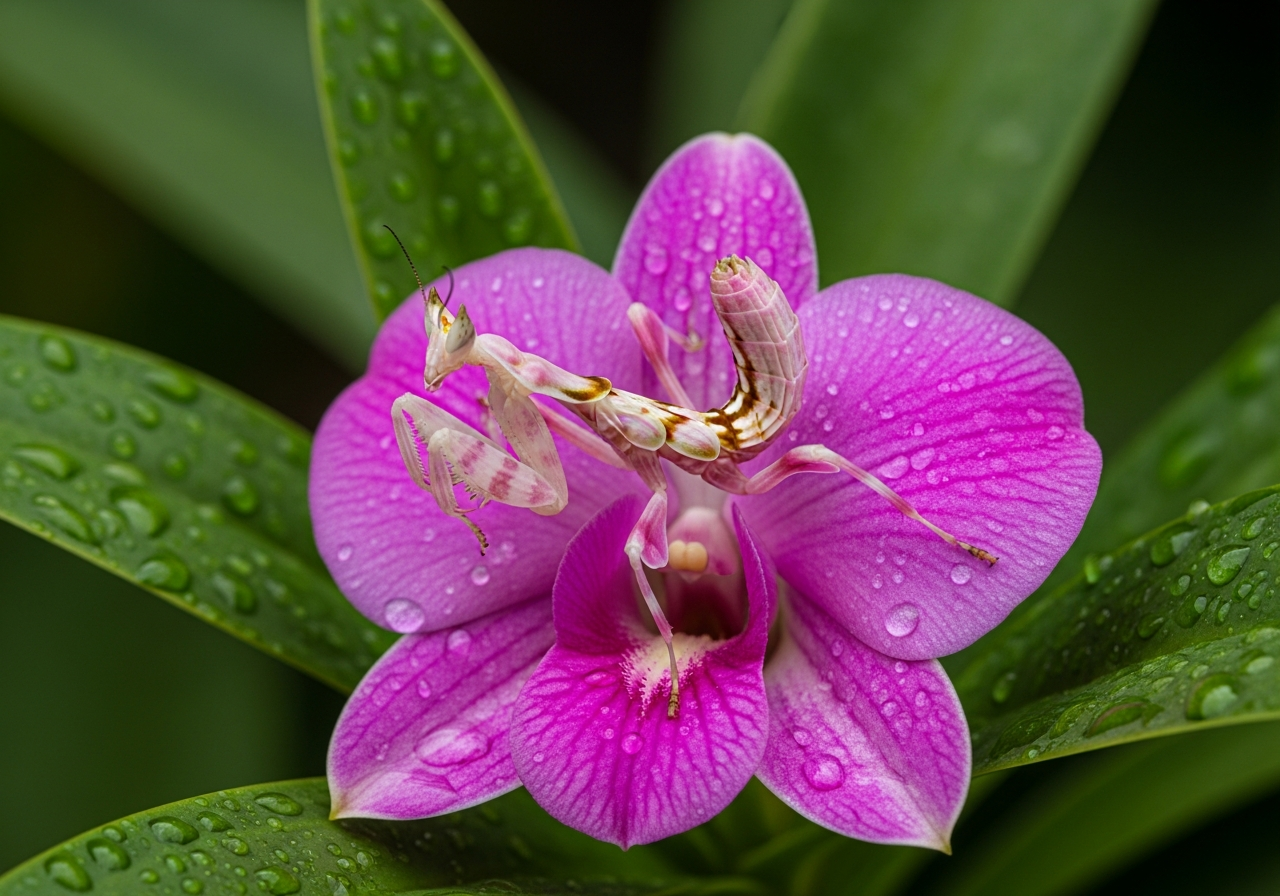
- The orchid mantis (Hymenopus coronatus) is a praying mantis from Southeast Asian rainforests whose flattened, lobed legs and pink-and-white colouring make it look convincingly like a flower.
- Not specifically. The 'orchid' in its name refers to its appearance, not its habitat preference. It perches on various flowers and foliage wherever pollinators are active and does not require orchids.
- Yes, it is a genuine insect. Hymenopus coronatus is a well-studied praying mantis native to Southeast Asian rainforests, and its extraordinary camouflage has been confirmed by peer-reviewed scientific research.
- Its flower-like appearance causes pollinators to land on it as they would on a real flower. Once within striking distance, the mantis seizes the insect with its spiked forelegs in a strike that can be completed in a fraction of a second.
- Extreme sexual size dimorphism in mantids is thought to reflect different ecological roles: the large female needs more energy for prey capture and egg production, while the small male needs only enough resources to mature and find a mate. Smaller males may also be less likely to trigger the female's predatory response.
- Conservation: Least Concern.
Diet & feeding
Orchid Mantis feeds primarily as a carnivore (insects, especially pollinators). The orchid mantis does not use its camouflage merely to avoid being seen — it uses it to attract prey. Research published in the journal Current Biology confirmed that pollinators (bees, flies, butterflies) are drawn to a resting orchid man
Adaptations
- The orchid mantis does not use its camouflage merely to avoid being seen — it uses it to attract prey. Research published in the journal Current Biology confirmed that pollinators (bees, flies, butterflies) are drawn to a resting orchid mantis as if it were a flower, and in controlled experiments they were attracted to the mantis even more readily than to some real flowers nearby. This 'aggressive mimicry,' where a predator resembles something harmless or appealing to its prey, is one of the clearest and most studied examples of the phenomenon in any animal.
- The orchid mantis has pale pink to white petal-shaped lobes on its legs (lobuli) that closely resemble flower petals. Its body is flattened and contoured to break up the recognisable outline of an insect. Juveniles tend to be more vividly pink; adults may be whiter or more variable. The mantis perches on stems, leaves, or foliage rather than on orchids specifically — it looks like an orchid flower without needing to be on one to fool pollinators.
Behaviour & ecology
- The orchid mantis does not use its camouflage merely to avoid being seen — it uses it to attract prey. Research published in the journal Current Biology confirmed that pollinators (bees, flies, butterflies) are drawn to a resting orchid mantis as if it were a flower, and in controlled experiments they were attracted to the mantis even more readily than to some real flowers nearby. This 'aggressive mimicry,' where a predator resembles something harmless or appealing to its prey, is one of the clearest and most studied examples of the phenomenon in any animal.
- The orchid mantis has pale pink to white petal-shaped lobes on its legs (lobuli) that closely resemble flower petals. Its body is flattened and contoured to break up the recognisable outline of an insect. Juveniles tend to be more vividly pink; adults may be whiter or more variable. The mantis perches on stems, leaves, or foliage rather than on orchids specifically — it looks like an orchid flower without needing to be on one to fool pollinators.
- Female orchid mantises are roughly twice the length of males and significantly heavier — one of the most extreme sexual size differences of any mantis species. Females can tackle much larger prey, including small lizards and frogs, while males are small enough that females sometimes eat them. Mating is consequently a risky endeavour for males, who must approach a much larger potential predator.
Communication
- Orchid Mantis uses scent, posture, and vocal signals to mark territory and coordinate social behaviour.
- Communication intensity often peaks during breeding seasons and territorial disputes.
Habitat & range
Tropical rainforests of Southeast Asia
Ecological role
Orchid Mantis acts as a predator that helps regulate prey populations and maintain balance in tropical rainforests of southeast asia.
Frequently asked questions about the Orchid Mantis
Where do orchid mantises live?
Orchid Mantises are native to Asia. Tropical rainforests of Southeast Asia, including Malaysia, Indonesia, and Thailand.
What do orchid mantises eat?
They feed on carnivore (insects, especially pollinators), adjusting seasonally based on what is available in Tropical rainforests of Southeast Asia.
How long do orchid mantises live?
Females around 8 months; males shorter. Captive individuals sometimes live longer with veterinary care and steady nutrition.
How big is a orchid mantis?
Adults weigh roughly 0.003 kg (0 lb) and reach roughly 0.07 metres long; males are often larger than females.
Are orchid mantises endangered?
Orchid Mantises are listed as Least Concern on the IUCN Red List. Threats include habitat loss, hunting, and human-wildlife conflict.
How fast can a orchid mantis run?
Orchid Mantises can reach about 3 km/h (2 mph) in short bursts.
What is a group of orchid mantises called?
A group of Orchid Mantises is called a swarm.
What is a baby orchid mantis called?
A baby Orchid Mantis is called a nymph.
Sources & references
This guide is compiled and reviewed against established zoological and conservation references. Key sources for the Orchid Mantis:
-
IUCN Red List of Threatened Species
Conservation status (Least Concern) reflects the IUCN Red List category for Hymenopus coronatus.
- IUCN Red List — Hymenopus coronatus.
Conservation status (Least Concern) and population trends.
- Animal Diversity Web — Hymenopus coronatus. University of Michigan Museum of Zoology.
Life history, morphology, and range.
- Wikipedia — Orchid Mantis.
General taxonomy and overview (cross-check primary sources).
-
Global Animal Guide editorial standards
How we research, source, review, and update every guide for accuracy.