Image sourcing: see credits & licences
The mountain goat (Oreamnos americanus) is a mammal of the family Bovidae, in the order Artiodactyla.
Quick answer
The mountain goat (Oreamnos americanus) is a sure-footed climber of alpine cliffs in western North America from Alaska and Yukon to Washington, Idaho, and Montana. Adults weigh around 80 kg, wear shaggy white coats, and graze alpine meadows. Listed Least Concern, with some introduced herds outside historic range.
Top questions about the Mountain Goat
Mountain Goat facts at a glance
- Weight 80 kg
- Length 1.5 m
- Top speed 25 km/h
- Lifespan 12 years
| Scientific name | Oreamnos americanus |
|---|---|
| Diet | Herbivore |
| Habitat | Alpine cliffs, meadows, and scree |
| Lifespan | Around 12 years in the wild (varies by population and captivity). |
| Weight | About 80 kg typical adult mass (sex and region vary). |
| Top speed | Up to roughly 25 km/h when moving at speed. |
| Conservation status | Least Concern (IUCN) |
| Kingdom | Animalia |
|---|---|
| Phylum | Chordata |
| Class | Mammalia |
| Order | Artiodactyla |
| Family | Bovidae |
| Genus | Oreamnos |
Where it lives
The mountain goat (Oreamnos americanus) is native to Alpine cliffs of western North America from Alaska and Yukon to Washington, Idaho, and Montana. — recorded across North America in this guide’s range summary.
For occurrence records, see GBIF species search and sources below.
How big is a mountain goat?
An adult mountain goat measures 1.5 m long — about 87% of the height of an average adult person (1.73 m) — and weighs around 80 kg, about 1.1× an average adult’s body weight (70 kg).
Length vs an average adult’s height (to scale)
What is a group of mountain goats called?
Group name (collective noun)
A group of Mountain Goats is called a band.
Baby name
A baby Mountain Goat is called a kid.
Explore more animal collective nouns and baby animal names .
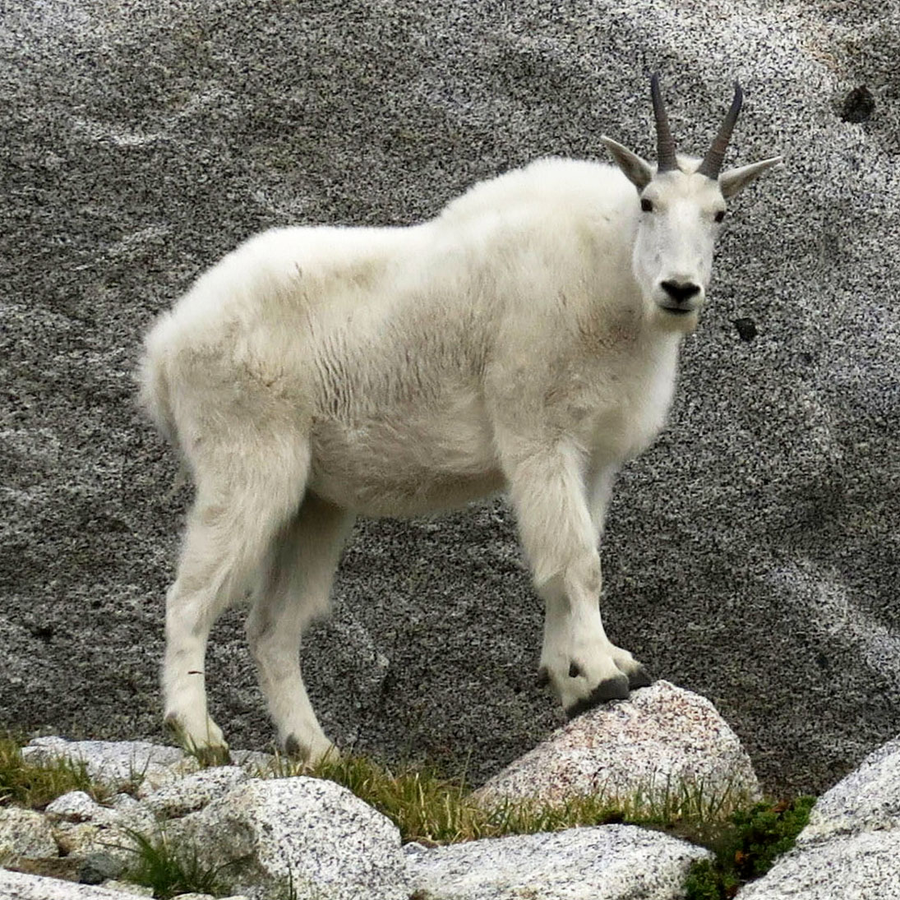
Cloven hooves on granite
Soft, grippy foot pads and muscular shoulders let goats traverse ledges predators cannot follow. Both sexes have black, slightly curved horns (not shed annually like deer antlers).
Alpine meadow browser
Diet includes grasses, herbs, mosses, and low shrubs of alpine and subalpine zones. Mineral licks draw herds to cliffs in spring. Across its range it is tied to alpine cliffs, meadows, and scree, and field accounts emphasise this species’ distinctive ecology rather than generic habitat labels.
Alaska to Cascades peaks
Alpine cliffs, meadows, and scree of western North America from Alaska and Yukon south to Washington, Idaho, and Montana; introduced populations exist in some ranges.
Climate and disturbance
Least Concern overall. Recreational disturbance at high-use peaks and shifting snow regimes are local concerns; hunting is regulated where permitted.
Explore the Mountain Goat
Close relatives
- Cow Same family
- Wildebeest Same family
- Domestic Goat Same family
- Saiga Antelope Same family
Range & geography
Conservation status of the Mountain Goat
The mountain goat (Oreamnos americanus) is listed as Least Concern on the IUCN Red List. Least Concern (LC) is the IUCN's lowest-risk category, assigned to widespread, abundant species that have been evaluated and found not to be threatened. It does not mean a species faces no pressures — only that it is not currently at risk of extinction.
The mountain goat (Oreamnos americanus) is assessed on the IUCN Red List. Look up on the IUCN Red List .
Frequently asked questions about the Mountain Goat
Are mountain goats true goats?
They are caprines related to goat-antelopes; not the same species as domestic goats.
Do mountain goats shed their horns?
No — horns are permanent and grow throughout life.
How do mountain goats climb cliffs?
Specialised hooves with rubbery pads and sharp edges grip tiny rock holds.
What is a baby mountain goat called?
A young mountain goat is called a kid — that is the usual English name for a young mountain goat.
Where do mountain goats live?
Alpine cliffs of western North America from Alaska and Yukon to the northwestern United States.
What is a group of mountain goats called?
A group of Mountain Goats is called a band.
Sources & references
This guide is compiled and reviewed against established zoological and conservation references. Key sources for the Mountain Goat:
-
IUCN Red List of Threatened Species
Conservation status (Least Concern) reflects the IUCN Red List category for Oreamnos americanus.
-
iNaturalist — observations & photos
Search citizen-science observations and community IDs for Oreamnos americanus. Useful for range checks and recent sightings — not a substitute for formal Red List status.
-
GBIF — occurrence data
Global Biodiversity Information Facility species search for Oreamnos americanus. Explore published occurrence records used in range research.
-
Global Animal Guide editorial standards
How we research, source, review, and update every guide for accuracy.