Image sourcing: see credits & licences
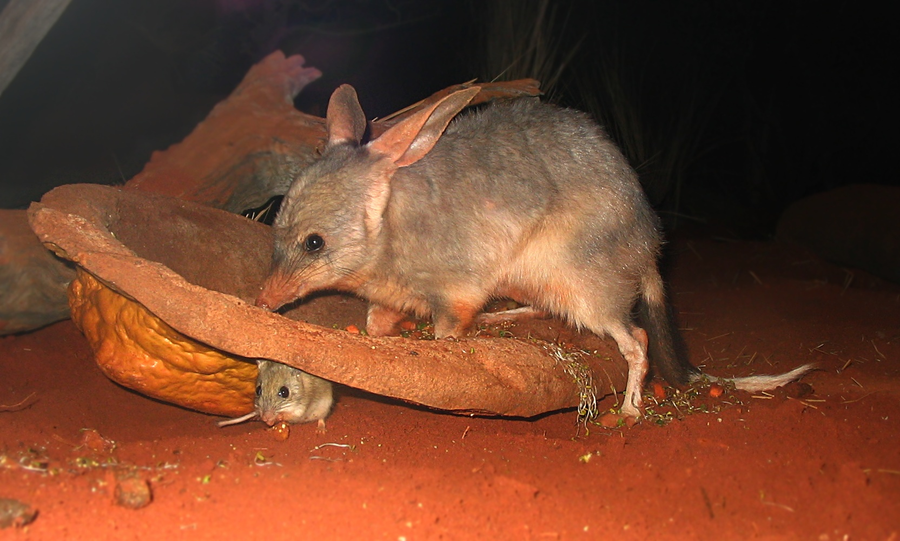
The greater bilby (Macrotis lagotis) is a mammal of the family Thylacomyidae, in the order Peramelemorphia.
Quick answer
The greater bilby (Macrotis lagotis) is a long-eared, burrowing bandicoot of arid Australia, nicknamed the "rabbit-eared bandicoot." It digs spiral burrows, eats insects, seeds, and fungi, weighs about 2 kg, and is Vulnerable after foxes, cats, and livestock transformed the deserts.
Top questions about the Greater Bilby
Greater Bilby facts at a glance
- Weight 2 kg
- Length 55 cm
- Top speed 25 km/h
- Lifespan 7 years
| Scientific name | Macrotis lagotis |
|---|---|
| Diet | Omnivore (insects, seeds, fungi) |
| Habitat | Desert grasslands and spinifex plains |
| Lifespan | Around 7 years in the wild (varies by population and captivity). |
| Weight | About 2 kg typical adult mass (sex and region vary). |
| Top speed | Up to roughly 25 km/h when moving at speed. |
| Conservation status | Vulnerable (IUCN) |
| Kingdom | Animalia |
|---|---|
| Phylum | Chordata |
| Class | Mammalia |
| Order | Peramelemorphia |
| Family | Thylacomyidae |
| Genus | Macrotis |
Where it lives
The greater bilby (Macrotis lagotis) is native to Arid Australia; strongholds in Western Australia, Northern Territory, and Queensland. — recorded across Oceania in this guide’s range summary.
For occurrence records, see GBIF species search and sources below.
How big is a greater bilby?
An adult greater bilby measures 55 cm long — about 32% of the height of an average adult person (1.73 m) — and weighs around 2.0 kg, about 3% of an average adult’s body weight (70 kg).
Length vs an average adult’s height (to scale)
What is a group of greater bilbies called?
Group name (collective noun)
A group of Greater Bilbies is called a colony.
Baby name
A baby Greater Bilby is called a joey.
Explore more animal collective nouns and baby animal names .
Spiral burrows and silky fur
Bilbies dig deep, spiralling burrows that buffer desert heat. Soft grey fur, a black-and-white tail, and enormous ears aid hearing and heat loss. They are nocturnal marsupials.
Insects, seeds, and fungi
Omnivorous diet includes insect larvae, termites, seeds, bulbs, and underground fungi. They do not need to drink free water when diet moisture suffices.
Arid Australia strongholds
Desert grasslands and spinifex plains with strongholds in Western Australia, Northern Territory, and Queensland. Once far more widespread across mainland Australia.
Vulnerable desert engineer
IUCN lists greater bilbies Vulnerable. Fox and cat predation, rabbits competing for burrows, and altered fire regimes remain key threats; reintroductions into fenced havens are expanding.
Explore the Greater Bilby
Close relatives
- Long-nosed Bandicoot Same order
- Lion Same class
- Dog Same class
- Tiger Same class
Collections
Range & geography
Conservation status of the Greater Bilby
The greater bilby (Macrotis lagotis) is listed as Vulnerable on the IUCN Red List. Vulnerable (VU) means a species faces a high risk of extinction in the medium-term future. It is the lowest-risk of the three 'threatened' IUCN categories — one step below Endangered, which is itself below Critically Endangered — and is often an early warning that a population is in trouble.
Main threats to the greater bilby
- Predation by introduced foxes and cats
- Habitat degradation from grazing and fire
- Competition with rabbits
- Changed fire regimes in arid Australia
Greater Bilby (Macrotis lagotis) was most recently assessed for the IUCN Red List in 2016. Look up on the IUCN Red List .
Frequently asked questions about the Greater Bilby
Why is the bilby Australia's Easter animal?
Conservation campaigns promote chocolate bilbies instead of rabbits — rabbits being an invasive pest that harmed bilbies.
Do bilbies dig like rabbits?
They dig extensive burrows but are marsupial bandicoots, not lagomorphs; burrow shape is often spiral.
What do bilbies eat?
Insects and larvae, seeds, bulbs, and fungi — an arid-zone omnivore diet.
Are bilbies Endangered?
Greater bilbies are Vulnerable; the lesser bilby is extinct.
Where do bilbies live?
Arid Australia, especially parts of Western Australia, Northern Territory, and Queensland.
What is a group of greater bilbies called?
A group of Greater Bilbies is called a colony.
What is a baby greater bilby called?
A baby Greater Bilby is called a joey.
Sources & references
This guide is compiled and reviewed against established zoological and conservation references. Key sources for the Greater Bilby:
-
IUCN Red List of Threatened Species
Conservation status (Vulnerable) reflects the IUCN Red List category for Macrotis lagotis, most recently assessed in 2016.
-
iNaturalist — observations & photos
Search citizen-science observations and community IDs for Macrotis lagotis. Useful for range checks and recent sightings — not a substitute for formal Red List status.
-
GBIF — occurrence data
Global Biodiversity Information Facility species search for Macrotis lagotis. Explore published occurrence records used in range research.
-
Global Animal Guide editorial standards
How we research, source, review, and update every guide for accuracy.