Monarch Butterfly
Danaus plexippus
Quick answer
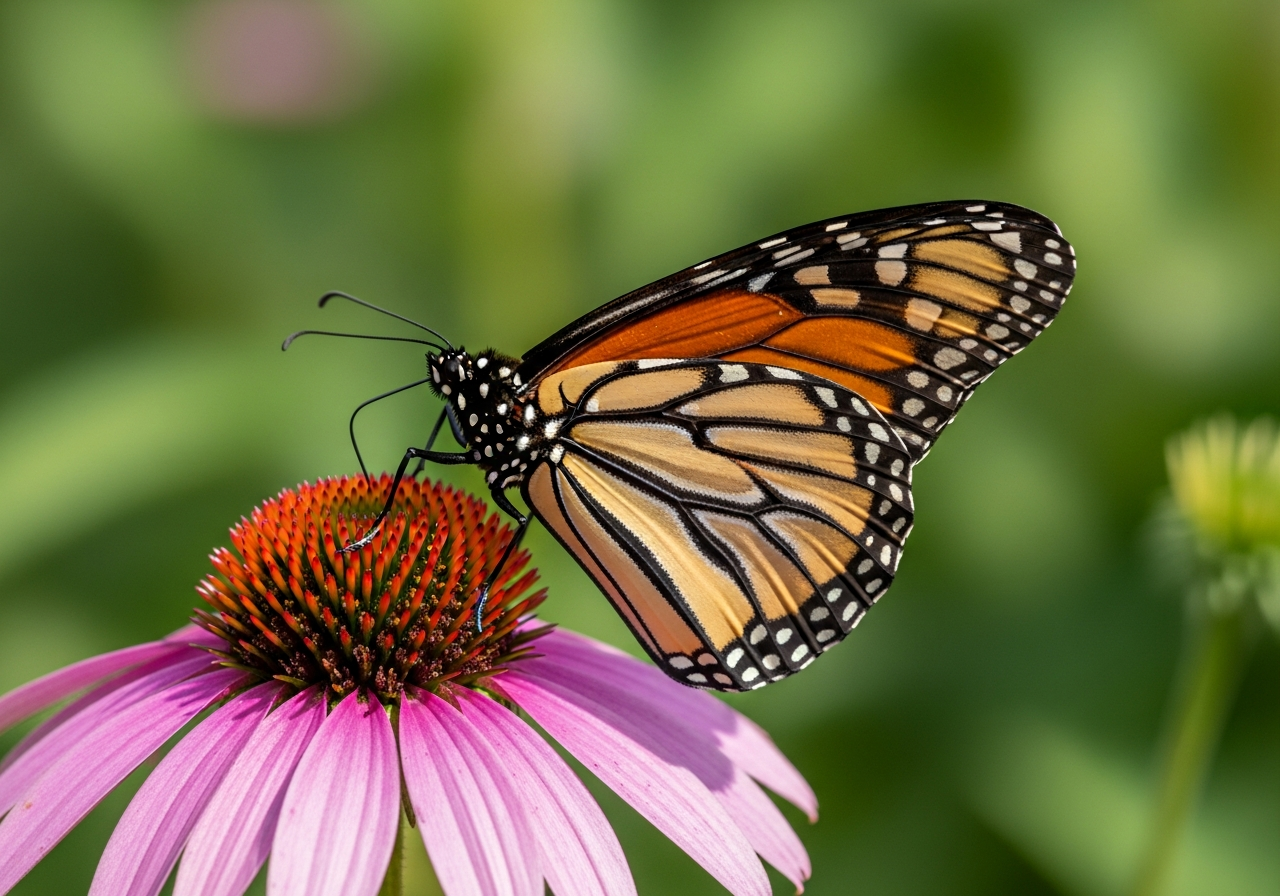
The monarch is a large orange-and-black butterfly famous for an epic multi-generation migration of up to 4,800 km (3,000 mi) between North America and central Mexico. Monarch caterpillars feed only on milkweed, which makes the adults toxic to predators. The migratory monarch is now listed as Vulnerable due to habitat loss.
Monarch Butterfly facts at a glance
| Scientific name | Danaus plexippus |
|---|---|
| Diet | Nectar (adult); milkweed (caterpillar) |
| Habitat | Meadows, fields, and gardens |
| Lifespan | 2–6 weeks; migratory generation up to 8 months |
| Wingspan | 8.9–10.2 cm (3.5–4 in) |
| Migration | Up to 4,800 km (3,000 mi) |
| Conservation status | Vulnerable (IUCN) |
| Kingdom | Animalia |
|---|---|
| Phylum | Arthropoda |
| Class | Insecta |
| Order | Lepidoptera |
| Family | Nymphalidae |
| Genus | Danaus |
Where it lives
Famous for its migration across North America, from Canada to the overwintering forests of central Mexico.
What is a group of monarch butterflies called?
Group name (collective noun)
A group of Monarch Butterflies is called a kaleidoscope. It is also known as a flutter or a swarm.
Baby name
A baby Monarch Butterfly is called a caterpillar. It may also be called a larva.
Explore more animal collective nouns and baby animal names .
The great migration
Each autumn, monarchs in eastern North America fly up to 4,800 km (3,000 mi) to a handful of mountain forests in central Mexico, where millions cluster on the same trees their great-grandparents used. No single butterfly makes the whole round trip; it takes several generations to complete the journey north again in spring.
Milkweed and toxicity
Monarch caterpillars eat only milkweed, absorbing the plant's toxins so that both the caterpillar and the adult butterfly taste foul and can poison predators. Their bold orange-and-black coloring is a warning signal, and the milkweed they depend on is essential to their survival.
From caterpillar to butterfly
A monarch goes through complete metamorphosis: egg, caterpillar, chrysalis, and adult. Inside the green, gold-flecked chrysalis the caterpillar's body is rebuilt into a winged butterfly over about two weeks. Summer adults live only a few weeks, but the special migratory generation can live up to eight months.
Conservation
The migratory monarch is listed as Vulnerable after steep population declines driven by loss of milkweed, habitat destruction in overwintering forests, pesticides, and climate change. Planting native milkweed and nectar flowers and protecting wintering sites are key to its recovery.
Dig deeper into the Monarch Butterfly
- Are Monarch Butterfly Endangered
Dig deeper into monarch butterfly — are monarch butterfly endangered.
- Monarch Butterfly Guide 5
Dig deeper into monarch butterfly — monarch butterfly guide 5.
- Monarch Migration
Dig deeper into monarch butterfly — monarch migration.
- What do Monarch Butterfly Eat
Dig deeper into monarch butterfly — what do monarch butterfly eat.
- Where do Monarch Butterfly Live?
Dig deeper into monarch butterfly — where do monarch butterfly live.
Explore the Monarch Butterfly
Collections
Range & geography
Did you know? Monarch Butterfly facts
- The monarch is a large orange-and-black butterfly famous for an epic multi-generation migration of up to 4,800 km (3,000 mi) between North America and central Mexico.
- Monarchs in eastern North America migrate up to 4,800 km (3,000 mi) to overwintering forests in central Mexico. It is one of the longest insect migrations known.
- Monarch caterpillars feed exclusively on milkweed, absorbing its toxins to become distasteful and poisonous to predators. Without milkweed, monarchs cannot reproduce, which is why its loss threatens the species.
- Most adult monarchs live only 2 to 6 weeks. The special generation that migrates in autumn enters a non-breeding state and can live up to about 8 months to complete the journey and overwinter.
- The migratory monarch is listed as Vulnerable on the IUCN Red List after large population declines. Habitat loss, milkweed decline, pesticides, and climate change are the main threats.
- Conservation: Vulnerable (IUCN).
Diet & feeding
Monarch Butterfly feeds primarily as a nectar (adult); milkweed (caterpillar). Each autumn, monarchs in eastern North America fly up to 4,800 km (3,000 mi) to a handful of mountain forests in central Mexico, where millions cluster on the same trees their great-grandparents used. No single butterfly makes the whole roun
Adaptations
- Each autumn, monarchs in eastern North America fly up to 4,800 km (3,000 mi) to a handful of mountain forests in central Mexico, where millions cluster on the same trees their great-grandparents used. No single butterfly makes the whole round trip; it takes several generations to complete the journey north again in spring.
- Monarch caterpillars eat only milkweed, absorbing the plant's toxins so that both the caterpillar and the adult butterfly taste foul and can poison predators. Their bold orange-and-black coloring is a warning signal, and the milkweed they depend on is essential to their survival.
Behaviour & ecology
- Each autumn, monarchs in eastern North America fly up to 4,800 km (3,000 mi) to a handful of mountain forests in central Mexico, where millions cluster on the same trees their great-grandparents used. No single butterfly makes the whole round trip; it takes several generations to complete the journey north again in spring.
- Monarch caterpillars eat only milkweed, absorbing the plant's toxins so that both the caterpillar and the adult butterfly taste foul and can poison predators. Their bold orange-and-black coloring is a warning signal, and the milkweed they depend on is essential to their survival.
- A monarch goes through complete metamorphosis: egg, caterpillar, chrysalis, and adult. Inside the green, gold-flecked chrysalis the caterpillar's body is rebuilt into a winged butterfly over about two weeks. Summer adults live only a few weeks, but the special migratory generation can live up to eight months.
Communication
- Monarch Butterfly uses scent, posture, and vocal signals to mark territory and coordinate social behaviour.
- Communication intensity often peaks during breeding seasons and territorial disputes.
Habitat & range
Meadows, fields, and gardens
Ecological role
Monarch Butterfly participates in pollination, decomposition, or prey-base support for birds and other insectivores.
Conservation status of the Monarch Butterfly
Vulnerable (VU) means a species faces a high risk of extinction in the medium-term future. It is the lowest-risk of the three 'threatened' IUCN categories — one step below Endangered, which is itself below Critically Endangered — and is often an early warning that a population is in trouble.
The monarch butterfly (Danaus plexippus) is assessed on the IUCN Red List. Look up on the IUCN Red List .
Frequently asked questions about the Monarch Butterfly
How far do monarch butterflies migrate?
Monarchs in eastern North America migrate up to 4,800 km (3,000 mi) to overwintering forests in central Mexico. It is one of the longest insect migrations known.
Why do monarch caterpillars only eat milkweed?
Monarch caterpillars feed exclusively on milkweed, absorbing its toxins to become distasteful and poisonous to predators. Without milkweed, monarchs cannot reproduce, which is why its loss threatens the species.
How long do monarch butterflies live?
Most adult monarchs live only 2 to 6 weeks. The special generation that migrates in autumn enters a non-breeding state and can live up to about 8 months to complete the journey and overwinter.
Are monarch butterflies endangered?
The migratory monarch is listed as Vulnerable on the IUCN Red List after large population declines. Habitat loss, milkweed decline, pesticides, and climate change are the main threats.
How can I help monarch butterflies?
Plant native milkweed for caterpillars and nectar-rich flowers for adults, avoid pesticides, and support the protection of their overwintering forests in Mexico and California.
What is a group of monarch butterflies called?
A group of Monarch Butterflies is called a kaleidoscope. It is also known as a flutter or a swarm.
What is a baby monarch butterfly called?
A baby Monarch Butterfly is called a caterpillar. It may also be called a larva.
Sources & references
This guide is compiled and reviewed against established zoological and conservation references. Key sources for the Monarch Butterfly:
-
IUCN Red List of Threatened Species
Conservation status (Vulnerable) reflects the IUCN Red List category for Danaus plexippus.
- IUCN Red List — Danaus plexippus.
Conservation status (Vulnerable) and population trends.
- Animal Diversity Web — Danaus plexippus. University of Michigan Museum of Zoology.
Life history, morphology, and range.
- Wikipedia — Monarch Butterfly.
General taxonomy and overview (cross-check primary sources).
-
Global Animal Guide editorial standards
How we research, source, review, and update every guide for accuracy.