Muskrat
Ondatra zibethicus
Quick answer
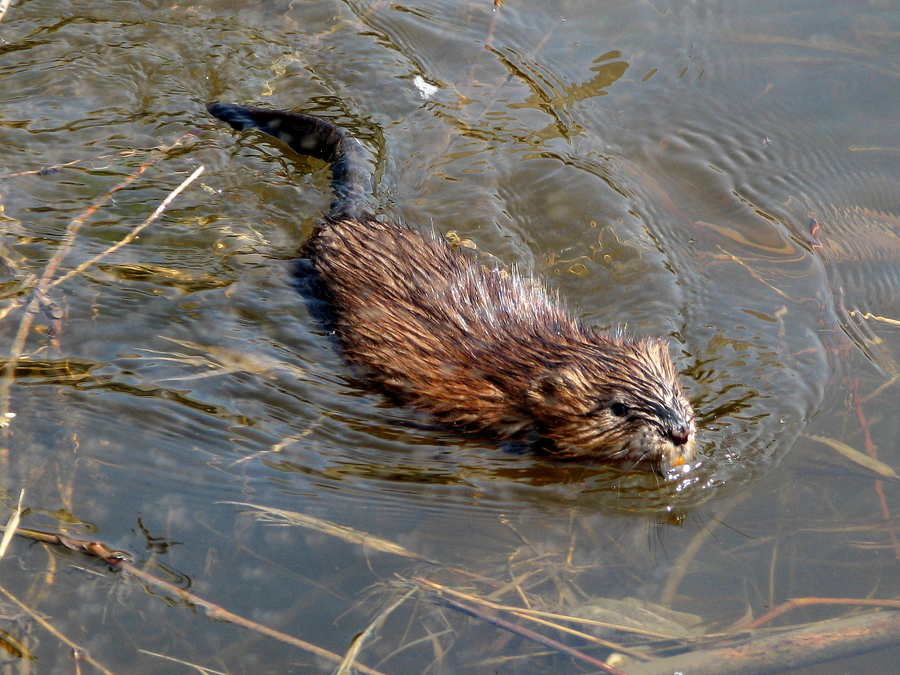
The muskrat is a semi-aquatic rodent weighing 0.6–2 kg (1.3–4.4 lb) with a scaly tail and webbed hind feet, found in wetlands across North America and introduced to Europe and Asia. It builds dome lodges from cattails, feeds on aquatic plants, and is trapped for fur while listed Least Concern globally.
Muskrat facts at a glance
| Scientific name | Ondatra zibethicus |
|---|---|
| Diet | Herbivore — cattails, pondweed, roots, and occasional mussels |
| Habitat | Marshes, ponds, slow rivers, and wetlands across temperate North America |
| Lifespan | 3–5 years in the wild (longer in captivity) |
| Weight | 0.6–2 kg (1.3–4.4 lb); compact and dense-furred |
| Top speed | Strong swimmer; moderate on land |
| Conservation status | Least Concern (IUCN) |
| Kingdom | Animalia |
|---|---|
| Phylum | Chordata |
| Class | Mammalia |
| Order | Rodentia |
| Family | Cricetidae |
| Genus | Ondatra |
Where it lives
Native to wetlands across Canada, the United States, and northern Mexico; introduced to Europe and parts of Asia for fur farming and now established in marshes from France to Siberia.
What is a group of muskrats called?
Group name (collective noun)
A group of Muskrats is called a colony.
Baby name
A baby Muskrat is called a kit.
Explore more animal collective nouns and baby animal names .
Wetland engineer
Muskrats excavate burrows into pond banks and build conical lodges from cattails and mud — structures that create habitat for ducks, turtles, and fish. Their feeding opens channels through dense vegetation, maintaining open water in marshes that might otherwise silt over.
Semi-aquatic adaptations
Partially webbed hind feet, a laterally flattened tail used as a rudder, and dense waterproof underfur let muskrats swim efficiently and stay warm in icy water. They can remain submerged for 15 minutes, closing ear flaps and using stored oxygen.
Fur trade and introductions
Muskrat fur ('musquash') supported a major trapping industry across North America for centuries. Deliberate and accidental introductions established populations in Europe and Asia, where they sometimes damage dikes and compete with native water voles.
Ecology and management
Listed Least Concern, muskrats remain abundant in suitable wetlands but face habitat loss from drainage and pollution. In some areas they are managed as pests when burrowing undermines levees; elsewhere they are valued as wetland indicators and fur-bearer resources.
Dig deeper into the Muskrat
- How Long do Muskrat Live?
Dig deeper into muskrat — how long do muskrat live.
- Muskrat Facts 4
Dig deeper into muskrat — muskrat facts 4.
- Muskrat Facts 5
Dig deeper into muskrat — muskrat facts 5.
- What do Muskrat Eat
Dig deeper into muskrat — what do muskrat eat.
- Where do Muskrat Live?
Dig deeper into muskrat — where do muskrat live.
Explore the Muskrat
Did you know? Muskrat facts
- The muskrat is a semi-aquatic rodent weighing 0.6–2 kg (1.3–4.4 lb) with a scaly tail and webbed hind feet, found in wetlands across North America and introduced to Europe and Asia.
- Despite the name, muskrats are not true rats — they belong to the vole and lemming family (Cricetidae), adapted for aquatic life with webbed feet and a scaly tail.
- Mainly aquatic plants such as cattails, pondweed, and roots; they occasionally eat mussels, snails, and small fish.
- Native to North America from Alaska and Canada through the United States and into northern Mexico; introduced to Europe and parts of Asia.
- Muskrats build lodges and burrows, not dams like beavers. Their structures use cattails and mud rather than felled trees.
- Conservation: Least Concern (IUCN).
Diet & feeding
Muskrat feeds primarily as a herbivore — cattails, pondweed, roots, and occasional mussels. Muskrats excavate burrows into pond banks and build conical lodges from cattails and mud — structures that create habitat for ducks, turtles, and fish. Their feeding opens channels through dense vegetation, maintaining open wate
Adaptations
- Muskrats excavate burrows into pond banks and build conical lodges from cattails and mud — structures that create habitat for ducks, turtles, and fish. Their feeding opens channels through dense vegetation, maintaining open water in marshes that might otherwise silt over.
- Partially webbed hind feet, a laterally flattened tail used as a rudder, and dense waterproof underfur let muskrats swim efficiently and stay warm in icy water. They can remain submerged for 15 minutes, closing ear flaps and using stored oxygen.
Behaviour & ecology
- Muskrats excavate burrows into pond banks and build conical lodges from cattails and mud — structures that create habitat for ducks, turtles, and fish. Their feeding opens channels through dense vegetation, maintaining open water in marshes that might otherwise silt over.
- Partially webbed hind feet, a laterally flattened tail used as a rudder, and dense waterproof underfur let muskrats swim efficiently and stay warm in icy water. They can remain submerged for 15 minutes, closing ear flaps and using stored oxygen.
- Muskrat fur ('musquash') supported a major trapping industry across North America for centuries. Deliberate and accidental introductions established populations in Europe and Asia, where they sometimes damage dikes and compete with native water voles.
Communication
- Muskrat uses scent, posture, and vocal signals to mark territory and coordinate social behaviour.
- Communication intensity often peaks during breeding seasons and territorial disputes.
Habitat & range
Marshes, ponds, slow rivers, and wetlands across temperate North America
Ecological role
Muskrat shapes vegetation through grazing or browsing and serves as prey for larger predators where ranges overlap.
Frequently asked questions about the Muskrat
Is a muskrat a rat?
Despite the name, muskrats are not true rats — they belong to the vole and lemming family (Cricetidae), adapted for aquatic life with webbed feet and a scaly tail.
What do muskrats eat?
Mainly aquatic plants such as cattails, pondweed, and roots; they occasionally eat mussels, snails, and small fish.
Where do muskrats live?
Native to North America from Alaska and Canada through the United States and into northern Mexico; introduced to Europe and parts of Asia.
Do muskrats build dams?
Muskrats build lodges and burrows, not dams like beavers. Their structures use cattails and mud rather than felled trees.
Are muskrats dangerous?
They generally avoid people and are not aggressive, though they may bite if handled. They can carry tularemia and other diseases in some regions.
What is a group of muskrats called?
A group of Muskrats is called a colony.
What is a baby muskrat called?
A baby Muskrat is called a kit.
Sources & references
This guide is compiled and reviewed against established zoological and conservation references. Key sources for the Muskrat:
-
IUCN Red List of Threatened Species
Conservation status (Least Concern) reflects the IUCN Red List category for Ondatra zibethicus.
- IUCN Red List — Ondatra zibethicus.
Conservation status (Least Concern) and population trends.
- Animal Diversity Web — Ondatra zibethicus. University of Michigan Museum of Zoology.
Life history, morphology, and range.
-
Global Animal Guide editorial standards
How we research, source, review, and update every guide for accuracy.