Groundhog
Marmota monax
Quick answer
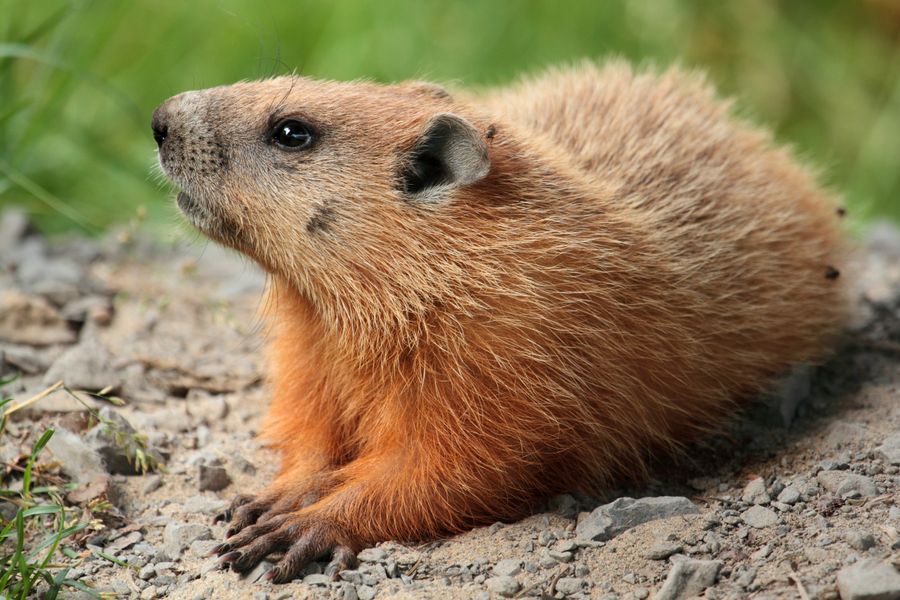
The groundhog — also called woodchuck — is a burrowing marmot famous for Groundhog Day folklore across North America. Weighing about 5 kg, living roughly 6 years, and reaching 16 km/h, it hibernates up to eight months with heart rate dropping to five beats per minute.
Groundhog facts at a glance
| Scientific name | Marmota monax |
|---|---|
| Diet | Herbivore — grasses, clover, dandelion, and garden vegetables |
| Habitat | Fields, woodland edges, and suburban areas of North America |
| Lifespan | 4–6 years in the wild (up to 14 in captivity) |
| Weight | 2–6 kg (4.4–13 lb); heavier before hibernation |
| Top speed | Up to 16 km/h (10 mph) to burrow |
| Conservation status | Least Concern (IUCN) |
| Kingdom | Animalia |
|---|---|
| Phylum | Chordata |
| Class | Mammalia |
| Order | Rodentia |
| Family | Sciuridae |
| Genus | Marmota |
Where it lives
Eastern and central North America from Alabama to Alaska across fields, woodland edges, and suburbs.
What is a group of groundhogs called?
Group name (collective noun)
A group of Groundhogs is called a colony.
Baby name
A baby Groundhog is called a pup.
Explore more animal collective nouns and baby animal names .
Distribution and habitat
Groundhogs live in Eastern and central North America from Alabama to Alaska across fields, woodland edges, and suburbs. Preferred habitat includes fields, woodland edges, and suburban areas of north america. Across North America, population density reflects prey availability, water access, and human disturbance. Protected areas and wildlife corridors remain essential for long-term persistence.
Physical traits and behaviour
Groundhogs typically reach about 0.65 m in length and 5 kg in weight, with top speeds near 16 km/h. North America's weather-watching marmot. Daily activity, social structure, and seasonal movements reflect pressures in their native environment.
Diet and ecological role
Groundhogs feed on herbivore — grasses, clover, dandelion, and garden vegetables. Foraging shifts with season and local abundance. As mammals, they influence food webs — controlling prey, dispersing seeds, or shaping habitat through feeding and movement.
Conservation and coexistence
Listed as Least Concern on the IUCN Red List. Habitat loss, hunting, and climate change threaten many populations. Responsible ecotourism and community conservation help in parts of their range. Never approach or feed wild groundhogs.
Human interest and research
Groundhogs feature in folklore, tourism, and scientific study worldwide. Ongoing research tracks population trends, genetics, and responses to environmental change — data that guides national protection policies.
Dig deeper into the Groundhog
- Groundhog Facts 4
Dig deeper into groundhog — groundhog facts 4.
- Groundhog Facts 5
Dig deeper into groundhog — groundhog facts 5.
- How Long do Groundhog Live?
Dig deeper into groundhog — how long do groundhog live.
- What do Groundhog Eat
Dig deeper into groundhog — what do groundhog eat.
- Where do Groundhog Live?
Dig deeper into groundhog — where do groundhog live.
Explore the Groundhog
Range & geography
Did you know? Groundhog facts
- Groundhogs — also called woodchucks — are burrowing marmots famous for Groundhog Day folklore.
- The tongue-twister name 'woodchuck' comes from Algonquian 'wuchak', not wood chewing.
- No scientific basis — shadow folklore is entertainment, not meteorology.
- Conservation: Least Concern.
Diet & feeding
Groundhog feeds primarily as a grasses, clover, vegetables. Heart rate drops from 80 to 5 beats per minute during winter torpor.
Adaptations
- Heart rate drops from 80 to 5 beats per minute during winter torpor.
- Complex burrows with separate chambers can extend over 15 metres.
Behaviour & ecology
- Heart rate drops from 80 to 5 beats per minute during winter torpor.
- Complex burrows with separate chambers can extend over 15 metres.
Communication
- Groundhog uses scent, posture, and vocal signals to mark territory and coordinate social behaviour.
- Communication intensity often peaks during breeding seasons and territorial disputes.
Habitat & range
Fields and woodland edges in North America
Ecological role
Groundhog plays a recognised ecological role in fields and woodland edges in north america.
Frequently asked questions about the Groundhog
Where do groundhogs live?
Eastern and central North America from Alabama to Alaska across fields, woodland edges, and suburbs.
What do groundhogs eat?
Herbivore — grasses, clover, dandelion, and garden vegetables.
How long do groundhogs live?
About 6 years in the wild on average.
Are groundhogs endangered?
IUCN status: Least Concern.
What is a group of groundhogs called?
A group of Groundhogs is called a colony.
What is a baby groundhog called?
A baby Groundhog is called a pup.
Sources & references
This guide is compiled and reviewed against established zoological and conservation references. Key sources for the Groundhog:
-
IUCN Red List of Threatened Species
Conservation status (Least Concern) reflects the IUCN Red List category for Marmota monax.
- IUCN Red List — Marmota monax.
Conservation status (Least Concern) and population trends.
- Animal Diversity Web — Marmota monax. University of Michigan Museum of Zoology.
Life history, morphology, and range.
-
Global Animal Guide editorial standards
How we research, source, review, and update every guide for accuracy.