Image sourcing: see credits & licences
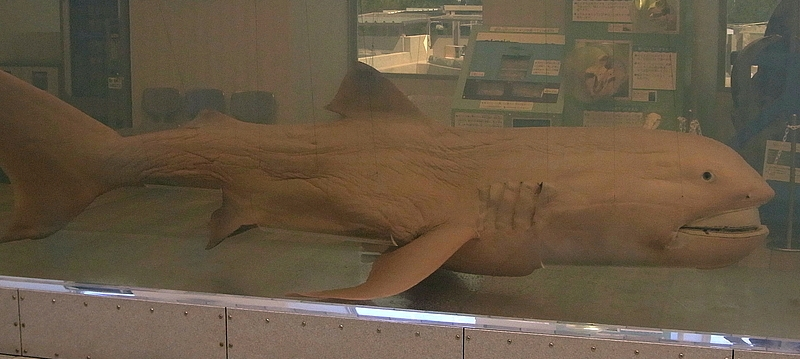
The megamouth shark (Megachasma pelagios) is a cartilaginous fish of the family Megachasmidae, in the order Lamniformes.
Quick answer
The megamouth shark (Megachasma pelagios) is a rare deep-water filter feeder discovered only in 1976. Adults reach about 5 m, swim vertical migrations nightly, and are listed Least Concern.
Top questions about the Megamouth Shark
Megamouth Shark facts at a glance
- Weight 600 kg
- Length 5 m
- Top speed 5 km/h
- Lifespan 100 years
| Scientific name | Megachasma pelagios |
|---|---|
| Diet | Filter feeder |
| Habitat | Open ocean deep waters |
| Lifespan | 100+ years |
| Weight | 500–800 kg |
| Top speed | up to 5 km/h |
| Conservation status | Least Concern (IUCN) |
| Kingdom | Animalia |
|---|---|
| Phylum | Chordata |
| Class | Chondrichthyes |
| Order | Lamniformes |
| Family | Megachasmidae |
| Genus | Megachasma |
Where it lives
The megamouth shark (Megachasma pelagios) is native to Deep tropical and subtropical oceans worldwide. — recorded across Asia, Oceania, North America, Africa in this guide’s range summary.
For occurrence records, see GBIF species search and sources below.
How big is a megamouth shark?
An adult megamouth shark measures 5 m long — about 2.9× the height of an average adult person (1.73 m) — and weighs around 600 kg, about 8.6× an average adult’s body weight (70 kg).
Length vs an average adult’s height (to scale)
What is a group of megamouth sharks called?
Group name (collective noun)
A group of Megamouth Sharks is called a school.
Baby name
A baby Megamouth Shark is called a pup.
Explore more animal collective nouns and baby animal names .
Filter feeder of the midnight zone
A bulbous head, rubbery lips, and huge mouth filter krill and jelly organisms. A white band around the snout may glow with bioluminescent symbionts — still debated.
Krill and deep scattering layer
Vertical migrations follow the deep scattering layer upward at night. Filter feeding suits low-energy life in nutrient-poor open ocean.
Tropical oceans worldwide
Recorded from Pacific, Atlantic, and Indian Ocean deep slopes and basins. Most encounters come from entanglement in deep nets or strandings.
Elusive but not yet threatened
Least Concern despite few sightings — huge deep habitat and no targeted fishery. Bycatch in deep gear remains the main human interaction.
Explore the Megamouth Shark
Close relatives
- Great White Shark Same order
- Thresher Shark Same order
- Basking Shark Same order
- Sand Tiger Shark Same order
Range & geography
Conservation status of the Megamouth Shark
The megamouth shark (Megachasma pelagios) is listed as Least Concern on the IUCN Red List. Least Concern (LC) is the IUCN's lowest-risk category, assigned to widespread, abundant species that have been evaluated and found not to be threatened. It does not mean a species faces no pressures — only that it is not currently at risk of extinction.
The megamouth shark (Megachasma pelagios) is assessed on the IUCN Red List. Look up on the IUCN Red List .
Frequently asked questions about the Megamouth Shark
When was the megamouth shark discovered?
In 1976 off Hawaii — the first shark family discovered in modern times.
How does a megamouth shark feed?
It swims with the huge mouth open, filtering krill and gelatinous plankton from deep water.
How big is a megamouth shark?
Adults reach roughly 4–5 m — large but smaller than basking or whale sharks.
Why is the mouth white?
A pale band may attract prey in darkness, possibly with bioluminescent bacteria.
Are megamouth sharks dangerous?
No — they are filter feeders eating tiny plankton, not large prey.
What is a group of megamouth sharks called?
A group of Megamouth Sharks is called a school.
What is a baby megamouth shark called?
A baby Megamouth Shark is called a pup.
Sources & references
This guide is compiled and reviewed against established zoological and conservation references. Key sources for the Megamouth Shark:
-
IUCN Red List of Threatened Species
Conservation status (Least Concern) reflects the IUCN Red List category for Megachasma pelagios.
-
iNaturalist — observations & photos
Search citizen-science observations and community IDs for Megachasma pelagios. Useful for range checks and recent sightings — not a substitute for formal Red List status.
-
GBIF — occurrence data
Global Biodiversity Information Facility species search for Megachasma pelagios. Explore published occurrence records used in range research.
-
Global Animal Guide editorial standards
How we research, source, review, and update every guide for accuracy.