Image sourcing: see credits & licences
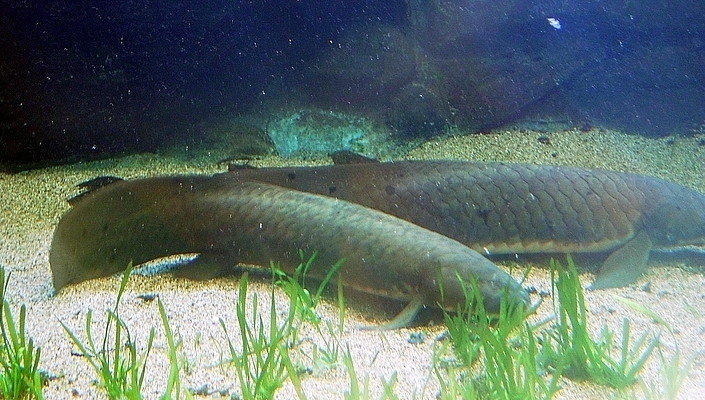
The Australian lungfish (Neoceratodus forsteri) is a ray-finned fish of the family Neoceratodontidae, in the order Ceratodontiformes.
Quick answer
The Australian lungfish (Neoceratodus forsteri) is a living fossil that breathes with lungs and gills in Queensland rivers. Adults reach 1.5 m and 40 kg, survive 100 years, and are listed Endangered.
Top questions about the Australian Lungfish
Australian Lungfish facts at a glance
- Weight 30 kg
- Length 1.5 m
- Top speed 10 km/h
- Lifespan 90 years
| Scientific name | Neoceratodus forsteri |
|---|---|
| Diet | Omnivore |
| Habitat | Slow rivers and pools |
| Lifespan | 80–100 years |
| Weight | 20–40 kg |
| Top speed | up to 10 km/h |
| Conservation status | Endangered (IUCN) |
| Kingdom | Animalia |
|---|---|
| Phylum | Chordata |
| Class | Actinopterygii |
| Order | Ceratodontiformes |
| Family | Neoceratodontidae |
| Genus | Neoceratodus |
Where it lives
The australian lungfish (Neoceratodus forsteri) is native to Burnett and Mary River systems of Queensland, Australia. — recorded across Oceania in this guide’s range summary.
For occurrence records, see GBIF species search and sources below.
How big is a australian lungfish?
An adult australian lungfish measures 1.5 m long — about 87% of the height of an average adult person (1.73 m) — and weighs around 30 kg, about 43% of an average adult’s body weight (70 kg).
Length vs an average adult’s height (to scale)
What is a group of australian lungfish called?
Group name (collective noun)
A group of Australian Lungfish is called a school.
Baby name
A baby Australian Lungfish is called a fry.
Explore more animal collective nouns and baby animal names .
Lungs plus gills
One of six surviving lungfish lineages, it rises to gulp air when water is warm and low in oxygen. Heavy scales, paddle tail, and lobed fins look ancient compared with modern teleosts.
Molluscs, plants, and slow hunts
Snails, clams, frogs, and aquatic plants are crushed with molar-like teeth. Adults are sedentary, moving little within home pools.
Burnett and Mary rivers
Endemic to southeast Queensland's slow rivers and impoundments. Larvae need vegetated shallows; adults hold deep pools.
Endangered in engineered rivers
IUCN lists Australian lungfish Endangered. Dams, weirs, and water extraction block spawning migrations and strand populations in modified channels.
Explore the Australian Lungfish
Close relatives
- Great White Shark Same class
- Ocean Sunfish Same class
- Rainbow Trout Same class
- Thresher Shark Same class
Collections
Range & geography
Conservation status of the Australian Lungfish
The australian lungfish (Neoceratodus forsteri) is listed as Endangered on the IUCN Red List. Endangered (EN) means a species faces a very high risk of extinction in the wild. Populations are usually declining sharply due to habitat loss, hunting, disease, or climate pressure. It sits one level below Critically Endangered on the IUCN Red List.
Main threats to the australian lungfish
- Water extraction and river regulation
- Barrier dams blocking movement
- Siltation from land clearing
- Extremely slow reproduction and long generation time
Australian Lungfish (Neoceratodus forsteri) was most recently assessed for the IUCN Red List in 2019. Look up on the IUCN Red List .
Frequently asked questions about the Australian Lungfish
Can Australian lungfish breathe air?
Yes — they supplement gill breathing with a single lung, especially in warm, low-oxygen water.
How old can Australian lungfish get?
Individuals may exceed 80–100 years; they are among the longest-lived freshwater fish.
Where are Australian lungfish found?
Only in selected Queensland river systems, mainly the Burnett and Mary rivers.
Are lungfish related to salamanders?
No — they are fish, though their air-breathing lung parallels early vertebrate evolution.
Why is the Australian lungfish Endangered?
Dam construction and river regulation destroyed spawning habitat and fragmented populations.
What is a group of australian lungfish called?
A group of Australian Lungfish is called a school.
What is a baby australian lungfish called?
A baby Australian Lungfish is called a fry.
Sources & references
This guide is compiled and reviewed against established zoological and conservation references. Key sources for the Australian Lungfish:
-
IUCN Red List of Threatened Species
Conservation status (Endangered) reflects the IUCN Red List category for Neoceratodus forsteri, most recently assessed in 2019.
-
iNaturalist — observations & photos
Search citizen-science observations and community IDs for Neoceratodus forsteri. Useful for range checks and recent sightings — not a substitute for formal Red List status.
-
GBIF — occurrence data
Global Biodiversity Information Facility species search for Neoceratodus forsteri. Explore published occurrence records used in range research.
-
Global Animal Guide editorial standards
How we research, source, review, and update every guide for accuracy.