Manta Ray
Mobula birostris
Image sourcing: see credits & licences
Quick answer
The giant manta ray (Mobula birostris) is the largest ray in the ocean, with a wingspan reaching up to 7 m (23 ft) and a weight of up to 1,400 kg (3,000 lb). It swims through tropical and subtropical open seas by flapping its broad pectoral fins like wings, filtering plankton from the water. Despite its size it is harmless to people, and it can live 40 years or more. The IUCN lists it as Endangered.
Manta Ray facts at a glance
| Scientific name | Mobula birostris |
|---|---|
| Diet | Filter feeder (plankton) |
| Habitat | Tropical and subtropical open ocean |
| Lifespan | Up to 40 years or more |
| Weight | Up to 1,400 kg (3,000 lb) |
| Wingspan | Up to 7 m (23 ft) across |
| Conservation status | Endangered (IUCN) |
| Kingdom | Animalia |
|---|---|
| Phylum | Chordata |
| Class | Chondrichthyes |
| Order | Myliobatiformes |
| Family | Mobulidae |
| Genus | Mobula |
Where it lives
Tropical and subtropical waters worldwide, near reefs, seamounts, and the open ocean.
What is a group of manta rays called?
Group name (collective noun)
A group of Manta Rays is called a fever.
Baby name
A baby Manta Ray is called a pup.
Explore more animal collective nouns and baby animal names .
Size and appearance
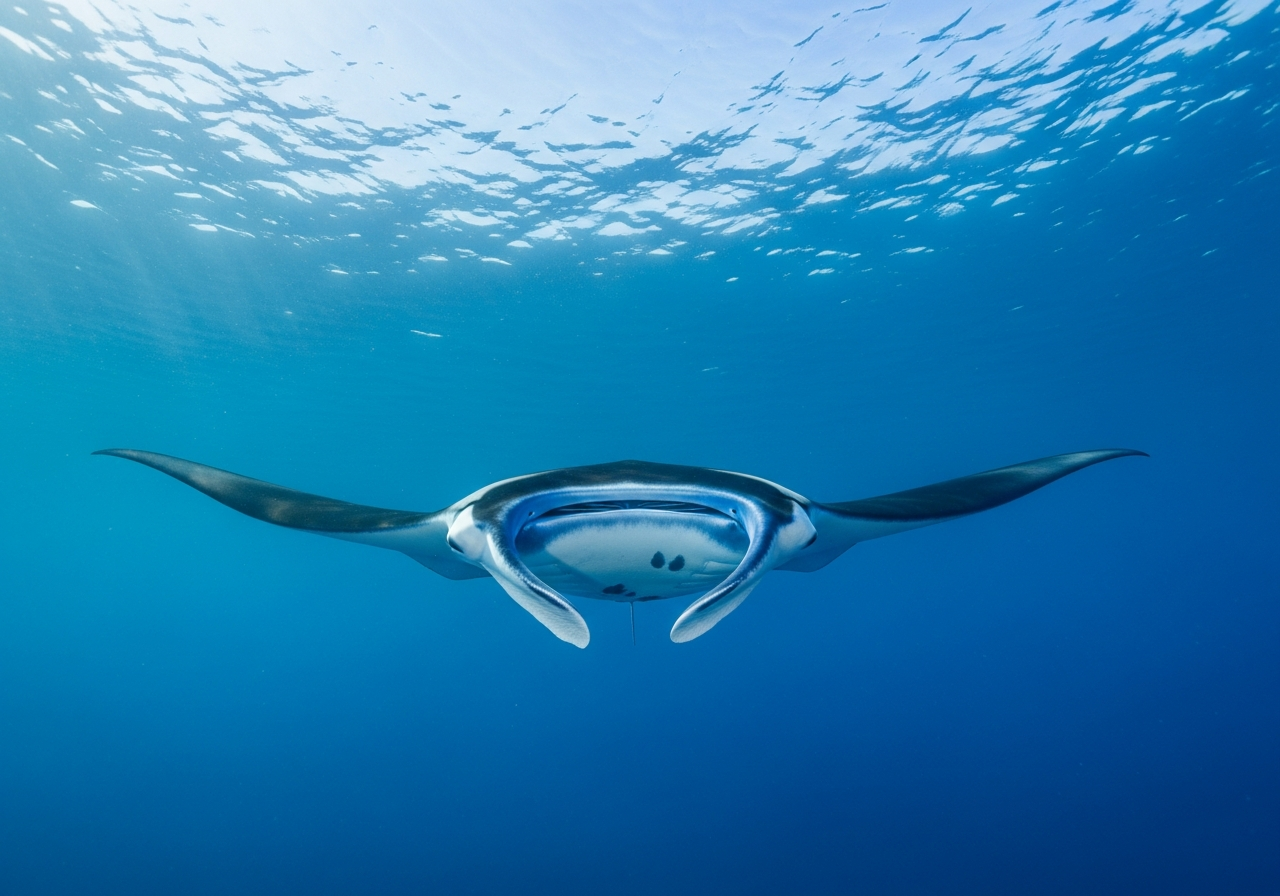
The giant manta ray is the largest of all rays, spanning up to 7 m (23 ft) from wing tip to wing tip and weighing as much as 1,400 kg (3,000 lb). Its flattened, diamond-shaped body is dark above and pale below, with a unique pattern of blotches on the belly that scientists use to identify individuals. A pair of fleshy cephalic fins projects from either side of its wide mouth, giving the animal its old nickname of "devil ray". Unlike stingrays, the manta has no functional stinging barb on its whip-like tail.
How it swims and moves
A manta ray appears to fly underwater, beating its huge triangular pectoral fins in slow, graceful strokes rather than swishing a tail. This wing-like motion lets it cruise efficiently across open water and reach bursts of around 35 km/h (22 mph) when it needs to. Mantas are strong ocean travellers that cover long distances between feeding and cleaning sites, and they are among the few fish known to leap clear of the surface, breaching before crashing back down.
Filter feeding and diet
Mantas are filter feeders that live almost entirely on tiny drifting plankton and small fish larvae. They swim forward with the mouth held wide open, channelling water and prey between the cephalic fins and across comb-like filter plates in the gills that trap the food while letting the water pass through. When they find a dense patch of plankton they often perform slow somersaults or gather in loose feeding chains to sweep up as much as possible. A single large manta can filter thousands of litres of seawater in a day.
Intelligence and behaviour
Manta rays have the largest brain relative to body size of any fish, and they show curiosity and problem-solving that is unusual among their relatives. They regularly visit "cleaning stations" on reefs, hovering while small wrasse and other fish pick parasites and dead skin from their bodies. Mantas have even passed mirror-test experiments that suggest a degree of self-awareness, and individuals often return to the same sites year after year.
Reproduction and life cycle
Manta rays reproduce very slowly, which makes their populations fragile. Females usually give birth to a single large pup, occasionally two, after a gestation of roughly a year, and the pup is born rolled up before unfurling its wings and swimming away. Females may only breed every two to three years, and mantas do not reach maturity until around ten years old. This low reproductive rate means lost animals are replaced very slowly.
Why it is endangered
The giant manta ray is listed as Endangered by the IUCN, mainly because of targeted fishing and accidental capture in nets. Demand for their gill plates, used in some traditional remedies, has driven heavy hunting in parts of their range. Because mantas grow slowly and produce so few young, even modest levels of fishing can cause steep declines. Protected areas, fishing bans, and manta-focused tourism now play an important part in efforts to safeguard them.
Dig deeper into the Manta Ray
- Are Manta Ray Endangered
Dig deeper into manta ray — are manta ray endangered.
- How Long do Manta Ray Live?
Dig deeper into manta ray — how long do manta ray live.
- Manta Ray Guide 5
Dig deeper into manta ray — manta ray guide 5.
- What do Manta Ray Eat
Dig deeper into manta ray — what do manta ray eat.
- Where do Manta Ray Live?
Dig deeper into manta ray — where do manta ray live.
Explore the Manta Ray
Related Fishs
Collections
Range & geography
Did you know? Manta Ray facts
- The manta ray is a huge but harmless filter-feeding fish related to sharks, with a wingspan that can reach 7 meters (23 ft).
- No. Manta rays are harmless filter feeders with no stinging barb, unlike stingrays. They are gentle and curious, and they pose no threat to swimmers or divers.
- Manta rays are filter feeders that eat tiny plankton such as shrimp and fish larvae. They swim with their mouths open and strain food from the water using comb-like plates on their gills.
- Giant manta rays can reach a wingspan of about 7 m (23 ft) and weigh up to 1,400 kg (3,000 lb), making them the largest rays in the ocean.
- Yes. Manta rays are cartilaginous fish, closely related to sharks. Their skeletons are made of cartilage rather than bone, and they breathe through gills like other fish.
- Conservation: Endangered (IUCN).
Diet & feeding
Manta Ray feeds primarily as a filter feeder (plankton). Manta rays are graceful, curious animals that often approach divers and may circle them repeatedly. They have the largest brain-to-body ratio of any fish and have passed mirror tests that suggest a high level of awareness. Mantas sometimes leap clear of the water
Adaptations
- Manta rays are graceful, curious animals that often approach divers and may circle them repeatedly. They have the largest brain-to-body ratio of any fish and have passed mirror tests that suggest a high level of awareness. Mantas sometimes leap clear of the water, though scientists are still unsure exactly why.
- Despite their size, manta rays eat some of the smallest food in the ocean. They swim with their mouths open, channeling water and plankton between flexible head fins called cephalic lobes, then strain out tiny shrimp and fish larvae with comb-like gill plates. Large groups sometimes gather where plankton is abundant.
Behaviour & ecology
- Manta rays are graceful, curious animals that often approach divers and may circle them repeatedly. They have the largest brain-to-body ratio of any fish and have passed mirror tests that suggest a high level of awareness. Mantas sometimes leap clear of the water, though scientists are still unsure exactly why.
- Despite their size, manta rays eat some of the smallest food in the ocean. They swim with their mouths open, channeling water and plankton between flexible head fins called cephalic lobes, then strain out tiny shrimp and fish larvae with comb-like gill plates. Large groups sometimes gather where plankton is abundant.
- Manta rays live in warm tropical and subtropical waters around the world, often near reefs, seamounts, and coastlines where they visit cleaning stations to have parasites removed by smaller fish. They are strong swimmers that can travel long distances across the open ocean in search of food.
Communication
- Lateral-line and visual cues coordinate schooling, courtship, or territorial behaviour.
- Some species produce low-frequency sounds or drumming for spawning or defence.
Habitat & range
Tropical and subtropical open ocean
Ecological role
Manta Ray occupies a defined trophic level in aquatic food webs, linking plankton or smaller fish to larger predators.
Conservation status of the Manta Ray
Endangered (EN) means a species faces a very high risk of extinction in the wild. Populations are usually declining sharply due to habitat loss, hunting, disease, or climate pressure. It sits one level below Critically Endangered on the IUCN Red List.
The manta ray (Mobula birostris) is assessed on the IUCN Red List. Look up on the IUCN Red List .
Frequently asked questions about the Manta Ray
How big is a manta ray?
The giant manta ray can reach a wingspan of up to 7 m (23 ft) and weigh as much as 1,400 kg (3,000 lb), making it the largest ray in the world.
Are manta rays dangerous to humans?
No. Manta rays are gentle filter feeders with no stinging barb and no interest in people. Divers can swim alongside them safely, and mantas are often curious about human visitors.
What do manta rays eat?
Manta rays are filter feeders that eat plankton and tiny fish larvae. They swim with their mouths open, straining food from the water through specialised filter plates in their gills.
How long do manta rays live?
Manta rays are long-lived and can survive for 40 years or more in the wild. They also reproduce very slowly, usually raising just one pup every few years.
Do manta rays sting like stingrays?
No. Although they are close relatives of stingrays, manta rays have lost the venomous barb on their tail and cannot sting. Their tail is a thin, harmless whip.
Why are manta rays endangered?
Manta rays are Endangered largely because of fishing for their gill plates and accidental capture in nets. Their very slow breeding rate means populations recover extremely slowly once numbers fall.
What is a group of manta rays called?
A group of Manta Rays is called a fever.
What is a baby manta ray called?
A baby Manta Ray is called a pup.
Sources & references
This guide is compiled and reviewed against established zoological and conservation references. Key sources for the Manta Ray:
-
IUCN Red List of Threatened Species
Conservation status (Endangered) reflects the IUCN Red List category for Mobula birostris.
- IUCN Red List — Mobula birostris.
Conservation status (Endangered) and population trends.
- Animal Diversity Web — Mobula birostris. University of Michigan Museum of Zoology.
Life history, morphology, and range.
- Wikipedia — Manta Ray.
General taxonomy and overview (cross-check primary sources).
-
Global Animal Guide editorial standards
How we research, source, review, and update every guide for accuracy.