Image sourcing: see credits & licences
Quick answer
The luna moth is a large, pale-green silk moth of eastern North America, with long, sweeping tails on its hindwings and a wingspan up to about 11 cm (4.5 in). Adults do not feed and live only about a week, focusing entirely on mating, while the caterpillars feed heavily on tree leaves. The trailing tails are thought to confuse the echolocation of hunting bats.
Top questions about the Luna Moth
Luna Moth facts at a glance
- Weight 2 g
- Length 5 cm
- Top speed 18 km/h
- Lifespan 1 years
| Scientific name | Actias luna |
|---|---|
| Diet | Caterpillars eat leaves; adults do not feed |
| Habitat | Deciduous forests of eastern North America |
| Lifespan | Adults about 1 week; full cycle a few months |
| Wingspan | Up to about 11 cm (4.5 in) |
| Tails | Long hindwing tails that confuse bats |
| Conservation status | Least Concern (IUCN) |
| Kingdom | Animalia |
|---|---|
| Phylum | Arthropoda |
| Class | Insecta |
| Order | Lepidoptera |
| Family | Saturniidae |
| Genus | Actias |
Where it lives
The luna moth (Actias luna) is native to Deciduous forests of eastern North America; a large, pale-green silk moth. — recorded across North America in this guide’s range summary.
For occurrence records, see GBIF species search and sources below.
How big is a luna moth?
An adult luna moth measures 5 cm long — about 3% of the height of an average adult person (1.73 m) — and weighs around 2 g, a small fraction of an average adult’s body weight (70 kg).
Length vs an average adult’s height (to scale)
What is a group of luna moths called?
Group name (collective noun)
A group of Luna Moths is called a swarm.
Baby name
A baby Luna Moth is called a caterpillar. It may also be called a larva.
Explore more animal collective nouns and baby animal names .
Appearance
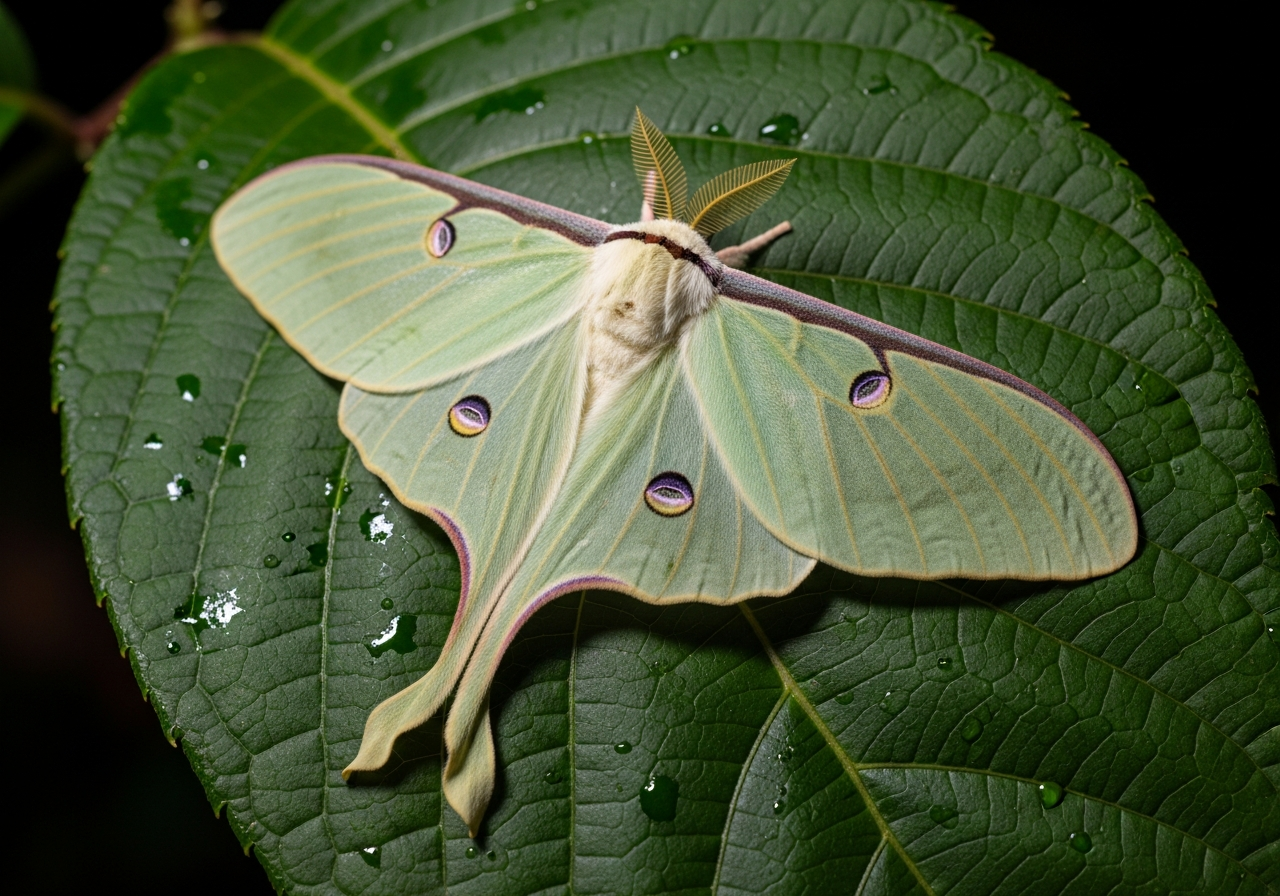
The luna moth is among the most striking moths in North America, with broad, pale-green wings, eyespots, and long, twisting tails trailing from the hindwings. Its body is white and furry, and the antennae of males are large and feathery for detecting females. Its size and soft color make it unmistakable when it appears at lights on summer nights.
A brief adult life
Adult luna moths have no functional mouthparts and do not feed, living on energy stored during the caterpillar stage. As a result they survive only about a week, during which their sole purpose is to find a mate and reproduce. Females release pheromones to attract males, which locate them using their sensitive antennae.
Caterpillars and life cycle
Luna moth caterpillars are plump and bright green and feed heavily on the leaves of trees such as walnut, hickory, birch, and sweetgum. After eating and growing through several stages, the caterpillar spins a silken cocoon wrapped in a leaf, where it pupates. Depending on the region there may be one or several generations a year, with the final generation overwintering as a pupa.
Tails and defense
The luna moth's long hindwing tails are more than decoration: as the moth flies, the spinning tails create confusing echoes that disrupt the echolocation hunting bats use to target prey. This can cause bats to strike the harmless tails instead of the body, giving the moth a chance to escape. Their nocturnal habits also help them avoid many daytime predators.
Dig deeper into the Luna Moth
- Luna Moth: Key Facts
The luna moth is a large, pale-green silk moth of eastern North America, with long, sweeping tails on its hindwings and a wingspan up to about 11 cm (4.5…
- What Do Luna Moths Eat?
What luna moths eat: Caterpillars eat leaves; adults do not feed, foraging style, and seasonal shifts in Deciduous forests of eastern North America.
- Where Do Luna Moths Live?
Where luna moths live: Deciduous forests of eastern North America, native range cues, and human overlap. Status Least Concern.
Explore the Luna Moth
Related Insects
Range & geography
Did you know? Luna Moth facts
- The luna moth is a large, pale-green silk moth of eastern North America, with long, sweeping tails on its hindwings and a wingspan up to about 11 cm (4.5 in).
- Adult luna moths have no functional mouthparts and cannot feed, relying entirely on energy stored as caterpillars. This is why they live only about a week, just long enough to mate and lay eggs.
- The adult luna moth lives only about a week. Most of its life is spent as a caterpillar and pupa, with the whole cycle taking a few months and the final generation overwintering as a pupa.
- Luna moth caterpillars feed on the leaves of trees such as walnut, hickory, birch, and sweetgum. They eat heavily to build the energy reserves the non-feeding adult will rely on.
- The long hindwing tails spin as the moth flies, creating misleading echoes that confuse the echolocation of hunting bats. This can cause a bat to strike the tails rather than the body, helping the moth escape.
- Conservation: Least Concern (IUCN).
Diet & feeding
Luna Moth feeds primarily as a caterpillars eat leaves; adults do not feed. The luna moth is among the most striking moths in North America, with broad, pale-green wings, eyespots, and long, twisting tails trailing from the hindwings. Its body is white and furry, and the antennae of males are large and feathery for det
Adaptations
- The luna moth is among the most striking moths in North America, with broad, pale-green wings, eyespots, and long, twisting tails trailing from the hindwings. Its body is white and furry, and the antennae of males are large and feathery for detecting females. Its size and soft color make it unmistakable when it appears at lights on summer nights.
- Adult luna moths have no functional mouthparts and do not feed, living on energy stored during the caterpillar stage. As a result they survive only about a week, during which their sole purpose is to find a mate and reproduce. Females release pheromones to attract males, which locate them using their sensitive antennae.
Behaviour & ecology
- The luna moth is among the most striking moths in North America, with broad, pale-green wings, eyespots, and long, twisting tails trailing from the hindwings. Its body is white and furry, and the antennae of males are large and feathery for detecting females. Its size and soft color make it unmistakable when it appears at lights on summer nights.
- Adult luna moths have no functional mouthparts and do not feed, living on energy stored during the caterpillar stage. As a result they survive only about a week, during which their sole purpose is to find a mate and reproduce. Females release pheromones to attract males, which locate them using their sensitive antennae.
- Luna moth caterpillars are plump and bright green and feed heavily on the leaves of trees such as walnut, hickory, birch, and sweetgum. After eating and growing through several stages, the caterpillar spins a silken cocoon wrapped in a leaf, where it pupates. Depending on the region there may be one or several generations a year, with the final generation overwintering as a pupa.
Communication
- Luna Moth uses scent, posture, and vocal signals to mark territory and coordinate social behaviour.
- Communication intensity often peaks during breeding seasons and territorial disputes.
Habitat & range
Deciduous forests of eastern North America
Ecological role
Luna Moth participates in pollination, decomposition, or prey-base support for birds and other insectivores.
Conservation status of the Luna Moth
The luna moth (Actias luna) is listed as Least Concern on the IUCN Red List. Least Concern (LC) is the IUCN's lowest-risk category, assigned to widespread, abundant species that have been evaluated and found not to be threatened. It does not mean a species faces no pressures — only that it is not currently at risk of extinction.
The luna moth (Actias luna) is assessed on the IUCN Red List. Look up on the IUCN Red List .
Frequently asked questions about the Luna Moth
Why don't adult luna moths eat?
Adult luna moths have no functional mouthparts and cannot feed, relying entirely on energy stored as caterpillars. This is why they live only about a week, just long enough to mate and lay eggs.
How long do luna moths live?
The adult luna moth lives only about a week. Most of its life is spent as a caterpillar and pupa, with the whole cycle taking a few months and the final generation overwintering as a pupa.
What do luna moth caterpillars eat?
Luna moth caterpillars feed on the leaves of trees such as walnut, hickory, birch, and sweetgum. They eat heavily to build the energy reserves the non-feeding adult will rely on.
Why do luna moths have long tails?
The long hindwing tails spin as the moth flies, creating misleading echoes that confuse the echolocation of hunting bats. This can cause a bat to strike the tails rather than the body, helping the moth escape.
Are luna moths rare?
Luna moths are listed as Least Concern and are widespread in eastern North America, but they are seldom seen because they fly at night and adults live only briefly. They are not considered endangered.
Do luna moths bite or sting?
No. Luna moths are completely harmless to people. The adults cannot even feed, and neither the moths nor their caterpillars sting or bite.
What is a group of luna moths called?
A group of Luna Moths is called a swarm.
What is a baby luna moth called?
A baby Luna Moth is called a caterpillar. It may also be called a larva.
Sources & references
This guide is compiled and reviewed against established zoological and conservation references. Key sources for the Luna Moth:
-
IUCN Red List of Threatened Species
Conservation status (Least Concern) reflects the IUCN Red List category for Actias luna.
-
iNaturalist — observations & photos
Search citizen-science observations and community IDs for Actias luna. Useful for range checks and recent sightings — not a substitute for formal Red List status.
-
GBIF — occurrence data
Global Biodiversity Information Facility species search for Actias luna. Explore published occurrence records used in range research.
- IUCN Red List — Actias luna.
Conservation status (Least Concern) and population trends.
- Animal Diversity Web — Actias luna. University of Michigan Museum of Zoology.
Life history, morphology, and range.
- Wikipedia — Luna Moth.
General taxonomy and overview (cross-check primary sources).
-
Global Animal Guide editorial standards
How we research, source, review, and update every guide for accuracy.