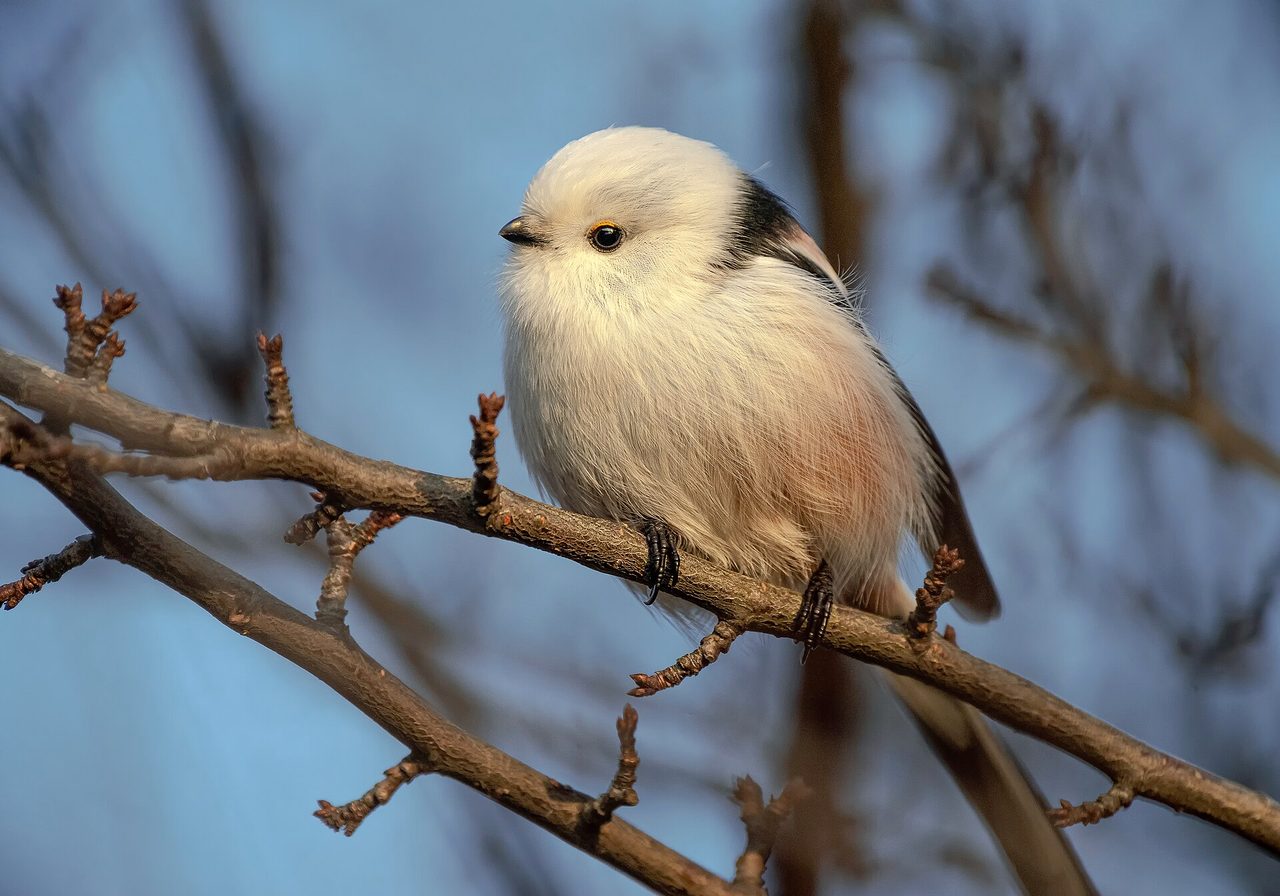
The long-tailed tit (Aegithalos caudatus) is a bird of the family Aegithalidae, in the order Passeriformes.
Quick answer
The long-tailed tit (Aegithalos caudatus) is a tiny, round songbird weighing only 7–9 g, with a tail longer than its body. It lives in woodland and hedgerows across Europe and Asia, travelling in chattering family flocks. Pairs build an elastic, domed nest of moss, lichen, spider silk and feathers. It typically lives 2–3 years and is listed as Least Concern.
Top questions about the Long-tailed Tit
Long-tailed Tit facts at a glance
- Weight 8 g
- Length 14 cm
- Lifespan 2 years
| Scientific name | Aegithalos caudatus |
|---|---|
| Diet | Small insects, spiders and their eggs; some seeds |
| Habitat | Woodland edges, hedgerows, scrub, parks and gardens |
| Size | About 14 cm long, most of it tail; wingspan 16–19 cm |
| Weight | 7–9 g |
| Lifespan | Typically 2–3 years; oldest ringed bird nearly 9 |
| Conservation status | Least Concern (IUCN Red List, assessed 2024) |
| Kingdom | Animalia |
|---|---|
| Phylum | Chordata |
| Class | Aves |
| Order | Passeriformes |
| Family | Aegithalidae |
| Genus | Aegithalos |
Where it lives
The long-tailed tit (Aegithalos caudatus) is native to Woodland and scrub across Europe and temperate Asia to Japan. — recorded across Europe, Asia in this guide’s range summary.
For occurrence records, see GBIF species search and sources below.
How big is a long-tailed tit?
An adult long-tailed tit measures 14 cm long — about 8% of the height of an average adult person (1.73 m) — and weighs around 8 g, a small fraction of an average adult’s body weight (70 kg).
Length vs an average adult’s height (to scale)
What is a group of long-tailed tits called?
Group name (collective noun)
A group of Long-tailed Tits is called a flock.
Baby name
A baby Long-tailed Tit is called a chick.
Explore more animal collective nouns and baby animal names .
Identification
Long-tailed tits are tiny, with a round body, a stubby bill and a black-and-white tail about as long as the rest of the bird. British and western European birds have a broad black stripe over the eye and pinkish tones; northern and eastern birds have pure white heads.
An elastic nest
Pairs spend weeks building an oval, domed nest of moss bound with spider silk, camouflaged with lichen and lined with hundreds of feathers. The silk lets the nest stretch as the chicks grow.
Family helpers
Pairs whose own nest fails often help raise the chicks of a relative, bringing food to their nephews and nieces. In winter, family flocks huddle together in a line on a branch to keep warm at night.
Status
BirdLife International lists the long-tailed tit as Least Concern (2024), estimating 36 to 65 million mature birds and a stable trend. Hard winters can cause large losses, which numbers then recover from.
Explore the Long-tailed Tit
Close relatives
- Canary Same order
- House Sparrow Same order
- Superb Lyrebird Same order
- Blue Tit Same order
Range & geography
Did you know? Long-tailed Tit facts
- Their nests are bound with spider silk so they can stretch as the chicks grow.
- Northern and eastern birds have pure white heads.
Conservation status of the Long-tailed Tit
The long-tailed tit (Aegithalos caudatus) is listed as Least Concern on the IUCN Red List. Least Concern (LC) is the IUCN's lowest-risk category, assigned to widespread, abundant species that have been evaluated and found not to be threatened. It does not mean a species faces no pressures — only that it is not currently at risk of extinction.
Long-tailed Tit (Aegithalos caudatus) was most recently assessed for the IUCN Red List in 2024. Look up on the IUCN Red List .
Frequently asked questions about the Long-tailed Tit
Is a long-tailed tit a true tit?
No. Despite the name it belongs to a separate family, the bushtits (Aegithalidae), not the true tits (Paridae).
How small is a long-tailed tit?
It weighs only 7–9 g, less than a pound coin, and much of its 14 cm length is tail.
Why do long-tailed tits travel in flocks?
Family groups stay together outside the breeding season, which helps them find food and keep warm by roosting together.
How long do long-tailed tits live?
Typically 2–3 years; the oldest ringed bird in Britain lived almost 9 years.
What is a group of long-tailed tits called?
A group of Long-tailed Tits is called a flock.
What is a baby long-tailed tit called?
A baby Long-tailed Tit is called a chick.
Sources & references
This guide is compiled and reviewed against established zoological and conservation references. Key sources for the Long-tailed Tit:
-
IUCN Red List of Threatened Species
Conservation status (Least Concern) reflects the IUCN Red List category for Aegithalos caudatus, most recently assessed in 2024.
-
iNaturalist — observations & photos
Search citizen-science observations and community IDs for Aegithalos caudatus. Useful for range checks and recent sightings — not a substitute for formal Red List status.
-
GBIF — occurrence data
Global Biodiversity Information Facility species search for Aegithalos caudatus. Explore published occurrence records used in range research.
-
eBird — bird observations
Cornell Lab eBird target search for Long-tailed Tit. Check recent checklists and seasonal abundance where birders report this species.
- BirdLife International (2026). Species factsheet: Long-tailed Tit Aegithalos caudatus. BirdLife DataZone. Checked 1 November 2026.
IUCN Red List category Least Concern (assessed 2024), population estimate and trend.
- Animal Diversity Web: Aegithalos caudatus. University of Michigan Museum of Zoology.
Size, lifespan and behaviour.
- BTO BirdFacts: Long-tailed Tit. British Trust for Ornithology.
Typical lifespan, oldest ringed bird and UK body weight.
- Tobias, J. A. et al. (2022). AVONET: morphological, ecological and geographical data for all birds. Ecology Letters 25: 581–597. doi:10.1111/ele.13898
Average body mass.
- Gill, F., Donsker, D. & Rasmussen, P. (Eds). IOC World Bird List v15.2.
English and scientific name, classification and range.
-
Global Animal Guide editorial standards
How we research, source, review, and update every guide for accuracy.