Quick answer
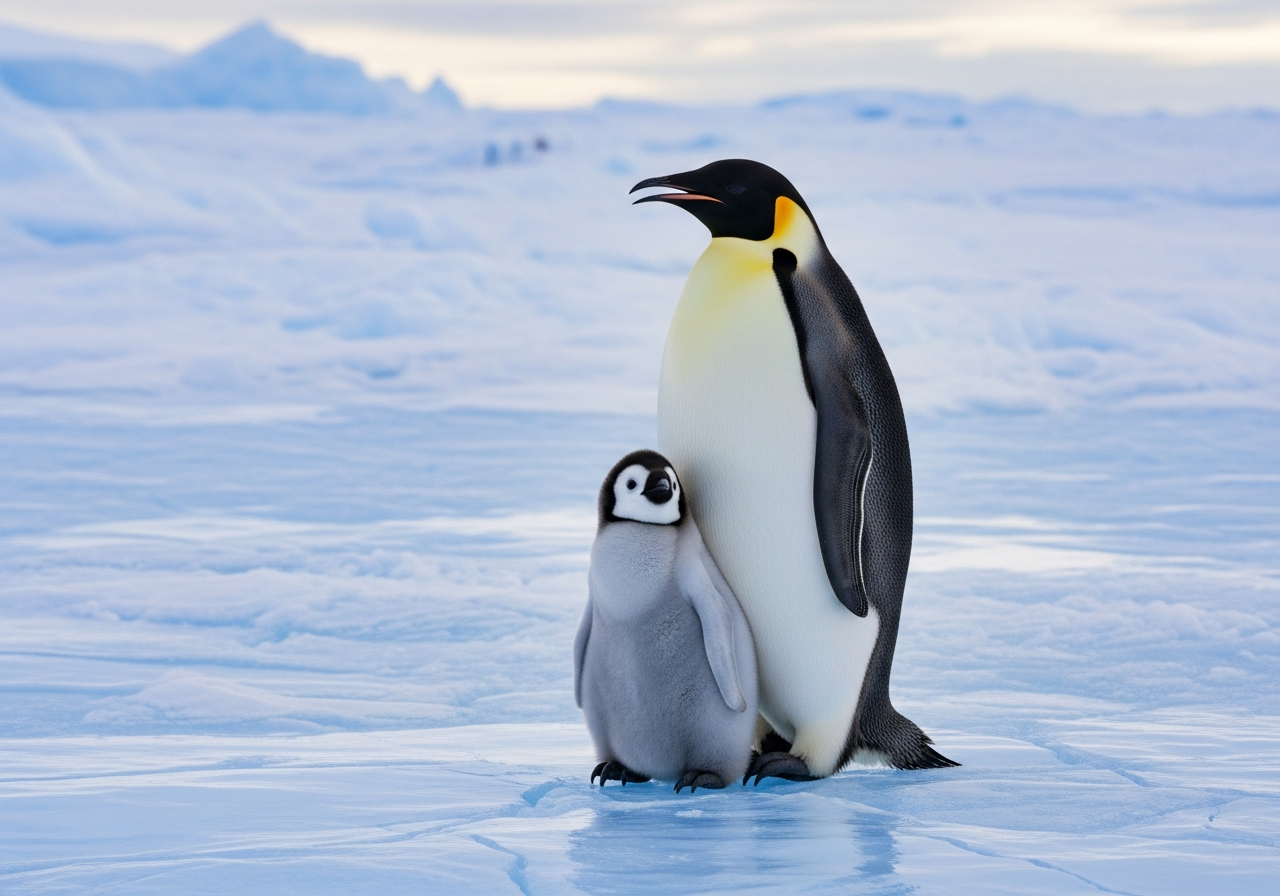
The emperor penguin is the tallest and heaviest penguin species, standing up to 1.2 m (4 ft). It is the only animal that breeds during the brutal Antarctic winter, where males incubate a single egg on their feet through months of darkness and temperatures below -40°C. Emperor penguins live around 20 years.
Top questions about the Emperor Penguin
Also available in Español (Pingüino emperador)
Emperor Penguin facts at a glance
- Weight 40 kg
- Length 1.2 m
- Top speed 12 km/h
- Lifespan 20 years
| Scientific name | Aptenodytes forsteri |
|---|---|
| Diet | Carnivore (fish, krill, squid) |
| Habitat | Antarctic sea ice and surrounding ocean |
| Lifespan | ~20 years |
| Height | Up to 1.2 m (4 ft) |
| Dive depth | Up to 500 m (1,640 ft) |
| Conservation status | Near Threatened (IUCN) |
| Kingdom | Animalia |
|---|---|
| Phylum | Chordata |
| Class | Aves |
| Order | Sphenisciformes |
| Family | Spheniscidae |
| Genus | Aptenodytes |
Where it lives
The emperor penguin (Aptenodytes forsteri) is native to The sea ice and coastline of Antarctica. — recorded across Antarctica in this guide’s range summary.
For occurrence records, see GBIF species search and sources below.
How big is a emperor penguin?
An adult emperor penguin measures 1.2 m long — about 69% of the height of an average adult person (1.73 m) — and weighs around 40 kg, about 57% of an average adult’s body weight (70 kg).
Length vs an average adult’s height (to scale)
What is a group of emperor penguins called?
Group name (collective noun)
A group of Emperor Penguins is called a colony. It is also known as a rookery or a waddle.
Baby name
A baby Emperor Penguin is called a chick.
Explore more animal collective nouns and baby animal names .
Breeding in the cold
Emperor penguins are the only species that breeds during the Antarctic winter. After the female lays a single egg, she returns to the sea to feed while the male balances the egg on his feet under a flap of skin for about two months, fasting the entire time.
Surviving the freeze
To endure temperatures below -40°C and fierce winds, emperor penguins huddle together in dense groups, constantly rotating so each bird gets time in the warm center. This cooperative behavior is essential for survival and warmth.
Diving and feeding
Emperor penguins are exceptional divers, reaching depths of up to 500 m and staying underwater for more than 20 minutes while hunting fish, krill, and squid. Their solid bones and streamlined bodies make them powerful swimmers.
Conservation
Emperor penguins depend on stable sea ice to breed. Because climate change is reducing and destabilizing Antarctic ice, the species is increasingly threatened, and scientists warn that continued ice loss could sharply reduce their populations this century.
Dig deeper into the Emperor Penguin
- Emperor Penguin: Key Facts
The emperor penguin is the tallest and heaviest penguin species, standing up to 1.2 m (4 ft).
- How Big Is An Emperor Penguin?
Emperor Penguin size and weight: typical about 40 kg, dimorphism, and growth.
- How Long Do Emperor Penguins Live?
Emperor Penguin lifespan is typically ~20 years. What shortens or extends life, life stages, and status (Near Threatened).
- What Do Emperor Penguins Eat?
What emperor penguins eat: Carnivore (fish, krill, squid), foraging style, and seasonal shifts in Antarctic sea ice and surrounding ocean.
- Where Do Emperor Penguins Live?
Where emperor penguins live: Antarctic sea ice and surrounding ocean, native range cues, and human overlap. Status Near Threatened.
Explore the Emperor Penguin
Compare
Related Birds
Collections
Range & geography
Did you know? Emperor Penguin facts
- Emperor penguins are the largest penguins, standing up to about 1.2 m tall.
- They breed through the brutal Antarctic winter, the harshest of any bird.
- Males incubate the single egg on their feet for around two months without eating.
- Huddling colonies share warmth, with birds rotating from edge to centre.
- Emperor penguins dive deeper than any other bird, beyond 500 m.
- They depend on stable sea ice, making them vulnerable to a warming climate.
Diet & feeding
Emperor penguins feed on fish, krill, and squid caught on deep dives beneath the sea ice, with diet shifting seasonally and by location.
Adaptations
- Dense, overlapping feathers and thick fat insulate against extreme Antarctic cold.
- Huddling behaviour conserves heat across the colony in winter.
- Deep-diving physiology and oxygen storage allow long dives for prey.
- A brood pouch lets the male shelter the egg and chick on his feet.
Behaviour & ecology
- Emperors breed in winter colonies on sea ice, males incubating while females feed at sea.
- Birds huddle and rotate position to share warmth in blizzards.
- They make long treks between colony and open water.
- Parents take turns foraging and feeding the chick.
Communication
- Distinct calls let mates and chicks find one another in a crowded, noisy colony.
- Vocal signatures identify individuals among thousands.
- Posture and movement coordinate huddling and pairing.
Habitat & range
Emperor penguins live around the coast of Antarctica, breeding on stable sea ice and feeding in the surrounding Southern Ocean.
Ecological role
As deep-diving Antarctic predators, emperor penguins link fish, krill, and squid to the ice ecosystem and are a key indicator of Southern Ocean and sea-ice health.
Conservation status of the Emperor Penguin
The emperor penguin (Aptenodytes forsteri) is listed as Near Threatened on the IUCN Red List. Near Threatened (NT) means a species does not yet qualify as threatened but is close to it, or likely to become so in the near future without ongoing conservation. It is a watch-list category just below Vulnerable.
Main threats to the emperor penguin
- Sea-ice loss from climate warming
- Changes in krill and fish prey
- Extreme weather events at colonies
- Human disturbance in parts of Antarctica
Emperor Penguin (Aptenodytes forsteri) was most recently assessed for the IUCN Red List in 2019. View the full IUCN assessment .
Frequently asked questions about the Emperor Penguin
How do emperor penguins survive the Antarctic winter?
Emperor penguins survive by huddling together in large groups and rotating positions so every bird shares time in the warm center. Their dense feathers and fat reserves also insulate them against extreme cold.
Do male or female penguins incubate the egg?
In emperor penguins, the male incubates the single egg. He balances it on his feet under a flap of skin for about two months while fasting, as the female feeds at sea.
What do emperor penguins eat?
Emperor penguins are carnivores that eat fish, krill, and squid. They dive deep into the ocean to hunt, sometimes reaching depths of 500 m.
How deep can emperor penguins dive?
Emperor penguins can dive up to 500 m (1,640 ft) deep and stay underwater for more than 20 minutes, making them the deepest-diving birds.
Are emperor penguins endangered?
Emperor penguins are listed as Near Threatened. Their reliance on stable sea ice makes them especially vulnerable to climate change and shrinking Antarctic ice.
How tall are emperor penguins?
Emperor penguins are the largest penguin species, standing up to about 1.2 m (4 ft) tall and weighing up to 45 kg (99 lb).
What is a group of emperor penguins called?
A group of Emperor Penguins is called a colony. It is also known as a rookery or a waddle.
What is a baby emperor penguin called?
A baby Emperor Penguin is called a chick.
Sources & references
This guide is compiled and reviewed against established zoological and conservation references. Key sources for the Emperor Penguin:
-
IUCN Red List of Threatened Species
Conservation status (Near Threatened) reflects the IUCN Red List category for Aptenodytes forsteri, most recently assessed in 2019.
-
iNaturalist — observations & photos
Search citizen-science observations and community IDs for Aptenodytes forsteri. Useful for range checks and recent sightings — not a substitute for formal Red List status.
-
GBIF — occurrence data
Global Biodiversity Information Facility species search for Aptenodytes forsteri. Explore published occurrence records used in range research.
-
eBird — bird observations
Cornell Lab eBird target search for Emperor Penguin. Check recent checklists and seasonal abundance where birders report this species.
- BirdLife International (2020). Aptenodytes forsteri. IUCN Red List of Threatened Species.
Status (Near Threatened) and sea-ice reliance.
- Billerman, S. M. et al. (eds.). Birds of the World. Cornell Lab of Ornithology.
Breeding biology and diving.
- Animal Diversity Web — Aptenodytes forsteri. University of Michigan Museum of Zoology.
Life history, morphology, and range.
-
Global Animal Guide editorial standards
How we research, source, review, and update every guide for accuracy.
Want to help directly? Learn how to symbolically adopt a emperor penguin and support its conservation.