Atlantic Horseshoe Crab
Limulus polyphemus
Quick answer
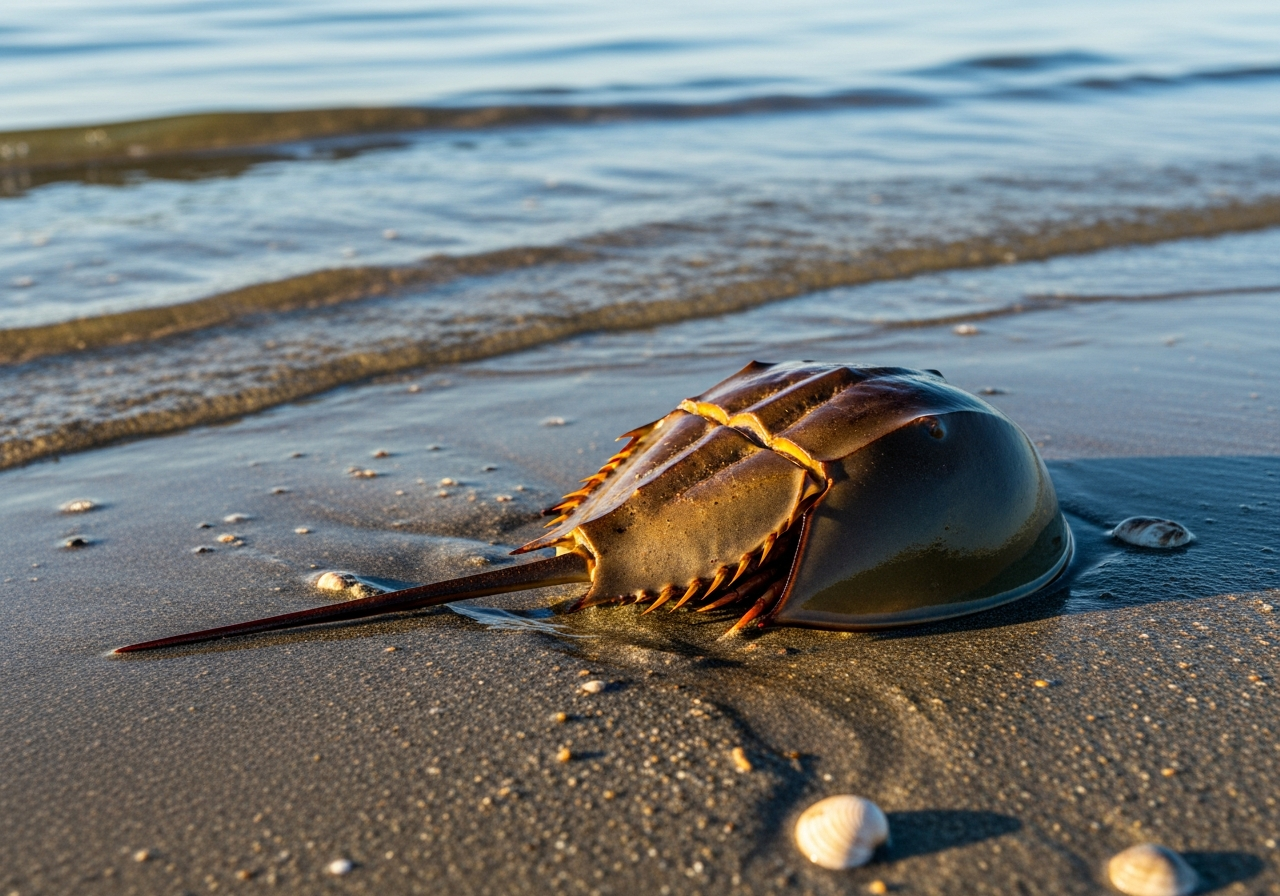
The Atlantic horseshoe crab (Limulus polyphemus) is an ancient marine arthropod, more closely related to spiders and scorpions than to true crabs. It has a domed horseshoe-shaped shell, a long spike-like tail, and reaches about 60 cm (24 in) including the tail. Found in shallow coastal waters and sandy beaches, it crawls along the bottom feeding on worms and molluscs, often living more than 20 years. It is listed as Vulnerable.
Atlantic Horseshoe Crab facts at a glance
| Scientific name | Limulus polyphemus |
|---|---|
| Diet | Omnivore (worms, mollusks, algae, carrion) |
| Habitat | Shallow coastal waters and sandy beaches |
| Lifespan | Often 20+ years |
| Size | Up to about 60 cm (24 in) including tail |
| Top speed | Slow; crawls and plows through sand |
| Conservation status | Vulnerable (IUCN) |
| Kingdom | Animalia |
|---|---|
| Phylum | Arthropoda |
| Class | Merostomata |
| Order | Xiphosura |
| Family | Limulidae |
| Genus | Limulus |
Where it lives
Shallow coastal waters and beaches of the western Atlantic, along the eastern United States and the Gulf of Mexico.
What is a baby atlantic horseshoe crab called?
Baby name
A baby Atlantic Horseshoe Crab is called a larva.
Explore more animal collective nouns and baby animal names .
A living fossil
Horseshoe crabs belong to an ancient lineage whose body plan has changed remarkably little for hundreds of millions of years, earning them the nickname "living fossils". Despite the name, they are not true crabs but chelicerates, more closely related to spiders and scorpions. The Atlantic species, Limulus polyphemus, is one of only four horseshoe crab species alive today. Their long evolutionary history makes them a favourite subject for studies of animal design and survival.
Anatomy and blue blood
The horseshoe crab has a hard, domed carapace shaped like a horseshoe, a smaller abdominal section, and a long, pointed tail called a telson. It grows to about 60 cm (24 in) including the tail and weighs around 2 kg, with several pairs of legs and multiple eyes, including large compound eyes on the shell. Its blood is copper-based and appears blue, and it contains a clotting agent that reacts to bacterial contamination. That property makes horseshoe crab blood valuable for testing the safety of medical products.
Habitat and movement
Atlantic horseshoe crabs live in shallow coastal waters and estuaries along the western Atlantic, moving onto sandy beaches to breed. They are slow-moving bottom-dwellers that crawl and plough through the sand rather than swim quickly, with a top speed of only around 1 km/h. The tail is used mainly as a lever to right themselves if a wave flips them over, not as a weapon. They tend to stay in soft-bottomed areas where food is easy to find.
Diet and feeding
Horseshoe crabs are omnivores that feed on marine worms, small molluscs, crustaceans, algae, and carrion. Lacking jaws, they crush food between the bristly bases of their legs and push it toward the mouth as they move. They forage mainly along the seabed, ploughing through sand and mud in search of buried prey. Their scavenging helps keep the shallow-water bottom clear of dead material.
Breeding and conservation
In spring and early summer horseshoe crabs gather on sandy beaches in large numbers to spawn, with females laying thousands of eggs in the sand and males fertilising them. These eggs are a vital food source for migrating shorebirds, so the crabs' breeding success affects other species too. The Atlantic horseshoe crab is listed as Vulnerable by the IUCN, threatened by habitat loss, harvesting for bait, and collection for the biomedical industry. Long-lived individuals, often surviving more than 20 years, take about a decade to reach breeding age.
Dig deeper into the Atlantic Horseshoe Crab
- Are Horseshoe Crab Endangered
Dig deeper into atlantic horseshoe crab — are horseshoe crab endangered.
- Horseshoe Crab Guide 5
Dig deeper into atlantic horseshoe crab — horseshoe crab guide 5.
- How Long do Horseshoe Crab Live?
Dig deeper into atlantic horseshoe crab — how long do horseshoe crab live.
- What do Horseshoe Crab Eat
Dig deeper into atlantic horseshoe crab — what do horseshoe crab eat.
- Where do Horseshoe Crab Live?
Dig deeper into atlantic horseshoe crab — where do horseshoe crab live.
Explore the Atlantic Horseshoe Crab
Related Invertebrates
Collections
Range & geography
Did you know? Atlantic Horseshoe Crab facts
- The Atlantic horseshoe crab is an ancient marine arthropod that has existed for hundreds of millions of years, making it a true living fossil.
- No. Despite the name, horseshoe crabs are not true crabs. They are chelicerates more closely related to spiders and scorpions than to crabs or lobsters.
- Their blood carries oxygen using copper-based hemocyanin instead of the iron-based hemoglobin in our red blood, which gives it a blue color. The blood also contains a clotting agent used to test medicines for contamination.
- No. Horseshoe crabs are harmless to people. Their long, pointed tail looks intimidating but is only used to flip the animal over if it lands on its back, not as a weapon.
- Horseshoe crabs are omnivores that eat worms, mollusks, algae, and carrion. They plow through sand and mud and crush their food using the bristly bases of their legs.
- Conservation: Vulnerable (IUCN).
Diet & feeding
Atlantic Horseshoe Crab feeds primarily as a omnivore (worms, mollusks, algae, carrion). A horseshoe crab has a smooth, domed shell, several pairs of legs hidden underneath, and a long, pointed tail called a telson that it uses to flip itself upright rather than as a weapon. It has up to ten eyes spread across its body
Adaptations
- Horseshoe crabs are among the oldest animal lineages still living, with fossil relatives dating back hundreds of millions of years, long before the dinosaurs. Their basic body plan has changed remarkably little over that time. Despite the name, they are not true crabs but chelicerates, the same broad group that includes spiders and scorpions.
- A horseshoe crab has a smooth, domed shell, several pairs of legs hidden underneath, and a long, pointed tail called a telson that it uses to flip itself upright rather than as a weapon. It has up to ten eyes spread across its body, including large compound eyes used to find mates. The tail and shell are harmless to people despite their fierce appearance.
Behaviour & ecology
- Horseshoe crabs are among the oldest animal lineages still living, with fossil relatives dating back hundreds of millions of years, long before the dinosaurs. Their basic body plan has changed remarkably little over that time. Despite the name, they are not true crabs but chelicerates, the same broad group that includes spiders and scorpions.
- A horseshoe crab has a smooth, domed shell, several pairs of legs hidden underneath, and a long, pointed tail called a telson that it uses to flip itself upright rather than as a weapon. It has up to ten eyes spread across its body, including large compound eyes used to find mates. The tail and shell are harmless to people despite their fierce appearance.
- Horseshoe crabs are omnivores that plow through sand and mud searching for worms, mollusks, algae, and carrion, crushing food with the bases of their legs. Each spring, huge numbers gather on beaches to spawn, with females laying thousands of eggs in the sand. These eggs are a critical food source for migrating shorebirds along the Atlantic coast.
Communication
- Atlantic Horseshoe Crab uses scent, posture, and vocal signals to mark territory and coordinate social behaviour.
- Communication intensity often peaks during breeding seasons and territorial disputes.
Habitat & range
Shallow coastal waters and sandy beaches
Ecological role
Atlantic Horseshoe Crab plays a recognised ecological role in shallow coastal waters and sandy beaches.
Conservation status of the Atlantic Horseshoe Crab
Vulnerable (VU) means a species faces a high risk of extinction in the medium-term future. It is the lowest-risk of the three 'threatened' IUCN categories — one step below Endangered, which is itself below Critically Endangered — and is often an early warning that a population is in trouble.
The atlantic horseshoe crab (Limulus polyphemus) is assessed on the IUCN Red List. Look up on the IUCN Red List .
Frequently asked questions about the Atlantic Horseshoe Crab
Is a horseshoe crab really a crab?
No. Despite its name, the horseshoe crab is not a true crab but a chelicerate, more closely related to spiders and scorpions. It belongs to an ancient group that has existed for hundreds of millions of years.
Why is horseshoe crab blood blue and valuable?
Their blood is copper-based, which makes it appear blue, and it contains a clotting agent that reacts to bacterial contamination. This property is used to test that medicines and medical devices are free of dangerous bacteria.
Are horseshoe crabs dangerous?
Horseshoe crabs are harmless to people. They have no claws or stinger, and their long tail is used only to flip themselves upright if a wave turns them over, not to attack.
What do horseshoe crabs eat?
They are omnivores that eat marine worms, small molluscs, crustaceans, algae, and carrion. Lacking jaws, they crush food between the bases of their legs as they crawl along the seabed.
How long do horseshoe crabs live?
Atlantic horseshoe crabs often live more than 20 years. They grow slowly and take around a decade to reach breeding age, which makes their populations sensitive to overharvesting.
Are horseshoe crabs endangered?
The Atlantic horseshoe crab is listed as Vulnerable by the IUCN. Habitat loss, harvesting for bait, and collection for the biomedical industry have reduced their numbers, and their eggs are also crucial food for migrating shorebirds.
What is a baby atlantic horseshoe crab called?
A baby Atlantic Horseshoe Crab is called a larva.
Sources & references
This guide is compiled and reviewed against established zoological and conservation references. Key sources for the Atlantic Horseshoe Crab:
-
IUCN Red List of Threatened Species
Conservation status (Vulnerable) reflects the IUCN Red List category for Limulus polyphemus.
- IUCN Red List — Limulus polyphemus.
Conservation status (Vulnerable) and population trends.
- Animal Diversity Web — Limulus polyphemus. University of Michigan Museum of Zoology.
Life history, morphology, and range.
- Wikipedia — Atlantic Horseshoe Crab.
General taxonomy and overview (cross-check primary sources).
-
Global Animal Guide editorial standards
How we research, source, review, and update every guide for accuracy.