Image sourcing: see credits & licences
Quick answer
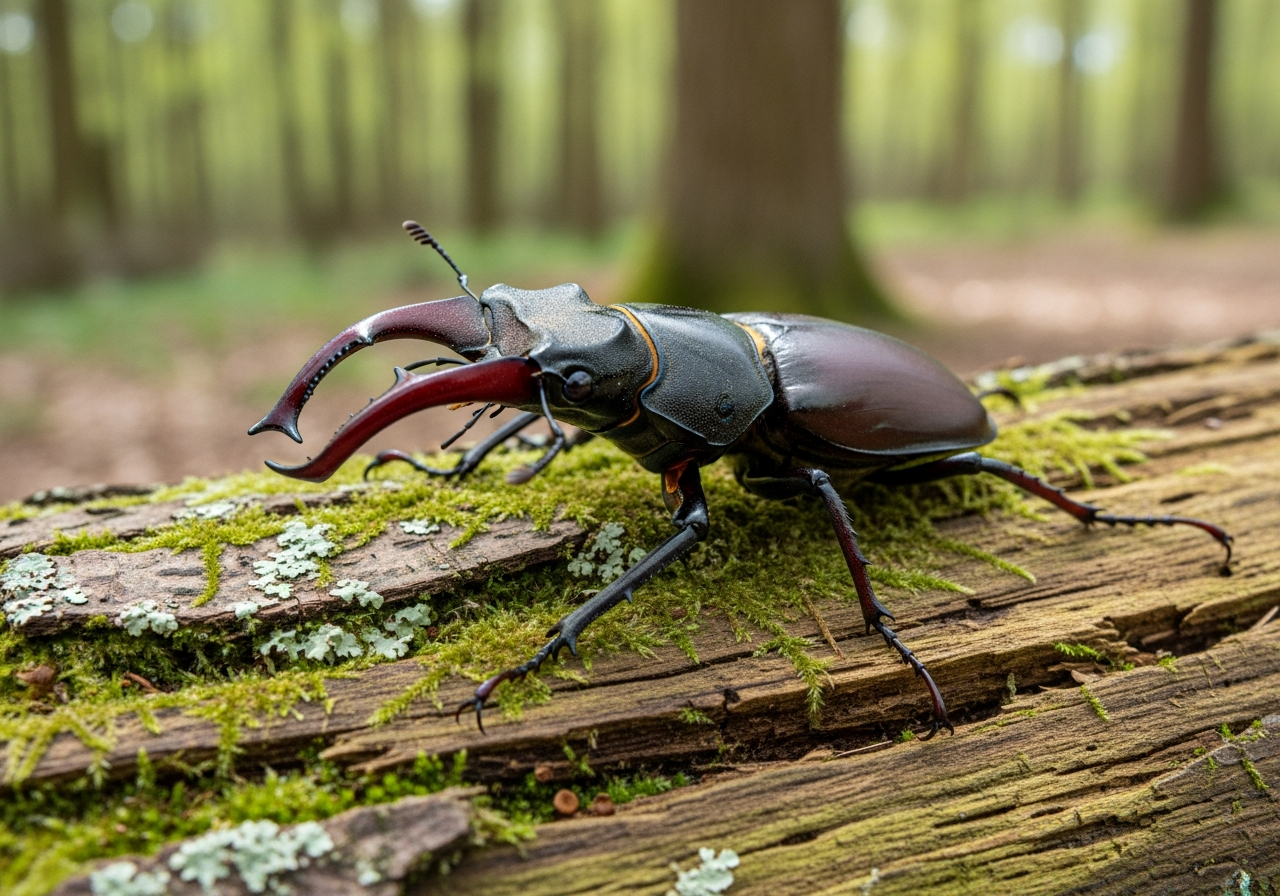
The stag beetle (Lucanus cervus) is one of Europe's largest land beetles, named for the antler-like jaws that males wave and wrestle with like tiny deer. Adults reach up to 7.5 cm long and live only a few weeks to months, while the grubs spend three to six years feeding on rotting wood underground. Found in old woodlands, parks, and gardens, the species is listed as Near Threatened by the IUCN, largely because dead wood is being cleared from the landscape.
Top questions about the Stag Beetle
Stag Beetle facts at a glance
- Weight 5 g
- Length 7 cm
- Top speed 5 km/h
- Lifespan 1 years
| Scientific name | Lucanus cervus |
|---|---|
| Diet | Larvae eat rotting wood; adults take tree sap and fruit juices |
| Habitat | Old woodlands, parks, and gardens with dead wood |
| Lifespan | Larvae 3–6 years; adults a few weeks to months |
| Length | Up to 7.5 cm (3 in) in large males |
| Jaws | Antler-like mandibles in males |
| Conservation status | Near Threatened (IUCN) |
| Kingdom | Animalia |
|---|---|
| Phylum | Arthropoda |
| Class | Insecta |
| Order | Coleoptera |
| Family | Lucanidae |
| Genus | Lucanus |
Where it lives
The stag beetle (Lucanus cervus) is native to Old woodlands and parks across Europe and parts of western Asia. — recorded across Europe, Asia in this guide’s range summary.
For occurrence records, see GBIF species search and sources below.
How big is a stag beetle?
An adult stag beetle measures 7 cm long — about 4% of the height of an average adult person (1.73 m) — and weighs around 5 g, a small fraction of an average adult’s body weight (70 kg).
Length vs an average adult’s height (to scale)
What is a group of stag beetles called?
Group name (collective noun)
A group of Stag Beetles is called a swarm. It is also known as a colony.
Baby name
A baby Stag Beetle is called a grub. It may also be called a larva.
Explore more animal collective nouns and baby animal names .
The antler-like jaws
Male stag beetles are unmistakable, sporting enormously enlarged mandibles that curve and branch like a stag's antlers. Despite their fearsome look these jaws are surprisingly weak and are used mainly for display and for wrestling rival males, not for feeding. In contests over females or feeding sites, two males lock jaws and try to lift and throw each other off the branch. Females lack the great antlers but have smaller, sharper jaws that can actually deliver a stronger pinch.
A long life underground
The stag beetle spends the overwhelming majority of its life hidden as a larva, not as the familiar adult. The grubs live for three to six years buried in rotting wood, chewing through decaying stumps and roots and growing to the size of a finger. When fully grown a larva builds a cocoon of soil and wood in which it pupates and transforms. This long development is why a steady supply of dead wood is so essential to the species.
What stag beetles eat
Diet changes completely between the two life stages. The larvae feed on rotting, fungus-softened wood, doing important work breaking down dead timber and returning its nutrients to the soil. Adults, by contrast, do not eat solid food at all; they survive on their fat reserves and sip only sap oozing from trees and juice from fallen, over-ripe fruit. Because the adults barely feed, their whole above-ground life is devoted to breeding.
The brief adult summer
After years underground, adult stag beetles emerge in early summer to mate, and their winged life lasts only a few weeks to a couple of months. Males take to the air on warm evenings, flying heavily with their bulky bodies held almost upright as they search for females. This is when people most often spot them, blundering around gardens and woodland edges at dusk. Once they have mated and the females have laid their eggs in dead wood, the adults die.
Why stag beetles are declining
The stag beetle is listed as Near Threatened by the IUCN and has vanished from parts of its former European range. Its decline is driven chiefly by the loss of the dead and decaying wood its larvae depend on, as woodlands are tidied, stumps removed, and fallen timber cleared away. Roads and predators take a further toll on the slow, low-flying adults. Leaving log piles and dead wood in gardens and parks is one of the most effective ways to help the species recover.
Dig deeper into the Stag Beetle
- Stag Beetle: Key Facts
Stag Beetles (Lucanus cervus) are insects found across Europe, Asia. The large beetle with antler-like jaws.
- What Do Stag Beetles Eat?
What stag beetles eat: Larvae eat rotting wood; adults take tree sap and fruit juices, foraging style, and seasonal shifts in Old woodlands, parks, and gardens with dead wood.
- Where Do Stag Beetles Live?
Where stag beetles live: Old woodlands, parks, and gardens with dead wood, native range cues, and human overlap. Status Near Threatened.
Explore the Stag Beetle
Related Insects
Range & geography
Did you know? Stag Beetle facts
- The stag beetle is one of Europe's largest beetles, named for the enormous antler-like jaws of the males, which they use to wrestle rivals rather than to bite.
- Only male stag beetles have the large antler-like jaws, which they use to wrestle other males over mates rather than to bite. Despite their size, these jaws are fairly weak.
- Stag beetle larvae feed on rotting wood underground, while the short-lived adults eat little and take only tree sap and the juices of soft fruit for energy.
- Stag beetles spend most of their life as larvae, developing for three to six years in dead wood. The adults live only a few weeks to a few months after emerging.
- No. Stag beetles are harmless to people, and even the large male jaws are too weak to cause real injury. They do not sting and pose no threat.
- Conservation: Near Threatened (IUCN).
Diet & feeding
Stag Beetle feeds primarily as a larvae eat rotting wood; adults take tree sap and fruit juices. Most of a stag beetle's life is spent underground as a larva, feeding on decaying wood for several years before pupating. The adults that emerge in early summer live only a few weeks to a few months, focusing on finding a m
Adaptations
- Male stag beetles are famous for their huge, branching mandibles, which resemble the antlers of a stag and give the insect its name. Despite their fearsome look, these jaws are relatively weak and are used mainly to grapple with rival males over mates and territory. Females have much smaller but stronger jaws.
- Most of a stag beetle's life is spent underground as a larva, feeding on decaying wood for several years before pupating. The adults that emerge in early summer live only a few weeks to a few months, focusing on finding a mate. This long larval stage means a healthy supply of dead wood is essential for the species.
Behaviour & ecology
- Male stag beetles are famous for their huge, branching mandibles, which resemble the antlers of a stag and give the insect its name. Despite their fearsome look, these jaws are relatively weak and are used mainly to grapple with rival males over mates and territory. Females have much smaller but stronger jaws.
- Most of a stag beetle's life is spent underground as a larva, feeding on decaying wood for several years before pupating. The adults that emerge in early summer live only a few weeks to a few months, focusing on finding a mate. This long larval stage means a healthy supply of dead wood is essential for the species.
- Stag beetle larvae feed on rotting wood, helping to break it down and recycle nutrients in the soil. Adults eat little, taking some tree sap and the juices of soft fruit for energy. On warm summer evenings, males fly in search of females, their large bodies producing a low, buzzing flight.
Communication
- Stag Beetle uses scent, posture, and vocal signals to mark territory and coordinate social behaviour.
- Communication intensity often peaks during breeding seasons and territorial disputes.
Habitat & range
Old woodlands, parks, and gardens with dead wood
Ecological role
Stag Beetle participates in pollination, decomposition, or prey-base support for birds and other insectivores.
Conservation status of the Stag Beetle
The stag beetle (Lucanus cervus) is listed as Near Threatened on the IUCN Red List. Near Threatened (NT) means a species does not yet qualify as threatened but is close to it, or likely to become so in the near future without ongoing conservation. It is a watch-list category just below Vulnerable.
The stag beetle (Lucanus cervus) is assessed on the IUCN Red List. Look up on the IUCN Red List .
Frequently asked questions about the Stag Beetle
Why do stag beetles have such big jaws?
Only the males have the large antler-like jaws, and they use them mainly for display and for wrestling other males over females and feeding sites. The jaws look powerful but are fairly weak; a male tries to grip a rival and flip him off the branch rather than injure him.
Do stag beetles bite?
They can, but they are not aggressive. A female's smaller jaws are strong enough to give a noticeable nip if she is handled carelessly, while the male's showy antlers are surprisingly weak. Neither is dangerous to people.
How long do stag beetles live?
Stag beetles spend three to six years as grubs feeding on rotting wood underground. Once they emerge as adults, they live only a few weeks to a couple of months, just long enough to mate and lay eggs.
What do stag beetles eat?
The larvae feed on decaying, fungus-softened wood over several years. Adults eat no solid food and instead sip tree sap and the juice of fallen ripe fruit, living mostly off fat reserves built up during the larval stage.
Are stag beetles endangered?
Stag beetles are listed as Near Threatened by the IUCN and have declined across much of Europe. The main cause is the loss of the dead and rotting wood their larvae need, as woodlands and gardens are tidied and fallen timber is cleared away.
How can I help stag beetles in my garden?
The best thing you can do is leave dead wood in place. A pile of logs, an old tree stump, or partly buried decaying wood gives the larvae the habitat they need for their long development, and avoiding pesticides helps the adults survive.
What is a group of stag beetles called?
A group of Stag Beetles is called a swarm. It is also known as a colony.
What is a baby stag beetle called?
A baby Stag Beetle is called a grub. It may also be called a larva.
Sources & references
This guide is compiled and reviewed against established zoological and conservation references. Key sources for the Stag Beetle:
-
IUCN Red List of Threatened Species
Conservation status (Near Threatened) reflects the IUCN Red List category for Lucanus cervus.
-
iNaturalist — observations & photos
Search citizen-science observations and community IDs for Lucanus cervus. Useful for range checks and recent sightings — not a substitute for formal Red List status.
-
GBIF — occurrence data
Global Biodiversity Information Facility species search for Lucanus cervus. Explore published occurrence records used in range research.
- IUCN Red List — Lucanus cervus.
Conservation status (Near Threatened) and population trends.
- Animal Diversity Web — Lucanus cervus. University of Michigan Museum of Zoology.
Life history, morphology, and range.
- Wikipedia — Stag Beetle.
General taxonomy and overview (cross-check primary sources).
-
Global Animal Guide editorial standards
How we research, source, review, and update every guide for accuracy.