Image sourcing: see credits & licences
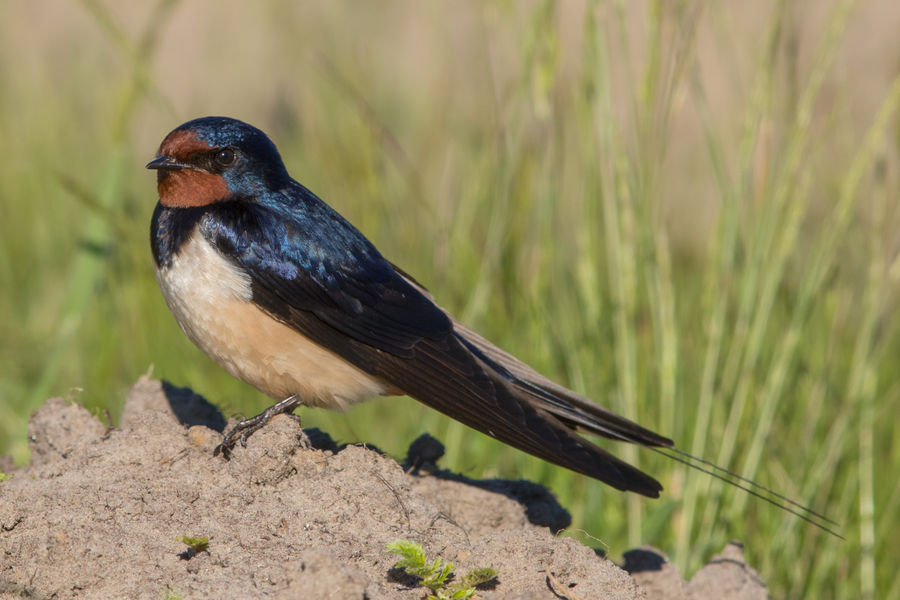
The barn swallow (Hirundo rustica) is a bird of the family Hirundinidae, in the order Passeriformes.
Quick answer
The barn swallow (Hirundo rustica) is a fork-tailed aerial insectivore that breeds across the Northern Hemisphere and winters in Africa, South America, and southern Asia. It nests on beams in barns and under bridges, weighs about 20 g, and is listed Least Concern, though some European farmland populations have declined with fewer insects and nest sites.
Top questions about the Barn Swallow
Barn Swallow facts at a glance
- Weight 20 g
- Length 18 cm
- Top speed 60 km/h
- Lifespan 4 years
| Scientific name | Hirundo rustica |
|---|---|
| Diet | Insectivore |
| Habitat | Open country, farms, and wetlands |
| Lifespan | Around 4 years in the wild (varies by population and captivity). |
| Weight | About 0.02 kg typical adult mass (sex and region vary). |
| Top speed | Up to roughly 60 km/h when moving at speed. |
| Conservation status | Least Concern (IUCN) |
| Kingdom | Animalia |
|---|---|
| Phylum | Chordata |
| Class | Aves |
| Order | Passeriformes |
| Family | Hirundinidae |
| Genus | Hirundo |
Where it lives
The barn swallow (Hirundo rustica) is native to Breeds across the Northern Hemisphere; winters in Africa, South America, and southern Asia. — recorded across North America, Europe, Asia, Africa in this guide’s range summary.
For occurrence records, see GBIF species search and sources below.
How big is a barn swallow?
An adult barn swallow measures 18 cm long — about 10% of the height of an average adult person (1.73 m) — and weighs around 20 g, a small fraction of an average adult’s body weight (70 kg).
Length vs an average adult’s height (to scale)
What is a group of barn swallows called?
Group name (collective noun)
A group of Barn Swallows is called a flight.
Baby name
A baby Barn Swallow is called a chick.
Explore more animal collective nouns and baby animal names .
Forked tail and mud cups
Long outer tail feathers aid aerial agility; adults build open mud-pellet cups stuck to vertical walls under eaves. Both parents feed chicks a stream of flying insects.
Hawking insects on the wing
Diet is almost entirely flying insects — flies, beetles, aphids, and flying ants — caught in continuous flight over fields, water, and livestock yards.
Global migrant of farms
Breeds across North America, Europe, and Asia in open country, farms, and wetlands; winters in the Southern Hemisphere. Traditional barns and bridges provide nest sites.
Insect declines and sealed buildings
Still Least Concern globally, but modern sealed barns, fewer insects from intensive farming, and bad weather on migration cut some regional numbers. Leaving access to outbuildings helps nesting pairs.
Explore the Barn Swallow
Close relatives
- Canary Same order
- House Sparrow Same order
- Superb Lyrebird Same order
- Blue Tit Same order
Range & geography
Conservation status of the Barn Swallow
The barn swallow (Hirundo rustica) is listed as Least Concern on the IUCN Red List. Least Concern (LC) is the IUCN's lowest-risk category, assigned to widespread, abundant species that have been evaluated and found not to be threatened. It does not mean a species faces no pressures — only that it is not currently at risk of extinction.
The barn swallow (Hirundo rustica) is assessed on the IUCN Red List. Look up on the IUCN Red List .
Frequently asked questions about the Barn Swallow
Why do barn swallows have forked tails?
Long streamers improve manoeuvrability when chasing insects and play a role in mate choice.
Do barn swallows migrate to Africa?
European breeders largely winter in sub-Saharan Africa; American birds head to Central and South America.
What do barn swallows eat?
Flying insects caught on the wing — not seeds or fruit.
Where do barn swallows nest?
Mud cup nests on beams, eaves, bridges, and similar sheltered vertical surfaces near open foraging habitat.
Are barn swallows declining?
Some farmland populations have dropped with insect and nest-site loss, though the species remains Least Concern worldwide.
What is a group of barn swallows called?
A group of Barn Swallows is called a flight.
What is a baby barn swallow called?
A baby Barn Swallow is called a chick.
Sources & references
This guide is compiled and reviewed against established zoological and conservation references. Key sources for the Barn Swallow:
-
IUCN Red List of Threatened Species
Conservation status (Least Concern) reflects the IUCN Red List category for Hirundo rustica.
-
iNaturalist — observations & photos
Search citizen-science observations and community IDs for Hirundo rustica. Useful for range checks and recent sightings — not a substitute for formal Red List status.
-
GBIF — occurrence data
Global Biodiversity Information Facility species search for Hirundo rustica. Explore published occurrence records used in range research.
-
eBird — bird observations
Cornell Lab eBird target search for Barn Swallow. Check recent checklists and seasonal abundance where birders report this species.
-
Global Animal Guide editorial standards
How we research, source, review, and update every guide for accuracy.