Quick answer
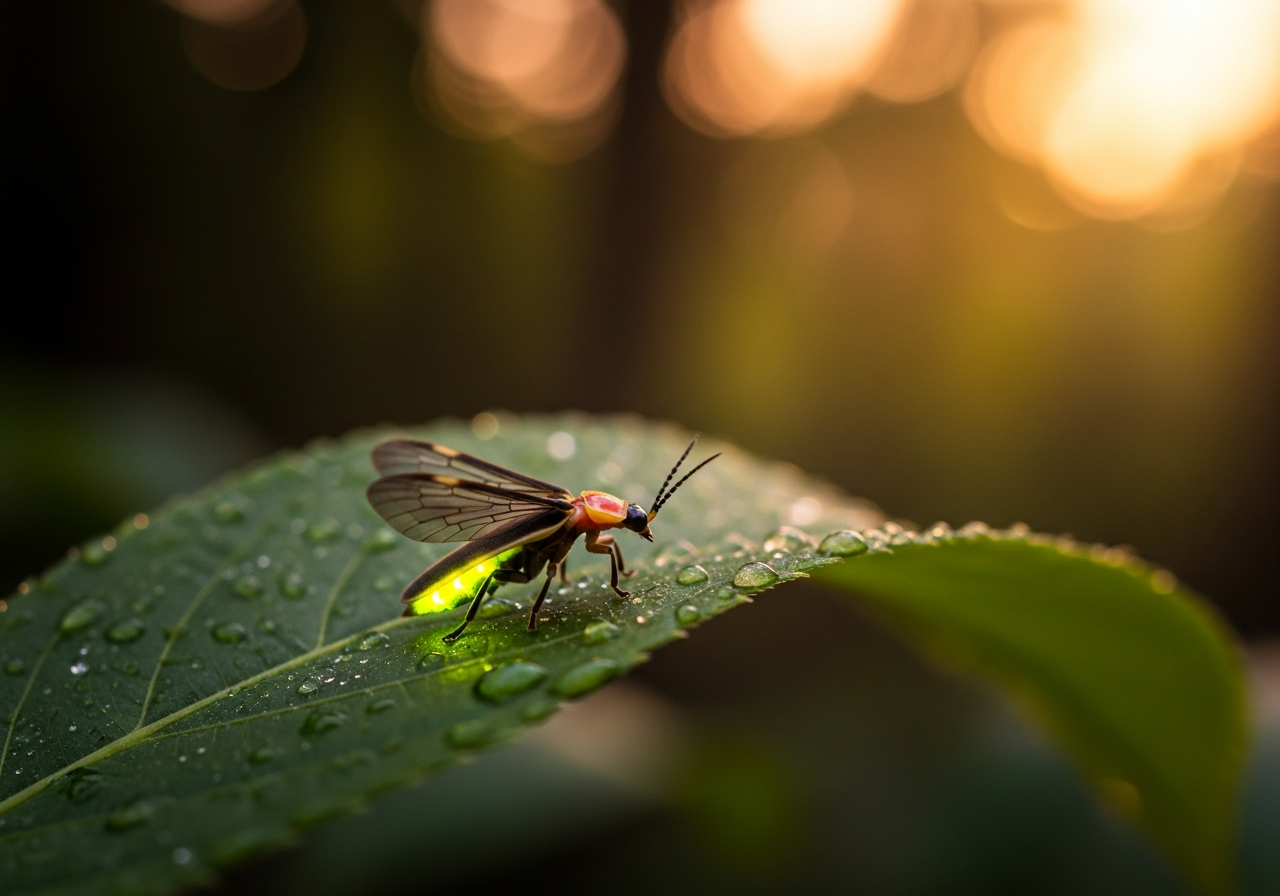
Fireflies are winged beetles of the family Lampyridae, famous for the cold, glowing light they flash to attract mates on warm summer nights. Most measure about 1 to 2.5 cm long and fly slowly over meadows, woodland edges, marshes and gardens. Adults live only around two to four weeks, though the predatory larvae can survive a year or more before maturing. Worldwide the group is common and listed as Least Concern.
Top questions about the Firefly
Firefly facts at a glance
- Weight 0 g
- Length 2 cm
- Top speed 8 km/h
- Lifespan 1 years
| Scientific name | Family Lampyridae |
|---|---|
| Diet | Larvae carnivorous; many adults eat little or nothing |
| Habitat | Meadows, forests, marshes, gardens |
| Lifespan | Adults ~2–4 weeks; larvae up to a year or more |
| Size | About 1–2.5 cm (0.4–1 in) |
| Light | Cold bioluminescent flashes |
| Conservation status | Least Concern (IUCN) |
| Kingdom | Animalia |
|---|---|
| Phylum | Arthropoda |
| Class | Insecta |
| Order | Coleoptera |
| Family | Lampyridae |
Where it lives
The firefly (Lampyridae) is native to Temperate and tropical regions worldwide, especially the Americas and Asia, in meadows, forests, and marshes. — recorded across Africa, Asia, Europe, North America, South America, Oceania in this guide’s range summary.
For occurrence records, see GBIF species search and sources below.
How big is a firefly?
An adult firefly measures 2 cm long — about 1% of the height of an average adult person (1.73 m) — and weighs around 0 g, a small fraction of an average adult’s body weight (70 kg).
Length vs an average adult’s height (to scale)
What is a group of fireflies called?
Group name (collective noun)
A group of Fireflies is called a swarm.
Baby name
A baby Firefly is called a larva. It may also be called a glow-worm.
Explore more animal collective nouns and baby animal names .
Not a fly but a beetle
Despite the name, fireflies are not flies at all but soft-bodied beetles belonging to the family Lampyridae. There are around 2,000 known species spread across much of the world, most active on warm, humid evenings. Adults are generally small, at roughly 1 to 2.5 cm long, with soft wing cases that cover membranous flight wings. In some species the females are wingless and stay on the ground, and these are often called glow-worms.
How and why they glow
A firefly's light comes from a chemical reaction in special cells in its abdomen, where a compound called luciferin reacts with oxygen. This is 'cold light', producing almost no heat and making it one of the most efficient forms of light in nature. The insect can switch its glow on and off and control the rhythm of its flashes. Even the eggs and larvae of many species glow faintly, which is thought to warn predators that they taste unpleasant.
Flash signals and finding a mate
The flashing has one main purpose: bringing males and females together to breed. Each species uses its own pattern of flashes, timed and coloured just so, allowing individuals to recognise their own kind in the dark. Typically flying males signal and waiting females answer with a matching flash. In some tropical regions huge numbers of fireflies famously synchronise their flashes, lighting up whole trees at once.
From glowing larva to adult
Fireflies spend most of their lives as larvae rather than as the glowing adults we notice. The larvae are fierce carnivores that hunt snails, slugs and worms, often for a year or more, injecting prey with digestive fluids. After pupating, the adult emerges to live only about two to four weeks, its short life focused entirely on breeding. Many adult fireflies eat little or nothing at all, relying on the reserves built up during the larval stage.
Habitat and where to see them
Fireflies favour damp, vegetated places such as meadows, forest edges, marshes and quiet gardens, where their larvae can find plenty of snails and slugs. They are most visible on warm, still nights in late spring and summer, usually near water or long grass. Because they need moisture and darkness, undisturbed habitat matters a great deal to them. A single warm evening in the right spot can reveal dozens flashing over a field.
Status and threats
As a whole the family is common and listed as Least Concern, but many individual firefly populations are thought to be declining. Light pollution is a particular problem, because artificial glow drowns out the flashes they rely on to find mates. Loss of the damp meadows and wetlands they breed in, along with pesticide use, adds further pressure. Reducing outdoor lighting and protecting moist habitat are simple ways to help them.
Dig deeper into the Firefly
- Firefly: Key Facts
Fireflys (Lampyridae) are insects found across Africa, Asia, Europe, North America, South America, Oceania. The glowing beetle of warm summer nights.
- What Do Fireflys Eat?
What fireflys eat: Larvae carnivorous; many adults eat little or nothing, foraging style, and seasonal shifts in Meadows, forests, marshes, gardens.
- Where Do Fireflys Live?
Where fireflys live: Meadows, forests, marshes, gardens, native range cues, and human overlap. Status Least Concern.
Explore the Firefly
Related Insects
Did you know? Firefly facts
- Fireflies, also called lightning bugs, are beetles that produce their own light through a chemical reaction in their abdomen.
- Fireflies glow through bioluminescence, a chemical reaction in their abdomen that produces light with almost no heat. They can turn the glow on and off to create flashing patterns.
- The main reason fireflies flash is to attract mates. Each species has its own pattern, and males and females exchange matching signals to find one another in the dark.
- Firefly larvae are predators that eat snails, slugs, and worms. Many adult fireflies eat little or nothing, living only long enough to mate and lay eggs.
- Adult fireflies usually live only about two to four weeks. They spend much longer, often a year or more, as larvae before becoming flashing adults.
- Conservation: Least Concern (IUCN).
Diet & feeding
Firefly feeds primarily as a larvae carnivorous; many adults eat little or nothing. Firefly larvae, sometimes called glowworms, live in damp soil or leaf litter and are predators that eat snails, slugs, and worms. After developing for many months, they pupate and emerge as adults. Many adult fireflies eat little or not
Adaptations
- Fireflies make light through bioluminescence, a chemical reaction in their lower abdomen that combines a compound called luciferin with oxygen and an enzyme. The result is a highly efficient \
- The main purpose of a firefly's glow is to find a mate. Each species has its own flash pattern, and males often fly while flashing as females respond from the ground or vegetation. By matching the right pattern, fireflies of the same species can recognize and locate one another in the dark.
Behaviour & ecology
- Fireflies make light through bioluminescence, a chemical reaction in their lower abdomen that combines a compound called luciferin with oxygen and an enzyme. The result is a highly efficient \
- The main purpose of a firefly's glow is to find a mate. Each species has its own flash pattern, and males often fly while flashing as females respond from the ground or vegetation. By matching the right pattern, fireflies of the same species can recognize and locate one another in the dark.
- Firefly larvae, sometimes called glowworms, live in damp soil or leaf litter and are predators that eat snails, slugs, and worms. After developing for many months, they pupate and emerge as adults. Many adult fireflies eat little or nothing and focus their short lives on reproducing.
Communication
- Firefly uses scent, posture, and vocal signals to mark territory and coordinate social behaviour.
- Communication intensity often peaks during breeding seasons and territorial disputes.
Habitat & range
Meadows, forests, marshes, gardens
Ecological role
Firefly acts as a predator that helps regulate prey populations and maintain balance in meadows, forests, marshes, gardens.
Conservation status of the Firefly
The firefly (Lampyridae) is listed as Least Concern on the IUCN Red List. Least Concern (LC) is the IUCN's lowest-risk category, assigned to widespread, abundant species that have been evaluated and found not to be threatened. It does not mean a species faces no pressures — only that it is not currently at risk of extinction.
The firefly (Lampyridae) is assessed on the IUCN Red List. Look up on the IUCN Red List .
Frequently asked questions about the Firefly
Are fireflies flies?
No. Despite the name, fireflies are beetles in the family Lampyridae, not true flies. There are around 2,000 species worldwide.
How do fireflies glow?
Fireflies glow through a chemical reaction in their abdomen, where a substance called luciferin reacts with oxygen. This produces 'cold light' with almost no heat, making it extremely efficient.
Why do fireflies flash?
Fireflies flash mainly to attract mates. Each species has its own flash pattern, so males and females can recognise and find one another in the dark.
How long do fireflies live?
Adult fireflies live only about two to four weeks, during which they focus on breeding. The larvae, however, can live for a year or more before becoming adults.
What do fireflies eat?
Firefly larvae are carnivores that hunt snails, slugs and worms. Many adult fireflies eat little or nothing, living off energy stored during the larval stage.
Why are fireflies disappearing in some areas?
Many firefly populations are declining because of light pollution, which masks their mating flashes, along with habitat loss and pesticide use. Reducing outdoor lighting and protecting damp habitat can help them recover.
What is a group of fireflies called?
A group of Fireflies is called a swarm.
What is a baby firefly called?
A baby Firefly is called a larva. It may also be called a glow-worm.
Sources & references
This guide is compiled and reviewed against established zoological and conservation references. Key sources for the Firefly:
-
IUCN Red List of Threatened Species
Conservation status (Least Concern) reflects the IUCN Red List category for Lampyridae.
-
iNaturalist — observations & photos
Search citizen-science observations and community IDs for Lampyridae. Useful for range checks and recent sightings — not a substitute for formal Red List status.
-
GBIF — occurrence data
Global Biodiversity Information Facility species search for Lampyridae. Explore published occurrence records used in range research.
- IUCN Red List — Lampyridae.
Conservation status (Least Concern) and population trends.
- Wikipedia — Firefly.
General taxonomy and overview (cross-check primary sources).
-
Global Animal Guide editorial standards
How we research, source, review, and update every guide for accuracy.