Hellbender
Cryptobranchus alleganiensis
Quick answer
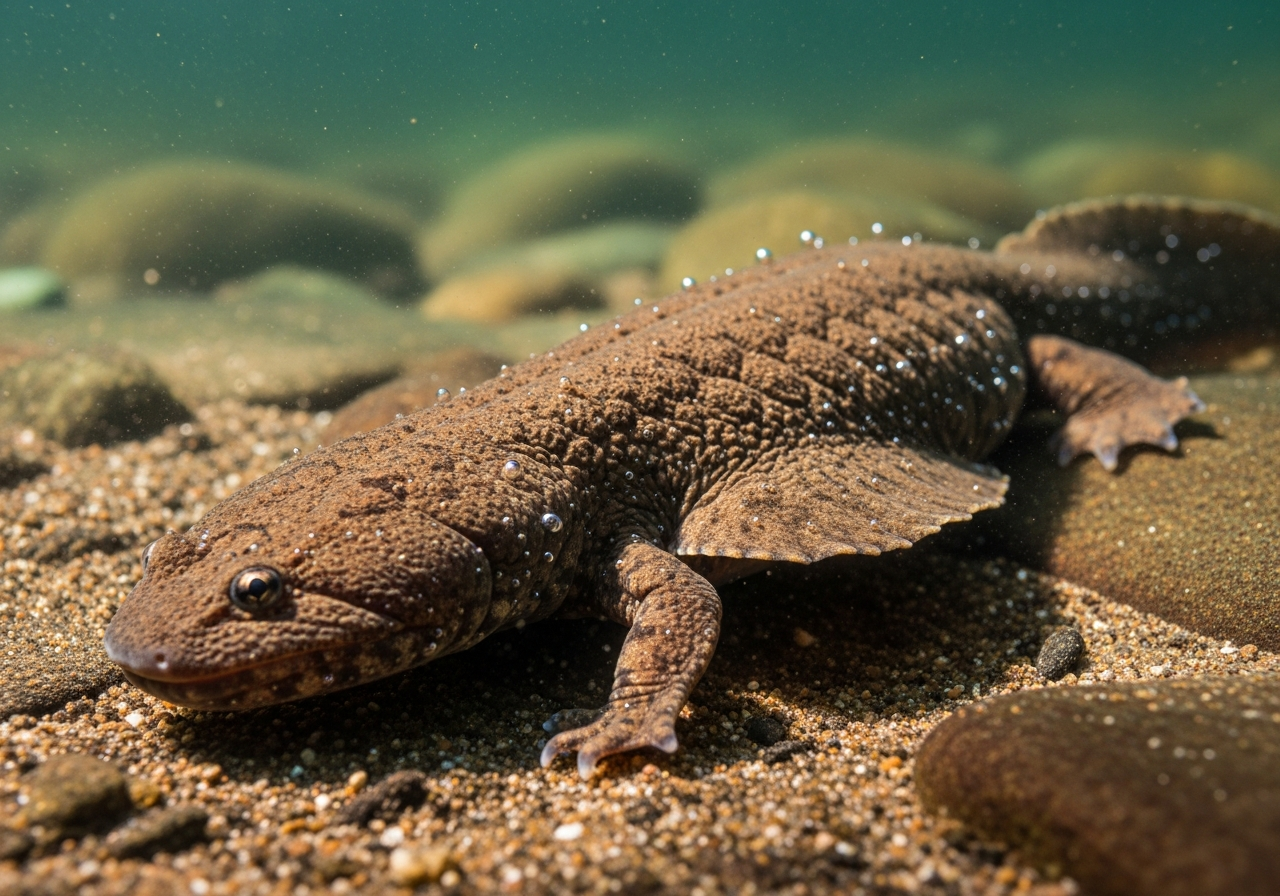
The hellbender is the largest salamander in North America, reaching up to 74 cm (29 in) long. It is fully aquatic, living its whole life in clean, fast-flowing streams where it breathes mainly through the wrinkled folds of its skin. Hellbenders are long-lived, often surviving 25 to 30 years.
Hellbender facts at a glance
| Scientific name | Cryptobranchus alleganiensis |
|---|---|
| Diet | Carnivore (crayfish, small fish) |
| Habitat | Clean, fast-flowing rocky streams and rivers |
| Lifespan | 25–30 years |
| Weight | Up to about 1.5 kg (3.3 lb) |
| Size | 30–74 cm (12–29 in) body length |
| Conservation status | Vulnerable (IUCN) |
| Kingdom | Animalia |
|---|---|
| Phylum | Chordata |
| Class | Amphibia |
| Order | Urodela |
| Family | Cryptobranchidae |
| Genus | Cryptobranchus |
Where it lives
Cool, clean, fast-flowing rivers of the eastern and central United States, especially the Appalachian region.
What is a group of hellbenders called?
Group name (collective noun)
A group of Hellbenders is called a congress.
Baby name
A baby Hellbender is called a larva.
Explore more animal collective nouns and baby animal names .
Behavior and breathing
Hellbenders are secretive, mostly nocturnal salamanders that hide by day under large flat rocks in the streambed. They are fully aquatic and absorb most of their oxygen directly through the heavily wrinkled folds of skin along their bodies, which increase surface area in cool, oxygen-rich water. They rarely leave the stream and rely on clean, flowing water to survive.
Diet and feeding
Hellbenders are carnivores whose diet is dominated by crayfish, along with small fish and aquatic insects. They hunt at night, using suction and a quick sideways snap of the jaws to capture prey. Healthy crayfish populations are essential to their survival.
Habitat and range
This giant salamander lives in cool, clear, fast-flowing rivers and streams of the eastern and central United States, particularly in the Appalachian region. It needs rocky stream bottoms with large flat stones for shelter and nesting. Because it breathes through its skin, it is extremely sensitive to silt and pollution.
Conservation
Hellbenders are listed as Vulnerable and have declined sharply across much of their range. The main threats are water pollution, siltation from erosion, dams, and disease, all of which degrade the clean streams they depend on. Captive breeding and stream restoration programs are working to recover populations.
Dig deeper into the Hellbender
- Are Hellbender Endangered
Dig deeper into hellbender — are hellbender endangered.
- How Long do Hellbender Live?
Dig deeper into hellbender — how long do hellbender live.
- What do Hellbender Eat
Dig deeper into hellbender — what do hellbender eat.
- Where do Hellbender Live?
Dig deeper into hellbender — where do hellbender live.
Explore the Hellbender
Related Amphibians
Collections
Range & geography
Did you know? Hellbender facts
- The hellbender is the largest salamander in North America, reaching up to 74 cm (29 in) long.
- Hellbenders are the largest salamanders in North America, reaching up to about 74 cm (29 in) in length and weighing as much as 1.5 kg (3.3 lb).
- Hellbenders breathe mainly through their skin. The loose, wrinkled folds along their body greatly increase surface area, letting them absorb oxygen directly from cool, fast-flowing water.
- Hellbenders are carnivores that feed mostly on crayfish, along with small fish and aquatic insects, hunting at night on the streambed.
- Hellbenders are listed as Vulnerable by the IUCN and have declined across much of their range due to water pollution, siltation, dams, and disease.
- Conservation: Vulnerable (IUCN).
Diet & feeding
Hellbender feeds primarily as a carnivore (crayfish, small fish). Hellbenders are carnivores whose diet is dominated by crayfish, along with small fish and aquatic insects. They hunt at night, using suction and a quick sideways snap of the jaws to capture prey. Healthy crayfish populations are essential to their surviv
Adaptations
- Hellbenders are secretive, mostly nocturnal salamanders that hide by day under large flat rocks in the streambed. They are fully aquatic and absorb most of their oxygen directly through the heavily wrinkled folds of skin along their bodies, which increase surface area in cool, oxygen-rich water. They rarely leave the stream and rely on clean, flowing water to survive.
- Hellbenders are carnivores whose diet is dominated by crayfish, along with small fish and aquatic insects. They hunt at night, using suction and a quick sideways snap of the jaws to capture prey. Healthy crayfish populations are essential to their survival.
Behaviour & ecology
- Hellbenders are secretive, mostly nocturnal salamanders that hide by day under large flat rocks in the streambed. They are fully aquatic and absorb most of their oxygen directly through the heavily wrinkled folds of skin along their bodies, which increase surface area in cool, oxygen-rich water. They rarely leave the stream and rely on clean, flowing water to survive.
- Hellbenders are carnivores whose diet is dominated by crayfish, along with small fish and aquatic insects. They hunt at night, using suction and a quick sideways snap of the jaws to capture prey. Healthy crayfish populations are essential to their survival.
- This giant salamander lives in cool, clear, fast-flowing rivers and streams of the eastern and central United States, particularly in the Appalachian region. It needs rocky stream bottoms with large flat stones for shelter and nesting. Because it breathes through its skin, it is extremely sensitive to silt and pollution.
Communication
- Hellbender uses scent, posture, and vocal signals to mark territory and coordinate social behaviour.
- Communication intensity often peaks during breeding seasons and territorial disputes.
Habitat & range
Clean, fast-flowing rocky streams and rivers
Ecological role
Hellbender acts as a predator that helps regulate prey populations and maintain balance in clean, fast-flowing rocky streams and rivers.
Conservation status of the Hellbender
Vulnerable (VU) means a species faces a high risk of extinction in the medium-term future. It is the lowest-risk of the three 'threatened' IUCN categories — one step below Endangered, which is itself below Critically Endangered — and is often an early warning that a population is in trouble.
The hellbender (Cryptobranchus alleganiensis) is assessed on the IUCN Red List. Look up on the IUCN Red List .
Frequently asked questions about the Hellbender
How big do hellbenders get?
Hellbenders are the largest salamanders in North America, reaching up to about 74 cm (29 in) in length and weighing as much as 1.5 kg (3.3 lb).
How do hellbenders breathe?
Hellbenders breathe mainly through their skin. The loose, wrinkled folds along their body greatly increase surface area, letting them absorb oxygen directly from cool, fast-flowing water.
What do hellbenders eat?
Hellbenders are carnivores that feed mostly on crayfish, along with small fish and aquatic insects, hunting at night on the streambed.
Are hellbenders endangered?
Hellbenders are listed as Vulnerable by the IUCN and have declined across much of their range due to water pollution, siltation, dams, and disease.
Are hellbenders dangerous to people?
No. Despite their fearsome name and appearance, hellbenders are harmless to humans. They are not venomous and pose no threat; they are simply large, secretive stream salamanders.
What is a group of hellbenders called?
A group of Hellbenders is called a congress.
What is a baby hellbender called?
A baby Hellbender is called a larva.
Sources & references
This guide is compiled and reviewed against established zoological and conservation references. Key sources for the Hellbender:
-
IUCN Red List of Threatened Species
Conservation status (Vulnerable) reflects the IUCN Red List category for Cryptobranchus alleganiensis.
- IUCN Red List — Cryptobranchus alleganiensis.
Conservation status (Vulnerable) and population trends.
- Animal Diversity Web — Cryptobranchus alleganiensis. University of Michigan Museum of Zoology.
Life history, morphology, and range.
- Wikipedia — Hellbender.
General taxonomy and overview (cross-check primary sources).
-
Global Animal Guide editorial standards
How we research, source, review, and update every guide for accuracy.