Quick answer
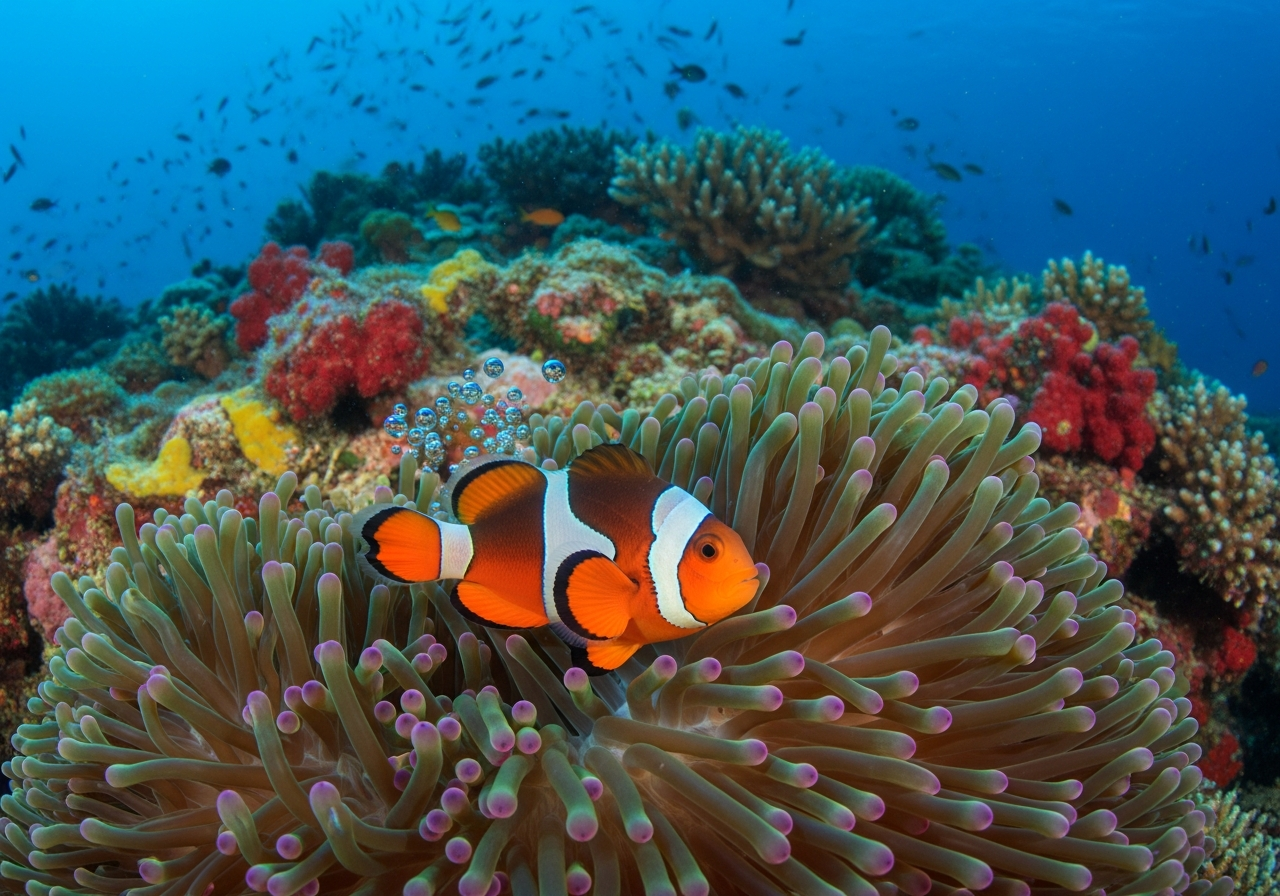
The clownfish, or anemonefish, is a small, brightly colored reef fish famous for living safely among the stinging tentacles of sea anemones, protected by a special mucus coating. Made famous by the film Finding Nemo, clownfish form a partnership with their anemone that benefits both. All clownfish are born male and can change sex, and they typically live 6 to 10 years.
Top questions about the Clownfish
Also available in Español (Pez payaso)
Clownfish facts at a glance
- Weight 30 g
- Length 11 cm
- Top speed 5 km/h
- Lifespan 10 years
| Scientific name | Amphiprion ocellaris |
|---|---|
| Diet | Omnivore |
| Habitat | Coral reefs of the Indo-Pacific |
| Lifespan | 6–10 years |
| Length | 8–11 cm (3–4.3 in) |
| Top speed | Slow; stays near its anemone |
| Conservation status | Least Concern (IUCN) |
| Kingdom | Animalia |
|---|---|
| Phylum | Chordata |
| Class | Actinopterygii |
| Order | Perciformes |
| Family | Pomacentridae |
| Genus | Amphiprion |
Where it lives
The clownfish (Amphiprion ocellaris) is native to Coral reefs of the warm Indo-Pacific, from the Red Sea and East Africa to Japan and Australia. — recorded across Oceans in this guide’s range summary.
For occurrence records, see GBIF species search and sources below.
How big is a clownfish?
An adult clownfish measures 11 cm long — about 6% of the height of an average adult person (1.73 m) — and weighs around 30 g, a small fraction of an average adult’s body weight (70 kg).
Length vs an average adult’s height (to scale)
What is a group of clownfish called?
Group name (collective noun)
A group of Clownfish is called a school. It is also known as a shoal.
Baby name
A baby Clownfish is called a fry.
Explore more animal collective nouns and baby animal names .
A partnership with anemones
Clownfish live among the venomous tentacles of sea anemones, which sting most other fish. A layer of special mucus on the clownfish's skin protects it from the stings, so the anemone becomes a safe home and shelter from predators. In return, the clownfish drives off intruders, cleans the anemone, and its waste helps feed it.
Born male, can change sex
All clownfish hatch as males. They live in small groups dominated by a single breeding female; if she dies, the largest male changes sex to become the new female, and the next fish in line steps up to breed. This flexible system keeps a breeding pair available within each anemone.
Reef life and diet
Clownfish rarely stray far from their host anemone. They are omnivores, feeding on algae, plankton, small crustaceans, and leftover scraps. Their bright orange-and-white pattern, bold against the anemone, warns rivals and helps members of the group recognize one another.
Conservation
Common clownfish are listed as Least Concern, but they depend entirely on healthy coral reefs and anemones. Coral bleaching from warming seas, reef destruction, and over-collection for the aquarium trade are growing concerns for some populations and the ecosystems they rely on.
Dig deeper into the Clownfish
- Clownfish: Key Facts
The clownfish, or anemonefish, is a small, brightly colored reef fish famous for living safely among the stinging tentacles of sea anemones, protected by…
- How Long Do Clownfish Live?
Clownfish lifespan is typically 6–10 years. What shortens or extends life, life stages, and status (Least Concern).
- What Do Clownfish Eat?
What clownfish eat: Omnivore, foraging style, and seasonal shifts in Coral reefs of the Indo-Pacific.
- Where Do Clownfish Live?
Where clownfish live: Coral reefs of the Indo-Pacific, native range cues, and human overlap. Status Least Concern.
Explore the Clownfish
Related Fishs
Collections
Range & geography
Did you know? Clownfish facts
- The clownfish, or anemonefish, is a small, brightly colored reef fish famous for living safely among the stinging tentacles of sea anemones, protected by a special mucus coating.
- Clownfish are protected by a special mucus coating on their skin that prevents the anemone's stinging cells from firing, letting them shelter safely among tentacles that would sting other fish.
- Yes. All clownfish are born male, and they live in groups led by one dominant female. If she dies, the largest male changes sex to become the new breeding female.
- Clownfish are omnivores that feed on algae, plankton, small crustaceans, and food scraps, usually staying close to the safety of their host anemone.
- Clownfish live on warm coral reefs in the Indo-Pacific, from the Red Sea and East Africa to Southeast Asia, Japan, and Australia, always closely associated with sea anemones.
- Conservation: Least Concern (IUCN).
Diet & feeding
Clownfish feeds primarily as a omnivore. Clownfish live among the venomous tentacles of sea anemones, which sting most other fish. A layer of special mucus on the clownfish's skin protects it from the stings, so the anemone becomes a safe home and shelter from predators. In return, the clownfish drives off intruders, c
Adaptations
- Clownfish live among the venomous tentacles of sea anemones, which sting most other fish. A layer of special mucus on the clownfish's skin protects it from the stings, so the anemone becomes a safe home and shelter from predators. In return, the clownfish drives off intruders, cleans the anemone, and its waste helps feed it.
- All clownfish hatch as males. They live in small groups dominated by a single breeding female; if she dies, the largest male changes sex to become the new female, and the next fish in line steps up to breed. This flexible system keeps a breeding pair available within each anemone.
Behaviour & ecology
- Clownfish live among the venomous tentacles of sea anemones, which sting most other fish. A layer of special mucus on the clownfish's skin protects it from the stings, so the anemone becomes a safe home and shelter from predators. In return, the clownfish drives off intruders, cleans the anemone, and its waste helps feed it.
- All clownfish hatch as males. They live in small groups dominated by a single breeding female; if she dies, the largest male changes sex to become the new female, and the next fish in line steps up to breed. This flexible system keeps a breeding pair available within each anemone.
- Clownfish rarely stray far from their host anemone. They are omnivores, feeding on algae, plankton, small crustaceans, and leftover scraps. Their bright orange-and-white pattern, bold against the anemone, warns rivals and helps members of the group recognize one another.
Communication
- Lateral-line and visual cues coordinate schooling, courtship, or territorial behaviour.
- Some species produce low-frequency sounds or drumming for spawning or defence.
Habitat & range
Coral reefs of the Indo-Pacific
Ecological role
Clownfish occupies a defined trophic level in aquatic food webs, linking plankton or smaller fish to larger predators.
Conservation status of the Clownfish
The clownfish (Amphiprion ocellaris) is listed as Least Concern on the IUCN Red List. Least Concern (LC) is the IUCN's lowest-risk category, assigned to widespread, abundant species that have been evaluated and found not to be threatened. It does not mean a species faces no pressures — only that it is not currently at risk of extinction.
The clownfish (Amphiprion ocellaris) is assessed on the IUCN Red List. Look up on the IUCN Red List .
Frequently asked questions about the Clownfish
How do clownfish live in anemones without being stung?
Clownfish are protected by a special mucus coating on their skin that prevents the anemone's stinging cells from firing, letting them shelter safely among tentacles that would sting other fish.
Can clownfish change sex?
Yes. All clownfish are born male, and they live in groups led by one dominant female. If she dies, the largest male changes sex to become the new breeding female.
What do clownfish eat?
Clownfish are omnivores that feed on algae, plankton, small crustaceans, and food scraps, usually staying close to the safety of their host anemone.
Where do clownfish live?
Clownfish live on warm coral reefs in the Indo-Pacific, from the Red Sea and East Africa to Southeast Asia, Japan, and Australia, always closely associated with sea anemones.
Are clownfish endangered?
Common clownfish are listed as Least Concern, but they rely on healthy reefs and anemones, so coral bleaching, habitat loss, and over-collection for aquariums are concerns for some populations.
What is a group of clownfish called?
A group of Clownfish is called a school. It is also known as a shoal.
What is a baby clownfish called?
A baby Clownfish is called a fry.
Sources & references
This guide is compiled and reviewed against established zoological and conservation references. Key sources for the Clownfish:
-
IUCN Red List of Threatened Species
Conservation status (Least Concern) reflects the IUCN Red List category for Amphiprion ocellaris.
-
iNaturalist — observations & photos
Search citizen-science observations and community IDs for Amphiprion ocellaris. Useful for range checks and recent sightings — not a substitute for formal Red List status.
-
GBIF — occurrence data
Global Biodiversity Information Facility species search for Amphiprion ocellaris. Explore published occurrence records used in range research.
- IUCN Red List — Amphiprion ocellaris.
Conservation status (Least Concern) and population trends.
- Animal Diversity Web — Amphiprion ocellaris. University of Michigan Museum of Zoology.
Life history, morphology, and range.
- Wikipedia — Clownfish.
General taxonomy and overview (cross-check primary sources).
-
Global Animal Guide editorial standards
How we research, source, review, and update every guide for accuracy.