Atlantic Puffin
Fratercula arctica
Image sourcing: see credits & licences
Quick answer
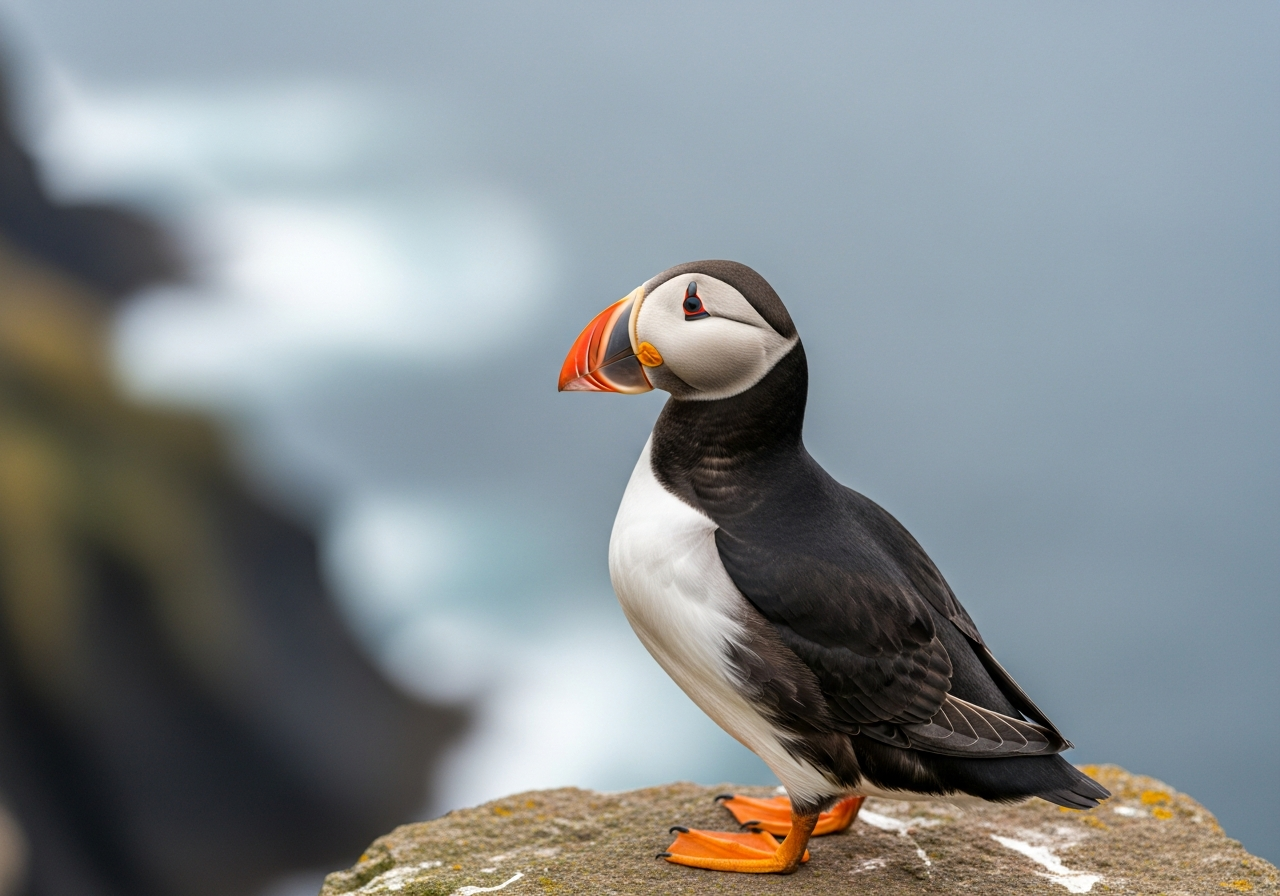
The Atlantic puffin (Fratercula arctica) is a small, colourful seabird of the North Atlantic, nicknamed the 'sea parrot' for its bright, striped bill. It spends most of the year far out at sea, coming ashore only to breed in dense colonies on grassy coastal cliffs and islands. It flies fast, up to 88 km/h (55 mph), and 'flies' underwater to catch small fish. Puffins live 20 years or more and are listed as Vulnerable.
Atlantic Puffin facts at a glance
| Scientific name | Fratercula arctica |
|---|---|
| Diet | Carnivore (small fish) |
| Habitat | Open ocean; coastal cliffs to breed |
| Lifespan | 20+ years |
| Weight | 300–500 g (0.7–1.1 lb) |
| Top speed | Up to 88 km/h (55 mph) in flight |
| Conservation status | Vulnerable (IUCN) |
| Kingdom | Animalia |
|---|---|
| Phylum | Chordata |
| Class | Aves |
| Order | Charadriiformes |
| Family | Alcidae |
| Genus | Fratercula |
Where it lives
The open North Atlantic, breeding on coastal cliffs and islands from Canada to Norway.
What is a group of atlantic puffins called?
Group name (collective noun)
A group of Atlantic Puffins is called a circus. It is also known as a colony or an improbability.
Baby name
A baby Atlantic Puffin is called a puffling.
Explore more animal collective nouns and baby animal names .
The colourful 'sea parrot'
In the breeding season the Atlantic puffin is unmistakable, with a white face, black cap and back, orange feet, and a large triangular bill striped in red, orange, and blue-grey. This bright bill is a breeding-season feature: after nesting, the colourful outer plates are shed and the bill becomes smaller and duller through winter. Adults stand about 28 cm tall and weigh 300 to 500 g, making them far smaller than most people expect. Both sexes look alike.
A master of two elements
Puffins are built for both air and water. In the air they whir along on short, rapid wingbeats of up to 400 a minute, reaching speeds around 88 km/h. Underwater those same wings become paddles, and the puffin effectively flies beneath the surface, using its webbed feet to steer as it chases fish. It can dive to depths of 60 m and stay submerged for around a minute in pursuit of a meal.
Fishing and diet
The Atlantic puffin is a carnivore that feeds almost entirely on small fish such as sand eels, herring, sprat, and capelin. A famous trick lets it carry many fish at once: backward-pointing spines on its tongue and palate hold each catch in place while it grabs the next, so it can return to the nest with a dozen or more fish crosswise in its bill. This lets a parent make fewer, more efficient trips to feed a hungry chick. Poor fish stocks near a colony can cause breeding to fail.
Breeding colonies and the puffling
Puffins nest in large, noisy colonies on grassy cliff tops and offshore islands, digging a burrow into the soil or using a crevice among rocks. A pair typically returns to the same burrow and mate year after year, laying a single egg each season. The chick, charmingly known as a puffling, is fed on fish by both parents until it is ready to leave. It departs the burrow alone at night and heads out to sea, where it will spend several years before returning to breed.
Life at sea
For most of the year the puffin lives far offshore, riding the open North Atlantic and rarely coming near land. It sleeps on the water, rides out storms, and feeds by diving, only returning to the coast in spring to breed. This oceanic lifestyle makes it difficult to study during winter. Young birds may not set foot on land again until they are old enough to nest, several years after fledging.
Why it is Vulnerable
The Atlantic puffin is listed as Vulnerable by the IUCN because its numbers are falling, especially in important colonies such as Iceland and Norway. Warming seas are shifting and reducing the small fish puffins depend on, so parents struggle to find enough food for their chicks. Historic threats include hunting, egg collection, and predators introduced to nesting islands, while oil spills and fishing bycatch add further pressure. Protecting fish stocks and keeping breeding islands predator-free are key to their recovery.
Dig deeper into the Atlantic Puffin
- Are Puffin Endangered
Dig deeper into atlantic puffin — are puffin endangered.
- How Long do Puffin Live?
Dig deeper into atlantic puffin — how long do puffin live.
- Puffin Guide 5
Dig deeper into atlantic puffin — puffin guide 5.
- What do Puffin Eat
Dig deeper into atlantic puffin — what do puffin eat.
- Where do Puffin Live?
Dig deeper into atlantic puffin — where do puffin live.
Explore the Atlantic Puffin
Related Birds
Collections
Did you know? Atlantic Puffin facts
- The Atlantic puffin is a small seabird of the North Atlantic, famous for its brightly colored bill during the breeding season, which gives it the nickname \
- The nickname comes from their large, brightly colored bills during the breeding season, which are striped orange, red, and blue and resemble a parrot's beak. The colors fade after breeding.
- Puffins eat small fish such as sand eels, herring, and capelin, which they catch by diving underwater. They can carry many fish crosswise in their bills at once to feed their chick.
- Yes. Puffins are capable fliers, beating their wings extremely fast to stay airborne, and they also use those wings to swim underwater when hunting fish.
- Atlantic puffins live across the North Atlantic, spending most of the year at sea and coming ashore to breed on cliffs and islands in places like Iceland, Norway, Britain, and eastern Canada.
- Conservation: Vulnerable (IUCN).
Diet & feeding
Atlantic Puffin feeds primarily as a carnivore (small fish). Atlantic puffins are strong but frantic fliers, beating their small wings up to 400 times a minute to stay aloft. Those same wings double as flippers underwater, letting them swim down to catch fish. The bright colors of the bill develop for the breeding seas
Adaptations
- Atlantic puffins are strong but frantic fliers, beating their small wings up to 400 times a minute to stay aloft. Those same wings double as flippers underwater, letting them swim down to catch fish. The bright colors of the bill develop for the breeding season and fade to a duller grey in winter at sea.
- Puffins feed mainly on small fish such as sand eels, herring, and capelin, which they catch by diving and pursuing underwater. A puffin can hold many small fish crosswise in its bill at once, thanks to a hinged jaw and a raspy tongue, allowing it to carry a full load back to its chick. Their breeding success depends heavily on healthy fish stocks.
Behaviour & ecology
- Atlantic puffins are strong but frantic fliers, beating their small wings up to 400 times a minute to stay aloft. Those same wings double as flippers underwater, letting them swim down to catch fish. The bright colors of the bill develop for the breeding season and fade to a duller grey in winter at sea.
- Puffins feed mainly on small fish such as sand eels, herring, and capelin, which they catch by diving and pursuing underwater. A puffin can hold many small fish crosswise in its bill at once, thanks to a hinged jaw and a raspy tongue, allowing it to carry a full load back to its chick. Their breeding success depends heavily on healthy fish stocks.
- Atlantic puffins spend most of the year out on the open ocean, coming ashore only to breed in large colonies on coastal cliffs and offshore islands. They nest in burrows dug into turf or among rocks, where a single chick is raised each season. Major colonies are found in Iceland, Norway, the British Isles, and eastern North America.
Communication
- Atlantic Puffin uses calls and visual displays to communicate territory, alarm, and breeding status.
- Vocal repertoires vary by species and are often learned or refined during development.
Habitat & range
Open ocean; coastal cliffs to breed
Ecological role
Atlantic Puffin acts as a predator that helps regulate prey populations and maintain balance in open ocean; coastal cliffs to breed.
Conservation status of the Atlantic Puffin
Vulnerable (VU) means a species faces a high risk of extinction in the medium-term future. It is the lowest-risk of the three 'threatened' IUCN categories — one step below Endangered, which is itself below Critically Endangered — and is often an early warning that a population is in trouble.
The atlantic puffin (Fratercula arctica) is assessed on the IUCN Red List. Look up on the IUCN Red List .
Frequently asked questions about the Atlantic Puffin
Why is the puffin called a sea parrot?
The Atlantic puffin earns the nickname 'sea parrot' from its large, brightly striped bill, coloured red, orange, and blue-grey in the breeding season. The bill and the bird's clownish face give it a parrot-like appearance, even though it is a seabird, not a parrot.
How do puffins catch fish?
Puffins dive from the surface and 'fly' underwater, flapping their wings to swim and steering with their webbed feet. They pursue small fish such as sand eels and herring, diving as deep as 60 m and holding many fish at once thanks to spines on the tongue and palate.
How fast can a puffin fly?
An Atlantic puffin can fly at up to 88 km/h (55 mph), beating its short wings up to 400 times a minute. Those fast wingbeats make its flight look frantic, but they let this small, heavy-bodied seabird cover long distances over the ocean.
Where do puffins live?
Atlantic puffins live across the North Atlantic, spending most of the year out on the open ocean. They come ashore only to breed, nesting in colonies on grassy coastal cliffs and offshore islands in places such as Iceland, Norway, Britain, and Ireland.
How long do puffins live?
Atlantic puffins are long-lived birds, commonly reaching 20 years or more, and some individuals live into their 30s. They breed slowly, laying just one egg a year, so a long life is important for raising enough young over a lifetime.
Why are puffins endangered?
The Atlantic puffin is listed as Vulnerable because its populations are declining. Warming seas are reducing the small fish it feeds on, causing chicks to starve, while hunting, egg collection, introduced predators on nesting islands, oil spills, and fishing bycatch add further pressure.
What is a group of atlantic puffins called?
A group of Atlantic Puffins is called a circus. It is also known as a colony or an improbability.
What is a baby atlantic puffin called?
A baby Atlantic Puffin is called a puffling.
Sources & references
This guide is compiled and reviewed against established zoological and conservation references. Key sources for the Atlantic Puffin:
-
IUCN Red List of Threatened Species
Conservation status (Vulnerable) reflects the IUCN Red List category for Fratercula arctica.
- IUCN Red List — Fratercula arctica.
Conservation status (Vulnerable) and population trends.
- Animal Diversity Web — Fratercula arctica. University of Michigan Museum of Zoology.
Life history, morphology, and range.
- Wikipedia — Atlantic Puffin.
General taxonomy and overview (cross-check primary sources).
-
Global Animal Guide editorial standards
How we research, source, review, and update every guide for accuracy.