Skunk
Mephitis mephitis
Quick answer
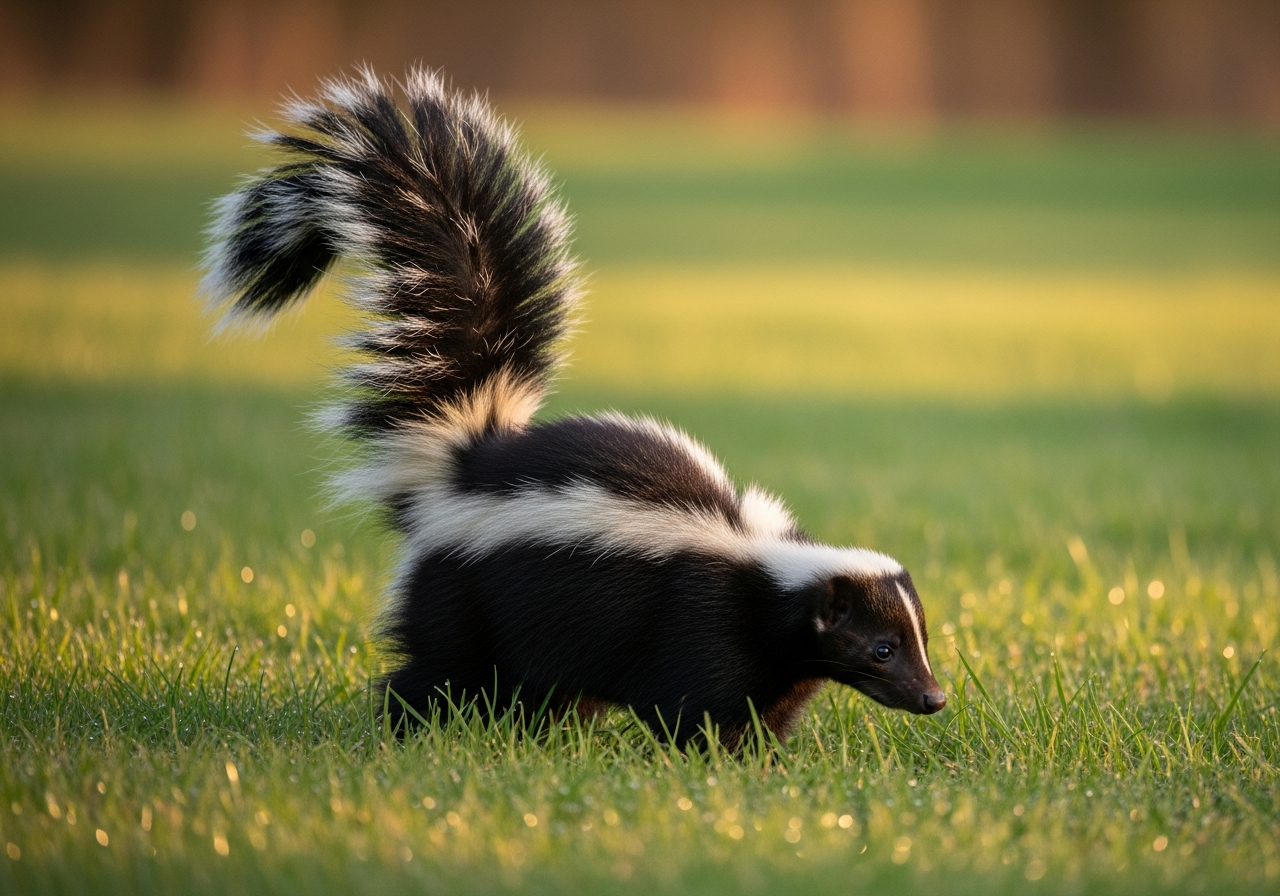
The striped skunk is a cat-sized North American mammal best known for the foul-smelling spray it fires from glands under its tail to deter predators. Its bold black-and-white pattern is a warning to leave it alone. Skunks are omnivores active mainly at night, weigh up to about 6 kg (13 lb), and usually live 2 to 3 years in the wild.
Skunk facts at a glance
| Scientific name | Mephitis mephitis |
|---|---|
| Diet | Omnivore (insects, small animals, fruit) |
| Habitat | Woodland, grassland, farmland, suburbs |
| Lifespan | 2–3 years wild (up to 7) |
| Weight | 1.2–6 kg (2.6–13 lb) |
| Top speed | 16 km/h (10 mph) |
| Conservation status | Least Concern (IUCN) |
| Kingdom | Animalia |
|---|---|
| Phylum | Chordata |
| Class | Mammalia |
| Order | Carnivora |
| Family | Mephitidae |
| Genus | Mephitis |
Where it lives
From southern Canada through the United States to northern Mexico, in woodland, grassland, farmland, and towns.
What is a group of skunks called?
Group name (collective noun)
A group of Skunks is called a surfeit.
Baby name
A baby Skunk is called a kit.
Explore more animal collective nouns and baby animal names .
The famous spray
A skunk's defence is a pair of glands beside the anus that can fire a fine, oily, sulphur-based spray up to about 3 m (10 ft) with good aim. The smell is overpowering and can cause stinging and temporary blindness if it hits the eyes. Skunks would rather warn than waste it: a threatened skunk stamps its feet, hisses, raises its tail, and — in spotted skunks — may even do a handstand before spraying as a last resort.
Diet and behaviour
Striped skunks are opportunistic omnivores that eat insects, grubs, worms, small rodents, eggs, fruit, and human refuse, using their strong claws to dig for grubs and raid wasp nests. They are mainly nocturnal and largely solitary, though several may share a den in cold weather. Their bold coloration means they have few predators apart from the great horned owl, which has a poor sense of smell.
Range and dens
The striped skunk ranges across most of North America from southern Canada to northern Mexico, living in woodland, grassland, farmland, and increasingly in towns and suburbs. It shelters in burrows — often abandoned ones dug by other animals — as well as under buildings, woodpiles, and decks, which sometimes brings it into conflict with people.
Conservation and disease
Skunks are listed as Least Concern and remain common across their range. Many are killed on roads, and skunks are one of the main wild carriers of rabies in North America, so a skunk acting tame or active in daylight should be treated with caution. Despite this, they provide a valuable service by eating large numbers of insect and rodent pests.
Dig deeper into the Skunk
- How Long do Skunk Live?
Dig deeper into skunk — how long do skunk live.
- Skunk Facts 4
Dig deeper into skunk — skunk facts 4.
- Skunk Facts 5
Dig deeper into skunk — skunk facts 5.
- What do Skunk Eat
Dig deeper into skunk — what do skunk eat.
- Where do Skunk Live?
Dig deeper into skunk — where do skunk live.
Explore the Skunk
Compare
Range & geography
Did you know? Skunk facts
- The striped skunk is a cat-sized North American mammal best known for the foul-smelling spray it fires from glands under its tail to deter predators.
- A group of skunks is called a surfeit. Skunks are mostly solitary, though several may share a den in winter, and a baby skunk is called a kit.
- A striped skunk can accurately spray its foul, oily musk up to about 3 m (10 ft), and the smell can carry much further on the wind. It usually gives several warnings before spraying.
- No. Spraying is a last resort because the supply takes time to refill. A skunk first warns by stamping its feet, hissing, and raising its tail, and only sprays if these threats are ignored.
- Skunks are omnivores that eat insects, grubs, worms, small rodents, eggs, fruit, and human food waste. They dig in soil for grubs and are useful natural controllers of insect and rodent pests.
- Conservation: Least Concern (IUCN).
Diet & feeding
Skunk feeds primarily as a omnivore (insects, small animals, fruit). A skunk's defence is a pair of glands beside the anus that can fire a fine, oily, sulphur-based spray up to about 3 m (10 ft) with good aim. The smell is overpowering and can cause stinging and temporary blindness if it hits the eyes. Skunks would rat
Adaptations
- A skunk's defence is a pair of glands beside the anus that can fire a fine, oily, sulphur-based spray up to about 3 m (10 ft) with good aim. The smell is overpowering and can cause stinging and temporary blindness if it hits the eyes. Skunks would rather warn than waste it: a threatened skunk stamps its feet, hisses, raises its tail, and — in spotted skunks — may even do a handstand before spraying as a last resort.
- Striped skunks are opportunistic omnivores that eat insects, grubs, worms, small rodents, eggs, fruit, and human refuse, using their strong claws to dig for grubs and raid wasp nests. They are mainly nocturnal and largely solitary, though several may share a den in cold weather. Their bold coloration means they have few predators apart from the great horned owl, which has a poor sense of smell.
Behaviour & ecology
- A skunk's defence is a pair of glands beside the anus that can fire a fine, oily, sulphur-based spray up to about 3 m (10 ft) with good aim. The smell is overpowering and can cause stinging and temporary blindness if it hits the eyes. Skunks would rather warn than waste it: a threatened skunk stamps its feet, hisses, raises its tail, and — in spotted skunks — may even do a handstand before spraying as a last resort.
- Striped skunks are opportunistic omnivores that eat insects, grubs, worms, small rodents, eggs, fruit, and human refuse, using their strong claws to dig for grubs and raid wasp nests. They are mainly nocturnal and largely solitary, though several may share a den in cold weather. Their bold coloration means they have few predators apart from the great horned owl, which has a poor sense of smell.
- The striped skunk ranges across most of North America from southern Canada to northern Mexico, living in woodland, grassland, farmland, and increasingly in towns and suburbs. It shelters in burrows — often abandoned ones dug by other animals — as well as under buildings, woodpiles, and decks, which sometimes brings it into conflict with people.
Communication
- Skunk uses scent, posture, and vocal signals to mark territory and coordinate social behaviour.
- Communication intensity often peaks during breeding seasons and territorial disputes.
Habitat & range
Woodland, grassland, farmland, suburbs
Ecological role
Skunk plays a recognised ecological role in woodland, grassland, farmland, suburbs.
Frequently asked questions about the Skunk
What is a group of skunks called?
A group of skunks is called a surfeit. Skunks are mostly solitary, though several may share a den in winter, and a baby skunk is called a kit.
How far can a skunk spray?
A striped skunk can accurately spray its foul, oily musk up to about 3 m (10 ft), and the smell can carry much further on the wind. It usually gives several warnings before spraying.
Do skunks always spray?
No. Spraying is a last resort because the supply takes time to refill. A skunk first warns by stamping its feet, hissing, and raising its tail, and only sprays if these threats are ignored.
What do skunks eat?
Skunks are omnivores that eat insects, grubs, worms, small rodents, eggs, fruit, and human food waste. They dig in soil for grubs and are useful natural controllers of insect and rodent pests.
Are skunks dangerous?
Skunks are not aggressive and rarely bite, but their spray is highly unpleasant and they are a leading wild carrier of rabies in North America. A skunk that seems tame or is active by day should be avoided.
What is a baby skunk called?
A baby Skunk is called a kit.
Sources & references
This guide is compiled and reviewed against established zoological and conservation references. Key sources for the Skunk:
-
IUCN Red List of Threatened Species
Conservation status (Least Concern) reflects the IUCN Red List category for Mephitis mephitis.
- IUCN Red List — Mephitis mephitis.
Conservation status (Least Concern) and population trends.
- Animal Diversity Web — Mephitis mephitis. University of Michigan Museum of Zoology.
Life history, morphology, and range.
- Wikipedia — Skunk.
General taxonomy and overview (cross-check primary sources).
-
Global Animal Guide editorial standards
How we research, source, review, and update every guide for accuracy.