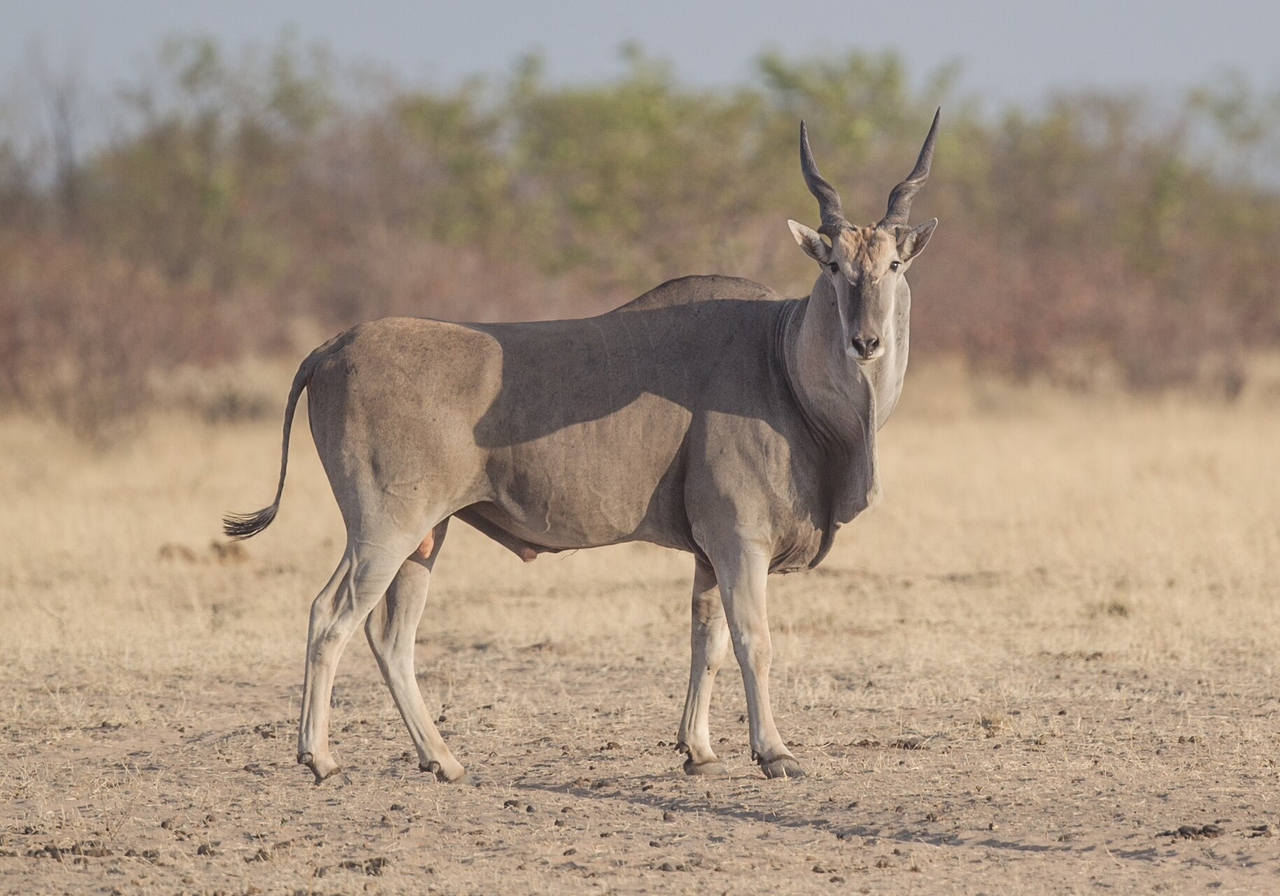
The common eland (Taurotragus oryx) is a mammal of the family Bovidae, in the order Artiodactyla.
Quick answer
The common eland (Taurotragus oryx) is one of the largest antelopes, with males weighing 400–1,000 kg and females 300–600 kg. It lives in open plains, sparse woodland and semi-desert from Ethiopia to South Africa. It has a fawn coat, corkscrew horns and a dewlap hanging from the throat. It is listed as Least Concern on the IUCN Red List (assessed 2016), with a stable population.
Top questions about the Common Eland
Common Eland facts at a glance
- Weight 600 kg
- Lifespan 23 years
| Scientific name | Taurotragus oryx (the IUCN Red List uses Tragelaphus oryx) |
|---|---|
| Diet | Grasses, herbs, tree leaves, bushes and succulent fruit |
| Habitat | Steppe, sparse forest and semi-desert, up to about 4,400 m |
| Weight | Males 400–1,000 kg; females 300–600 kg |
| Herd size | Usually up to 25 |
| Lifespan | 23.6 years recorded in captivity |
| Conservation status | Least Concern (IUCN Red List, assessed 2016) |
| Kingdom | Animalia |
|---|---|
| Phylum | Chordata |
| Class | Mammalia |
| Order | Artiodactyla |
| Family | Bovidae |
| Genus | Taurotragus |
Where it lives
The common eland (Taurotragus oryx) is native to East and southern Africa, from Ethiopia and South Sudan through Kenya and Tanzania to Angola, Namibia, Botswana and South Africa. — recorded across Africa in this guide’s range summary.
For occurrence records, see GBIF species search and sources below.
What is a group of common elands called?
Group name (collective noun)
A group of Common Elands is called a herd.
Baby name
A baby Common Eland is called a calf.
Explore more animal collective nouns and baby animal names .
A very large antelope
Males are much heavier than females. The coat is a uniform fawn with a few vertical white stripes on the upper body, and the heavy horns twist like a corkscrew. The dewlap hanging from the throat is thought to help the animal lose heat.
Where elands live
Elands use steppe, sparse forest and semi-desert, and rest in shade during the heat of the day. The IUCN Red List records them in 17 countries from Ethiopia and South Sudan to South Africa.
Food and water
They eat grasses, herbs, leaves and succulent fruit, mostly in open areas. They drink heavily when water is available but can go without it in the dry season.
Status
Elands have declined or disappeared from parts of their range, with overhunting one cause, but they are still fairly common. The IUCN Red List classes the species as Least Concern with a stable population.
Explore the Common Eland
Close relatives
- Cow Same family
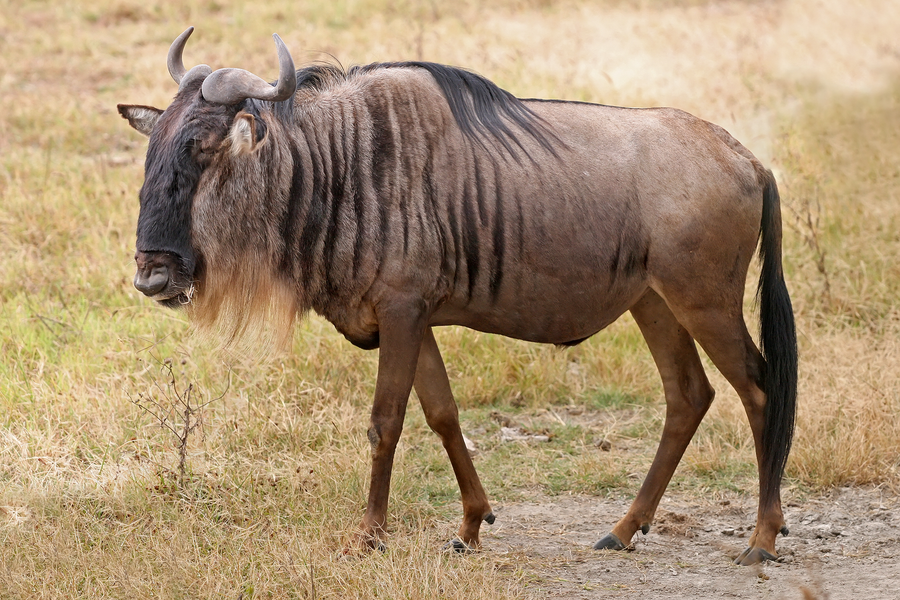
- Wildebeest Same family
- Domestic Goat Same family
- Saiga Antelope Same family
Range & geography
Did you know? Common Eland facts
- Elands can go without drinking in the dry season.
- A male eland can weigh up to a tonne.
Conservation status of the Common Eland
The common eland (Taurotragus oryx) is listed as Least Concern on the IUCN Red List. Least Concern (LC) is the IUCN's lowest-risk category, assigned to widespread, abundant species that have been evaluated and found not to be threatened. It does not mean a species faces no pressures — only that it is not currently at risk of extinction.
Main threats to the common eland
- Overhunting
Common Eland (Taurotragus oryx) was most recently assessed for the IUCN Red List in 2016. View the full IUCN assessment .
Frequently asked questions about the Common Eland
How big is an eland?
Males weigh 400–1,000 kg and females 300–600 kg, which makes it one of the largest antelopes.
What do elands eat?
Grasses, herbs, tree leaves, bushes and succulent fruit.
Why does an eland have a dewlap?
The flap of skin under the throat is thought to help it lose heat.
What is a group of common elands called?
A group of Common Elands is called a herd.
What is a baby common eland called?
A baby Common Eland is called a calf.
Sources & references
This guide is compiled and reviewed against established zoological and conservation references. Key sources for the Common Eland:
-
IUCN Red List of Threatened Species
Conservation status (Least Concern) reflects the IUCN Red List category for Taurotragus oryx, most recently assessed in 2016.
-
iNaturalist — observations & photos
Search citizen-science observations and community IDs for Taurotragus oryx. Useful for range checks and recent sightings — not a substitute for formal Red List status.
-
GBIF — occurrence data
Global Biodiversity Information Facility species search for Taurotragus oryx. Explore published occurrence records used in range research.
- IUCN Red List of Threatened Species: Tragelaphus oryx (assessed 2016). Checked 16 November 2026.
IUCN Red List category Least Concern, assessed 2016; population trend stable; native range.
- Animal Diversity Web: Taurotragus oryx. University of Michigan Museum of Zoology.
Size, lifespan, range, diet and behaviour.
-
Global Animal Guide editorial standards
How we research, source, review, and update every guide for accuracy.