Bull Shark
Carcharhinus leucas
Quick answer
The bull shark (Carcharhinus leucas) is a stocky, aggressive coastal shark famous for swimming far up rivers and into freshwater lakes. It grows up to about 3.5 m (11 ft) long and 130 kg (290 lb), and hunts a wide range of prey in warm seas, rivers, and estuaries. Fast in short bursts, it can reach around 40 km/h (25 mph) and lives 16 to 25 years. The IUCN lists it as Vulnerable.
Bull Shark facts at a glance
| Scientific name | Carcharhinus leucas |
|---|---|
| Diet | Carnivore |
| Habitat | Warm coastal seas, rivers, and lakes |
| Lifespan | 16–25 years |
| Length | 2–3.5 m (7–11 ft) |
| Top speed | Up to 40 km/h (25 mph) in bursts |
| Conservation status | Vulnerable (IUCN) |
| Kingdom | Animalia |
|---|---|
| Phylum | Chordata |
| Class | Chondrichthyes |
| Order | Carcharhiniformes |
| Family | Carcharhinidae |
| Genus | Carcharhinus |
Where it lives
Warm coastal seas worldwide, and unusually far up rivers and into freshwater lakes such as the Amazon, Mississippi, and Ganges.
What is a group of bull sharks called?
Group name (collective noun)
A group of Bull Sharks is called a shiver. It is also known as a school.
Baby name
A baby Bull Shark is called a pup.
Explore more animal collective nouns and baby animal names .
Size and appearance
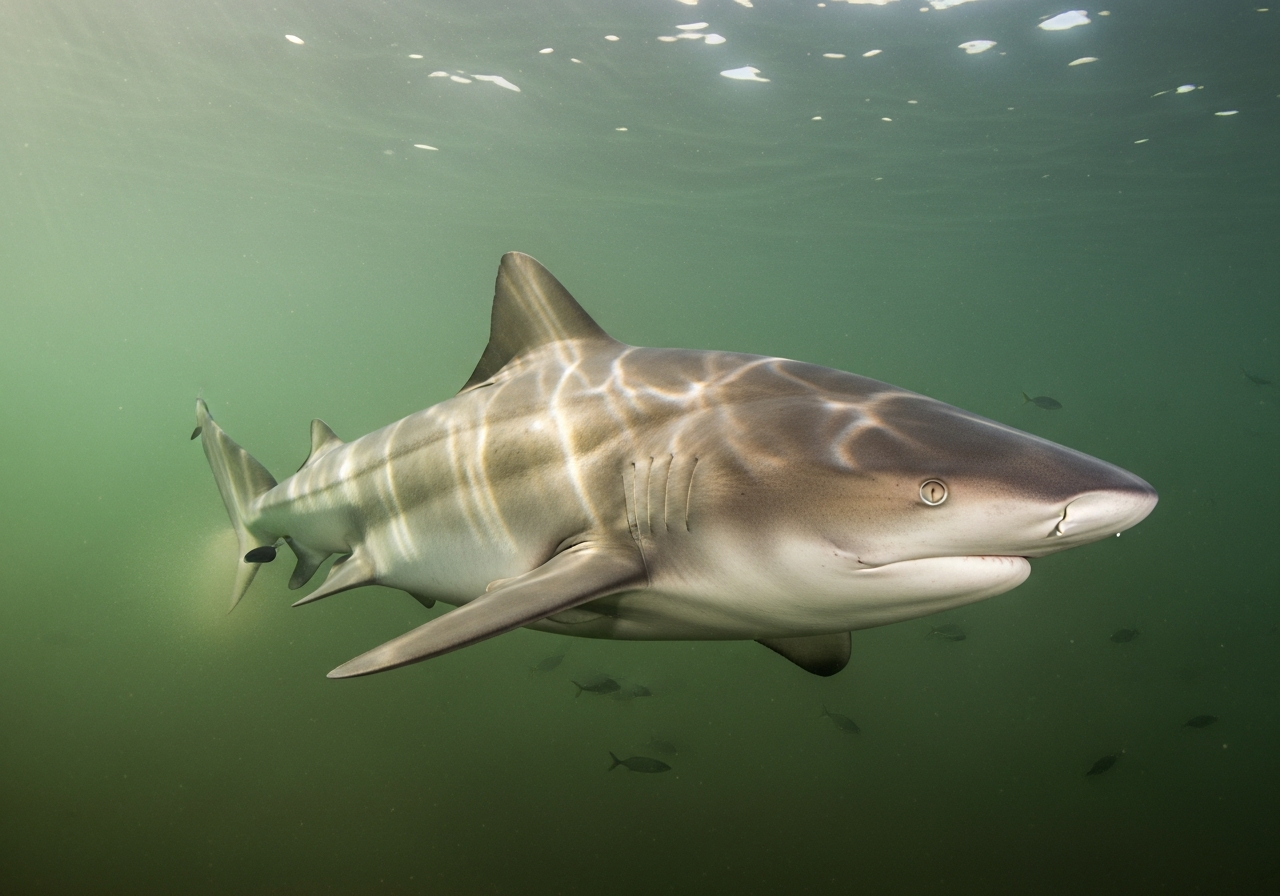
Bull sharks are heavy-bodied and muscular, typically 2 to 3.5 m (7 to 11 ft) long and weighing up to about 130 kg (290 lb), with females larger than males. They are grey above and pale below, with a short, broad, rounded snout that gives them their name and their pugnacious look. Their small eyes suggest they often rely on other senses in the murky water they favour. Powerful jaws and stout teeth let them tackle unusually large and varied prey for their size.
Life in freshwater
The bull shark is one of the very few sharks that can thrive in freshwater as well as the sea. Special adaptations in its kidneys, gills, and other organs let it control the salt balance in its body, so it can swim far up rivers and into lakes. Bull sharks have been recorded thousands of kilometres up the Amazon and Mississippi and living in Lake Nicaragua. This ability lets them hunt and give birth in places most sharks can never reach.
Hunting and diet
Bull sharks are opportunistic carnivores with one of the broadest diets of any shark. They eat bony fish, other sharks and rays, turtles, crustaceans, seabirds, and even dolphins, taking almost anything they can overpower. They often hunt in shallow, cloudy coastal water and river mouths, using surprise and sudden bursts of speed of up to about 40 km/h (25 mph). This adaptable appetite is part of why they succeed in so many habitats.
Reproduction and young
Female bull sharks give birth to live young, usually producing litters of around one to a dozen pups after a gestation of roughly a year. They favour shallow, brackish estuaries and river mouths as nurseries, where the young are relatively safe from larger ocean predators. Newborn pups are about 70 cm long and are independent from birth. Bull sharks live for around 16 to 25 years in the wild.
Encounters with people
Because bull sharks are large, bold, and often swim in the shallow, murky water where people swim, they are considered one of the shark species most likely to be involved in bites on humans. Their tolerance of rivers and estuaries brings them into contact with people far from the open sea. Serious incidents are still rare, and most bull sharks show little interest in people. Sensible caution in murky coastal and river water reduces the already low risk.
Conservation status
The bull shark is listed as Vulnerable by the IUCN. Like many sharks it is slow to mature and produces relatively few young, so populations recover slowly from pressure. Overfishing, capture for fins and meat, and the loss of the coastal and estuary habitats it uses as nurseries all threaten its numbers. Protecting river mouths and limiting catches are key to keeping the species healthy.
Dig deeper into the Bull Shark
- Are Bull Shark Endangered
Dig deeper into bull shark — are bull shark endangered.
- Bull Shark Guide 5
Dig deeper into bull shark — bull shark guide 5.
- How Long do Bull Shark Live?
Dig deeper into bull shark — how long do bull shark live.
- What do Bull Shark Eat
Dig deeper into bull shark — what do bull shark eat.
- Where do Bull Shark Live?
Dig deeper into bull shark — where do bull shark live.
Explore the Bull Shark
Related Fishs
Collections
Range & geography
Did you know? Bull Shark facts
- Bull sharks can live in fresh water and swim far up rivers, even into lakes.
- They have been recorded thousands of kilometres up the Amazon and Mississippi.
- Their tolerance of fresh water is rare among sharks.
- Bull sharks are stocky, aggressive, and among the species most often linked to attacks.
- They thrive in shallow, murky coastal waters where people also swim.
- Special kidney and gland function lets them regulate salt in fresh water.
Diet & feeding
Bull sharks are opportunistic carnivores eating fish (including other sharks and rays), crustaceans, and occasionally turtles and dolphins, hunting effectively in low-visibility water.
Adaptations
- Specialised salt-regulating physiology lets bull sharks enter fresh water. (Compagno 2001)
- A robust, muscular body suits hunting in turbid, shallow water.
- Powerful jaws and a strong bite handle varied, large prey.
- Tolerance of low visibility makes murky estuaries productive hunting grounds.
Behaviour & ecology
- Bull sharks move between sea, estuary, and river, using fresh water as nursery habitat.
- They hunt in shallow, often murky coastal waters.
- Young are reared in rivers and estuaries away from larger predators.
- They are opportunistic and investigate a wide range of prey.
Communication
- Bull sharks rely on body posture and movement rather than vocal signals.
- Keen senses, including electroreception, drive prey detection in murky water.
- Threat displays may precede aggressive encounters.
Habitat & range
Bull sharks inhabit warm coastal seas worldwide and uniquely penetrate estuaries, rivers, and even freshwater lakes, favouring shallow, turbid water.
Ecological role
As adaptable coastal predators bridging marine and freshwater systems, bull sharks influence prey populations across estuaries, rivers, and inshore seas.
Conservation status of the Bull Shark
Vulnerable (VU) means a species faces a high risk of extinction in the medium-term future. It is the lowest-risk of the three 'threatened' IUCN categories — one step below Endangered, which is itself below Critically Endangered — and is often an early warning that a population is in trouble.
The bull shark (Carcharhinus leucas) is assessed on the IUCN Red List. Look up on the IUCN Red List .
Frequently asked questions about the Bull Shark
Can bull sharks live in freshwater?
Yes. Bull sharks are among the few sharks that can survive in freshwater. Special adaptations let them control their body's salt balance, so they swim far up rivers and into lakes.
How big do bull sharks get?
Bull sharks grow up to about 3.5 m (11 ft) long and can weigh around 130 kg (290 lb). Females are typically larger and heavier than males.
Are bull sharks dangerous to humans?
Bull sharks are considered one of the species most likely to bite people because they are large, bold, and share shallow, murky water with swimmers. Even so, serious incidents remain rare.
What do bull sharks eat?
Bull sharks are opportunistic carnivores with a very broad diet, including bony fish, other sharks and rays, turtles, crustaceans, seabirds, and occasionally dolphins.
How fast can a bull shark swim?
Bull sharks can swim in short bursts of up to about 40 km/h (25 mph). They use these bursts of speed to ambush prey in shallow, cloudy water.
How long do bull sharks live?
Bull sharks live for around 16 to 25 years in the wild. Like many sharks they mature slowly, which makes their populations sensitive to overfishing.
What is a group of bull sharks called?
A group of Bull Sharks is called a shiver. It is also known as a school.
What is a baby bull shark called?
A baby Bull Shark is called a pup.
Sources & references
This guide is compiled and reviewed against established zoological and conservation references. Key sources for the Bull Shark:
-
IUCN Red List of Threatened Species
Conservation status (Vulnerable) reflects the IUCN Red List category for Carcharhinus leucas.
- Rigby, C. L. et al. (2021). Carcharhinus leucas. IUCN Red List of Threatened Species.
Status (Vulnerable) and range.
- Compagno, L. J. V. (2001). Sharks of the World. FAO Species Catalogue for Fishery Purposes.
Freshwater tolerance and biology.
- Froese, R. & Pauly, D. (eds.). FishBase — Carcharhinus leucas.
Size, distribution, and biology.
-
Global Animal Guide editorial standards
How we research, source, review, and update every guide for accuracy.