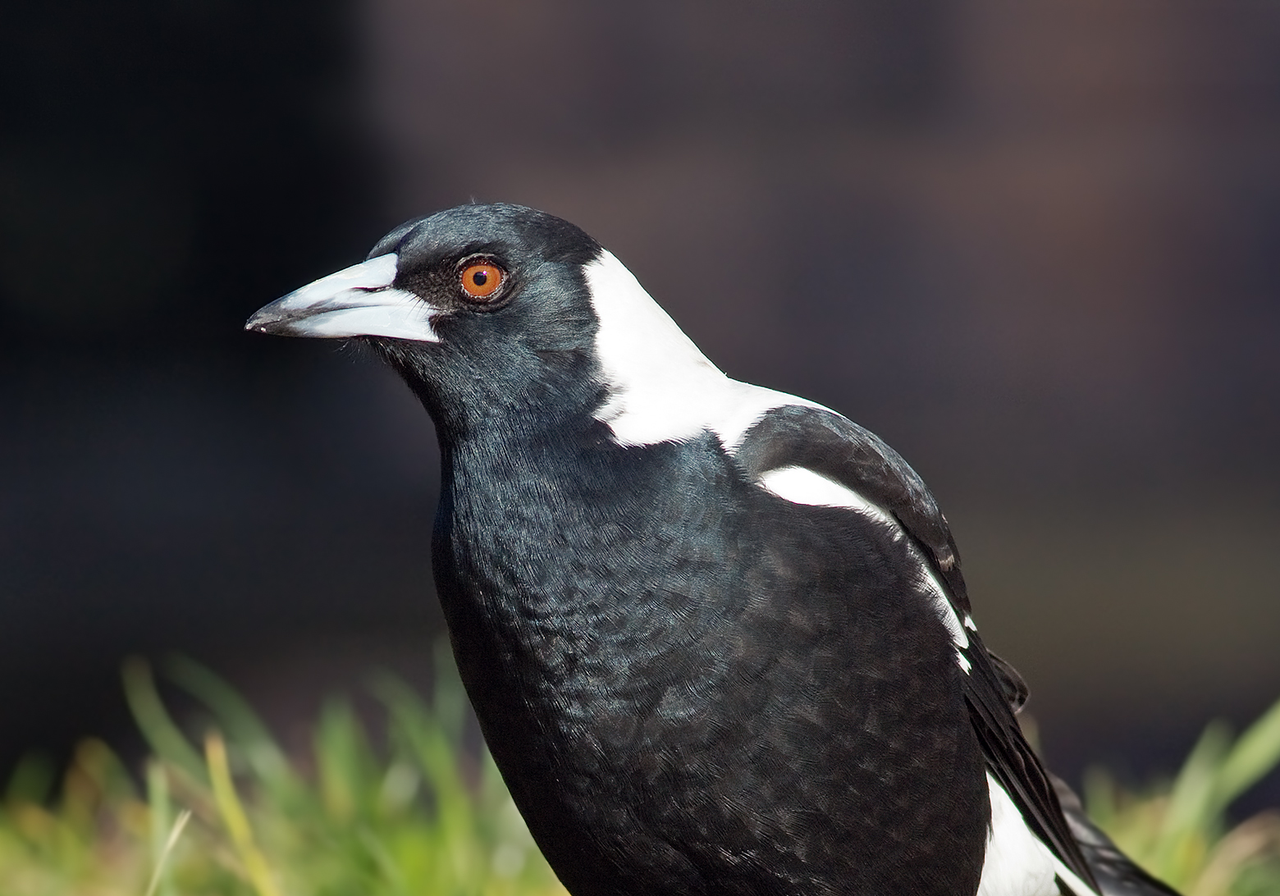
The Australian magpie (Gymnorhina tibicen) is a bird of the family Artamidae, in the order Passeriformes.
Quick answer
The Australian magpie (Gymnorhina tibicen) is a black-and-white songbird of Australia and southern New Guinea, famous for its rich, flute-like carolling and for swooping at people near its nest in spring. Despite its name it is not related to the European magpie: it belongs to the butcherbird family, Artamidae. It is common, increasing and listed as Least Concern.
Top questions about the Australian Magpie
Australian Magpie facts at a glance
- Weight 280 g
| Scientific name | Gymnorhina tibicen |
|---|---|
| Family | Artamidae (butcherbirds and woodswallows) |
| Diet | Mainly ground insects and other invertebrates |
| Habitat | Open woodland, farmland, parks and suburbs |
| Weight | Average about 285 g |
| Range | Australia and southern New Guinea |
| Conservation status | Least Concern (IUCN Red List, assessed 2018) |
| Kingdom | Animalia |
|---|---|
| Phylum | Chordata |
| Class | Aves |
| Order | Passeriformes |
| Family | Artamidae |
| Genus | Gymnorhina |
Where it lives
The australian magpie (Gymnorhina tibicen) is native to Most of Australia and southern New Guinea; introduced to New Zealand. — recorded across Oceania in this guide’s range summary.
For occurrence records, see GBIF species search and sources below.
What is a baby australian magpie called?
Baby name
A baby Australian Magpie is called a chick.
Explore more animal collective nouns and baby animal names .
Not a true magpie
European settlers named the bird after the black-and-white magpie of home, but the Australian magpie is not a crow. It belongs to the family Artamidae with the butcherbirds and currawongs. Plumage varies by region: some birds have white backs, others black backs with a white nape.
Carolling
Australian magpies are among the most accomplished songbirds in Australia. Family groups sing together in a loud, warbling chorus to advertise their territory, and individuals also mimic other birds and sounds.
Swooping season
In the breeding season, roughly late winter and spring, some males defend the nest by swooping at people, cyclists and dogs that come close. Most swooping happens within about 100 m of the nest and stops when the young fledge.
Status
BirdLife International lists the Australian magpie as Least Concern (2018), with an increasing trend. It thrives in farmland and cities. It was introduced to New Zealand, where it is now widespread.
Explore the Australian Magpie
Close relatives
- Canary Same order
- House Sparrow Same order
- Superb Lyrebird Same order
- Blue Tit Same order
Range & geography
Did you know? Australian Magpie facts
- Family groups sing together in a loud chorus to mark their territory.
- Most swooping happens within about 100 m of the nest.
Conservation status of the Australian Magpie
The Australian magpie (Gymnorhina tibicen) is listed as Least Concern on the IUCN Red List. Least Concern (LC) is the IUCN's lowest-risk category, assigned to widespread, abundant species that have been evaluated and found not to be threatened. It does not mean a species faces no pressures — only that it is not currently at risk of extinction.
Australian Magpie (Gymnorhina tibicen) was most recently assessed for the IUCN Red List in 2018. Look up on the IUCN Red List .
Frequently asked questions about the Australian Magpie
Why do magpies swoop in Australia?
To defend their nest and chicks during the breeding season. Only some birds swoop, and they target anything they see as a threat near the nest.
Is the Australian magpie related to the European magpie?
No. The Eurasian magpie is a crow (Corvidae); the Australian magpie belongs to the butcherbird family, Artamidae.
Where do Australian magpies live?
Across most of Australia and in southern New Guinea. They were introduced to New Zealand.
What do Australian magpies eat?
Mainly insects and other invertebrates that they find by walking on the ground, plus some small animals and seeds.
What is a baby australian magpie called?
A baby Australian Magpie is called a chick.
Sources & references
This guide is compiled and reviewed against established zoological and conservation references. Key sources for the Australian Magpie:
-
IUCN Red List of Threatened Species
Conservation status (Least Concern) reflects the IUCN Red List category for Gymnorhina tibicen, most recently assessed in 2018.
-
iNaturalist — observations & photos
Search citizen-science observations and community IDs for Gymnorhina tibicen. Useful for range checks and recent sightings — not a substitute for formal Red List status.
-
GBIF — occurrence data
Global Biodiversity Information Facility species search for Gymnorhina tibicen. Explore published occurrence records used in range research.
-
eBird — bird observations
Cornell Lab eBird target search for Australian Magpie. Check recent checklists and seasonal abundance where birders report this species.
- BirdLife International (2026). Species factsheet: Australian Magpie Gymnorhina tibicen. BirdLife DataZone. Checked 1 November 2026.
IUCN Red List category Least Concern (assessed 2018), population estimate and trend.
- Tobias, J. A. et al. (2022). AVONET: morphological, ecological and geographical data for all birds. Ecology Letters 25: 581–597. doi:10.1111/ele.13898
Average body mass.
- Gill, F., Donsker, D. & Rasmussen, P. (Eds). IOC World Bird List v15.2.
English and scientific name, classification and range.
-
Global Animal Guide editorial standards
How we research, source, review, and update every guide for accuracy.