Invertebrates Explained: Animals Without Backbones
Invertebrates lack a backbone and make up about 97% of animal species — insects, mollusks, worms, jellyfish, spiders, and more. Definition, characteristics, and major groups.
Global Animal Guide · July 10, 2026
Quick answer
Invertebrates are animals without a vertebral column. They are not a single evolutionary clade but an informal umbrella covering sponges, cnidarians, worms, arthropods, mollusks, echinoderms, and dozens of other phyla — roughly 97% of described animal species. Insects alone account for about a million named species.
Last updated: July 2026.
Definition (and a caveat)
Invertebrate is a useful teaching word, not a formal taxon like Mammalia. French naturalist Jean-Baptiste Lamarck popularised it for “animals without vertebrae.” Modern biology still uses it as a practical umbrella for everything outside Vertebrata.
The caveat is worth taking seriously, because the word is defined by an absence. Grouping animals by what they lack cuts across evolutionary history rather than following it — the same logic that would file bats, birds, and bees together as “flyers”. An octopus and an earthworm are both invertebrates, yet no more closely related to each other than either is to you.
The group is also paraphyletic: it is what remains after you remove one branch from the animal tree. Vertebrates are not an alternative to invertebrates but a twig nested inside them. A starfish is, in strict terms, a closer relative of a human than of a snail. “Invertebrate” means “the other 97%”, and it survives because that shorthand is convenient — not because it names anything real.
Major invertebrate groups
Porifera (sponges) — Cellular organisation; filter feeders; no true tissues in the classic sense.
Cnidaria — Jellyfish, corals, sea anemones, hydroids — radial symmetry and stinging cells (cnidocytes). The box jellyfish and reef-building coral sit in the same phylum.
Platyhelminthes — Flatworms, including free-living planarians and parasitic flukes/tapeworms.
Annelida — Segmented worms such as earthworms and leeches.
Mollusca — Snails, clams, octopuses, squids — soft bodies, often with shells. The phylum spans an almost absurd range, from a limpet to the giant squid.
Arthropoda — Insects, spiders, crustaceans, millipedes — jointed legs and exoskeletons; the largest phylum. See arthropods explained.
Echinodermata — Starfish, sea urchins, sea cucumbers — pentaradial adults, water-vascular systems.
Dozens of smaller phyla (nematodes, tardigrades, bryozoans, and more) fill every habitat from deep sea to soil, obscure only because they are small: nematodes may be the most abundant animals on Earth, and the water bear survives desiccation and vacuum by suspending its metabolism entirely.
How invertebrates hold themselves up
Without a vertebral column, invertebrates have arrived at three broad solutions to the structural problem — and each carries a distinct trade-off.
Exoskeletons put the rigid material on the outside. Arthropods armour themselves in chitin, molluscs in calcium carbonate. It is superb protection and gives muscle firm anchor points, which is part of why arthropods dominate. The catch is growth: a rigid box cannot expand. Arthropods must moult, and every moult leaves the animal soft and defenceless for hours or days. A hermit crab sidesteps the problem entirely by borrowing a mollusc shell and trading up as it grows.
Hydrostatic skeletons use pressurised fluid as the rigid element. An earthworm has no hard parts at all; it pushes against incompressible body fluid, alternately squeezing circular and longitudinal muscles to drive itself through soil. Echinoderms run a variation — a starfish extends hundreds of tube feet using a pressurised water-vascular system, generating enough sustained pull to prise open a bivalve.
Little or no skeleton is the third route, viable only where water does the supporting. A jellyfish is roughly 95% water, held in shape by buoyancy and a jelly-like mesoglea; beached, it collapses into a puddle. Sponges compromise, stiffening themselves with mineral spicules.
Shared patterns (with exceptions)
| Feature | Typical invertebrate pattern |
|---|---|
| Support | Exoskeleton, hydrostatic skeleton, or none |
| Circulation | Often open (haemolymph bathes organs) |
| Respiration | Gills, tracheae, book lungs, or skin |
| Digestion | Complete or incomplete gut |
| Nervous system | Nerve nets or ganglia — not always a brain |
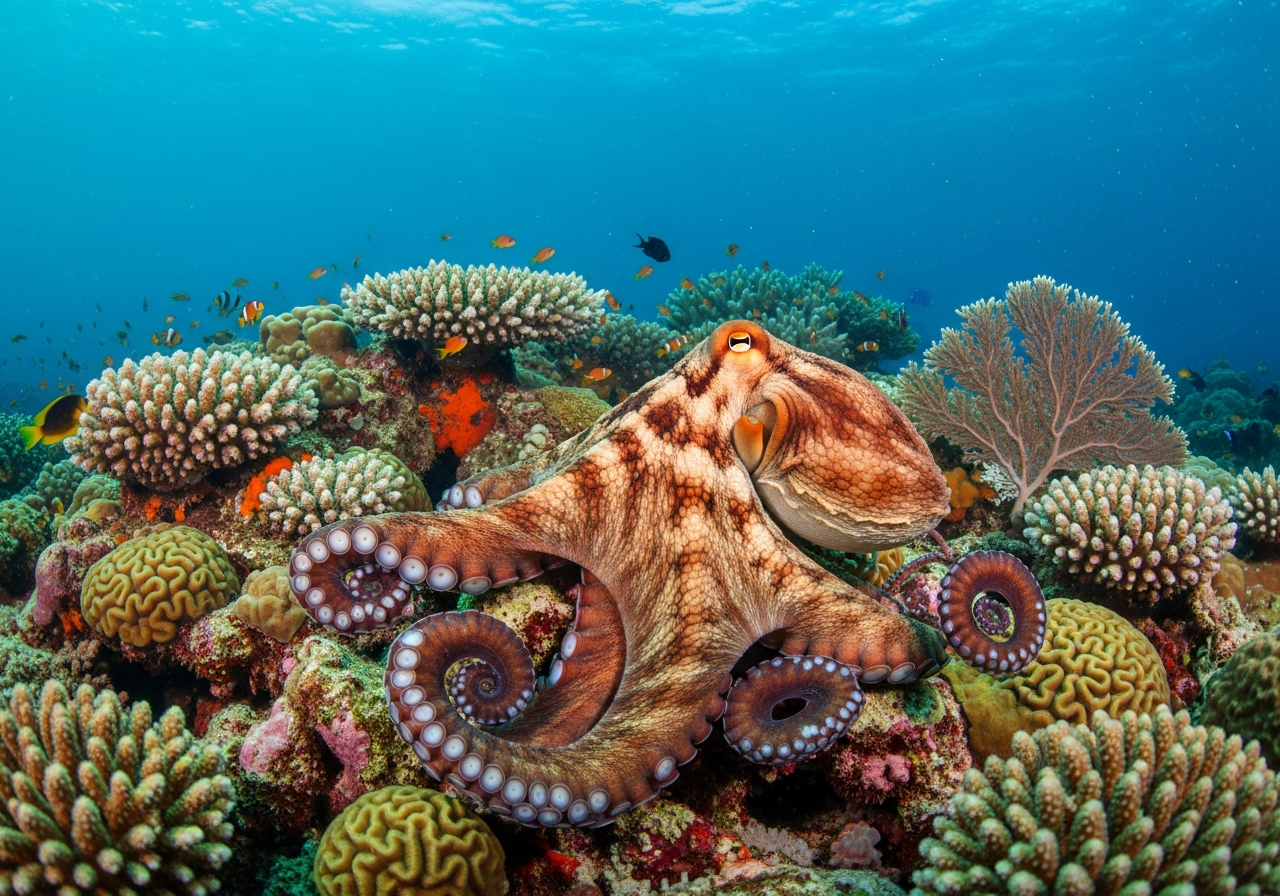
Cephalopods break stereotypes: closed circulation, camera eyes, and problem-solving behaviour rival vertebrates.
What limits invertebrate size
Invertebrates are mostly small, and the reasons are mechanical rather than accidental. Insects breathe through tracheae — branching air tubes that deliver oxygen by diffusion straight to the tissues, no blood involved. Diffusion is quick over short distances and hopeless over long ones, which caps how thick an insect can get.
The exoskeleton adds its own ceiling. Volume grows with the cube of length while supporting cross-sections grow only with the square, so a scaled-up insect would need ever thicker armour until it could no longer move — and would still have to shed it periodically. The coconut crab, the largest land arthropod, is about as far as the design stretches in air.
Water relaxes almost every one of those constraints, which is why the giants are marine. Buoyancy carries the weight, so a Japanese spider crab can span several metres on legs that would snap on land. Cephalopods went further, abandoning the shell and adopting closed circulation with three hearts; the giant and colossal squid are the result.
Nervous systems, and the cephalopod exception
Invertebrate nervous systems span a wider range than vertebrate ones. Cnidarians have a nerve net and no brain at all — a diffuse mesh that lets a jellyfish coordinate swimming and stinging without a control centre. Most bilaterians concentrate neurons into paired ganglia strung along a nerve cord, with a modest cluster at the head end: decentralised, and remarkably robust.
Cephalopods took the same starting material somewhere else. An octopus has the largest nervous system of any invertebrate, though most of its neurons sit in the arms rather than the brain, giving each arm substantial autonomy. It has camera-type eyes convergent with our own, opens containers, and learns by observation — on a body plan whose ancestor was a slow shelled grazer like the nautilus. Cognition is not a vertebrate invention.
Sensory specialisation runs just as far: the mantis shrimp carries more photoreceptor classes than any vertebrate and detects polarised light.
Why invertebrates matter
- Pollination — Bees, butterflies, flies, beetles
- Decomposition — Earthworms, dung beetles, soil mites
- Food webs — Krill, copepods, insects feed fish, birds, and mammals
- Reef building — Corals create habitat for a quarter of marine species
- Bioindicators — Damselflies and mayflies signal freshwater quality
These are not decorative roles. Invertebrates are the layer that converts plants into food vertebrates can use, and the layer that turns dead matter back into soil. A dung beetle buries waste that would otherwise sterilise pasture; an earthworm rebuilds soil structure so water infiltrates instead of running off; krill and copepods carry nearly the whole productivity of the ocean upward into fish, seabirds, and whales.
The reverse also holds. The crown-of-thorns starfish eats coral, and unchecked outbreaks can strip large sections of reef — these animals are load-bearing in both directions.
The quiet decline
Invertebrate populations are falling across many monitored regions, and the losses are harder to see than a declining tiger because the baseline shifts unnoticed. Habitat loss, pesticides, light pollution, and warming press on the same groups at once, and insects — short-lived, specialised, often tied to a single host plant — absorb it first.
Conservation still struggles here. Assessments are dominated by vertebrates, most invertebrate species have never been evaluated, and many have not even been described, so extinctions can happen without anyone recording that anything existed. Charismatic exceptions like the monarch butterfly attract funding; the pollinating flies, soil mites, and parasitoid wasps doing comparable work do not. Losing insects collapses ecosystems faster than losing a single charismatic mammal — and far more quietly.
Related reading
- Vertebrates explained
- Arthropods explained
- Symbiotic relationships
- Octopus profile · Jellyfish · Coral
Sources
Frequently asked questions
What are invertebrates?
Animals that lack a backbone. The term is informal — it groups many unrelated phyla that share the absence of vertebrae.
What percentage of animals are invertebrates?
About 95–97% of described animal species are invertebrates.
Is an octopus an invertebrate?
Yes. Octopuses are mollusks (cephalopods) with no backbone, despite advanced intelligence.
What is the largest invertebrate?
The giant squid and colossal squid are among the largest — tentacle spans can exceed 10 m.
Are insects invertebrates?
Yes. Insects are arthropods, the most species-rich invertebrate group.