Chipmunk
Tamias striatus
Quick answer
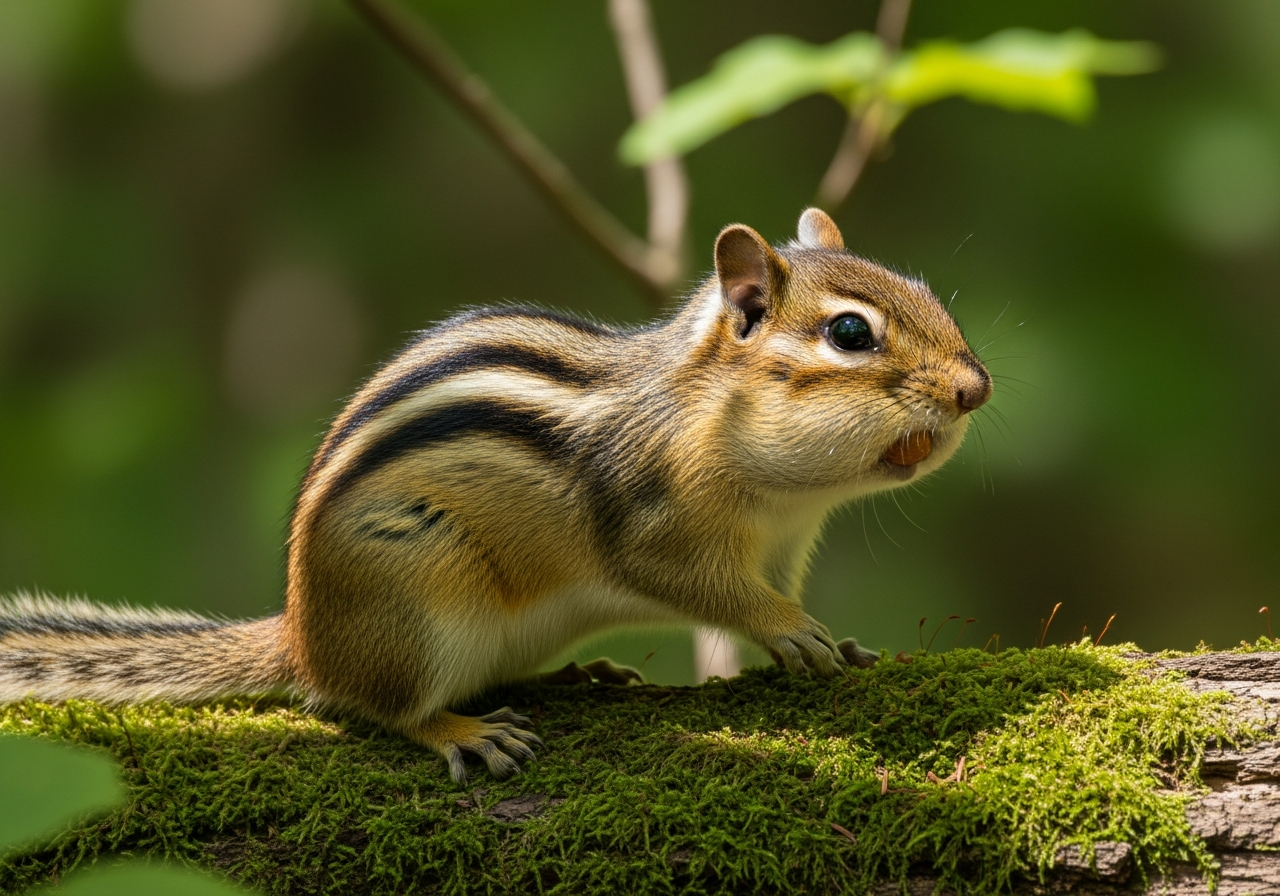
Chipmunks are small, striped members of the squirrel family native mainly to North America. The eastern chipmunk has bold dark-and-cream stripes down its back, large cheek pouches for carrying food, and lives in burrows. It hoards seeds and nuts for winter, spends the coldest months in a sleepy, torpid state underground, and typically lives 2 to 3 years in the wild.
Chipmunk facts at a glance
| Scientific name | Tamias striatus |
|---|---|
| Diet | Omnivore (seeds, nuts, fruit, insects) |
| Habitat | Deciduous forest, woodland edges, suburbs |
| Lifespan | 2–3 years wild (up to 8) |
| Weight | 70–140 g (2.5–5 oz) |
| Top speed | 33 km/h (21 mph) |
| Conservation status | Least Concern (IUCN) |
| Kingdom | Animalia |
|---|---|
| Phylum | Chordata |
| Class | Mammalia |
| Order | Rodentia |
| Family | Sciuridae |
| Genus | Tamias |
Where it lives
Deciduous forests, woodland edges, and suburbs across eastern North America, from southern Canada through the eastern United States.
What is a group of chipmunks called?
Group name (collective noun)
A group of Chipmunks is called a scurry.
Baby name
A baby Chipmunk is called a pup. It may also be called a kit.
Explore more animal collective nouns and baby animal names .
Cheek pouches and hoarding
A chipmunk's most useful tool is its pair of stretchy cheek pouches, which can expand to carry surprising quantities of seeds and nuts back to the burrow — a single chipmunk can stash thousands of food items over a season. Rather than building up body fat like a true hibernator, it relies on these underground larders to survive winter, waking periodically to eat from its stored supplies.
Burrows and winter torpor
Eastern chipmunks dig extensive burrow systems with tunnels, sleeping chambers, and storage rooms, often with well-hidden entrances. Through the coldest months they enter torpor, dropping their body temperature and heart rate to save energy, but they are not deeply asleep all winter — they rouse to feed on their hoard and may emerge on mild days.
Diet and behaviour
Chipmunks are omnivores that eat seeds, nuts, berries, fungi, buds, and insects, and occasionally bird eggs or small invertebrates. They are mostly solitary and territorial, active by day, and use a range of sharp 'chip' and 'chuck' calls to warn of predators such as hawks, foxes, snakes, and domestic cats.
Range and role
The eastern chipmunk lives across eastern North America in deciduous forests, woodland edges, parks, and suburban gardens, while many other chipmunk species live in western North America and one in Asia. By burying and forgetting some of their seed caches, chipmunks help plant new trees, making them important seed dispersers in forest ecosystems.
Dig deeper into the Chipmunk
- Chipmunk Facts 5
Dig deeper into chipmunk — chipmunk facts 5.
- How Fast Is A Chipmunk
Dig deeper into chipmunk — how fast is a chipmunk.
- How Long do Chipmunk Live?
Dig deeper into chipmunk — how long do chipmunk live.
- What do Chipmunk Eat
Dig deeper into chipmunk — what do chipmunk eat.
- Where do Chipmunk Live?
Dig deeper into chipmunk — where do chipmunk live.
Explore the Chipmunk
Collections
Range & geography
Did you know? Chipmunk facts
- Chipmunks are small, striped members of the squirrel family native mainly to North America.
- A group of chipmunks is called a scurry. Chipmunks are mostly solitary and territorial, so they are usually seen alone rather than in groups, and a baby chipmunk is called a pup or kit.
- Chipmunks enter a state called torpor through winter rather than true deep hibernation. They lower their body temperature and heart rate but wake periodically to feed on the seeds and nuts stored in their burrow.
- Chipmunks are omnivores that eat seeds, nuts, berries, fungi, and buds, along with insects and occasionally bird eggs. They carry food in their cheek pouches to store underground for winter.
- Chipmunks have stretchy cheek pouches used to carry large amounts of food back to their burrows. This lets them gather and store seeds and nuts quickly while staying alert to predators.
- Conservation: Least Concern (IUCN).
Diet & feeding
Chipmunk feeds primarily as a omnivore (seeds, nuts, fruit, insects). A chipmunk's most useful tool is its pair of stretchy cheek pouches, which can expand to carry surprising quantities of seeds and nuts back to the burrow — a single chipmunk can stash thousands of food items over a season. Rather than building up bod
Adaptations
- A chipmunk's most useful tool is its pair of stretchy cheek pouches, which can expand to carry surprising quantities of seeds and nuts back to the burrow — a single chipmunk can stash thousands of food items over a season. Rather than building up body fat like a true hibernator, it relies on these underground larders to survive winter, waking periodically to eat from its stored supplies.
- Eastern chipmunks dig extensive burrow systems with tunnels, sleeping chambers, and storage rooms, often with well-hidden entrances. Through the coldest months they enter torpor, dropping their body temperature and heart rate to save energy, but they are not deeply asleep all winter — they rouse to feed on their hoard and may emerge on mild days.
Behaviour & ecology
- A chipmunk's most useful tool is its pair of stretchy cheek pouches, which can expand to carry surprising quantities of seeds and nuts back to the burrow — a single chipmunk can stash thousands of food items over a season. Rather than building up body fat like a true hibernator, it relies on these underground larders to survive winter, waking periodically to eat from its stored supplies.
- Eastern chipmunks dig extensive burrow systems with tunnels, sleeping chambers, and storage rooms, often with well-hidden entrances. Through the coldest months they enter torpor, dropping their body temperature and heart rate to save energy, but they are not deeply asleep all winter — they rouse to feed on their hoard and may emerge on mild days.
- Chipmunks are omnivores that eat seeds, nuts, berries, fungi, buds, and insects, and occasionally bird eggs or small invertebrates. They are mostly solitary and territorial, active by day, and use a range of sharp 'chip' and 'chuck' calls to warn of predators such as hawks, foxes, snakes, and domestic cats.
Communication
- Chipmunk uses scent, posture, and vocal signals to mark territory and coordinate social behaviour.
- Communication intensity often peaks during breeding seasons and territorial disputes.
Habitat & range
Deciduous forest, woodland edges, suburbs
Ecological role
Chipmunk plays a recognised ecological role in deciduous forest, woodland edges, suburbs.
Frequently asked questions about the Chipmunk
What is a group of chipmunks called?
A group of chipmunks is called a scurry. Chipmunks are mostly solitary and territorial, so they are usually seen alone rather than in groups, and a baby chipmunk is called a pup or kit.
Do chipmunks hibernate?
Chipmunks enter a state called torpor through winter rather than true deep hibernation. They lower their body temperature and heart rate but wake periodically to feed on the seeds and nuts stored in their burrow.
What do chipmunks eat?
Chipmunks are omnivores that eat seeds, nuts, berries, fungi, and buds, along with insects and occasionally bird eggs. They carry food in their cheek pouches to store underground for winter.
Why do chipmunks have big cheeks?
Chipmunks have stretchy cheek pouches used to carry large amounts of food back to their burrows. This lets them gather and store seeds and nuts quickly while staying alert to predators.
Are chipmunks and squirrels the same?
Chipmunks are members of the squirrel family but are a distinct group. They are smaller, have facial and body stripes, spend more time on the ground, and store food in burrows rather than living mainly in trees.
What is a baby chipmunk called?
A baby Chipmunk is called a pup. It may also be called a kit.
Sources & references
This guide is compiled and reviewed against established zoological and conservation references. Key sources for the Chipmunk:
-
IUCN Red List of Threatened Species
Conservation status (Least Concern) reflects the IUCN Red List category for Tamias striatus.
- IUCN Red List — Tamias striatus.
Conservation status (Least Concern) and population trends.
- Animal Diversity Web — Tamias striatus. University of Michigan Museum of Zoology.
Life history, morphology, and range.
- Wikipedia — Chipmunk.
General taxonomy and overview (cross-check primary sources).
-
Global Animal Guide editorial standards
How we research, source, review, and update every guide for accuracy.